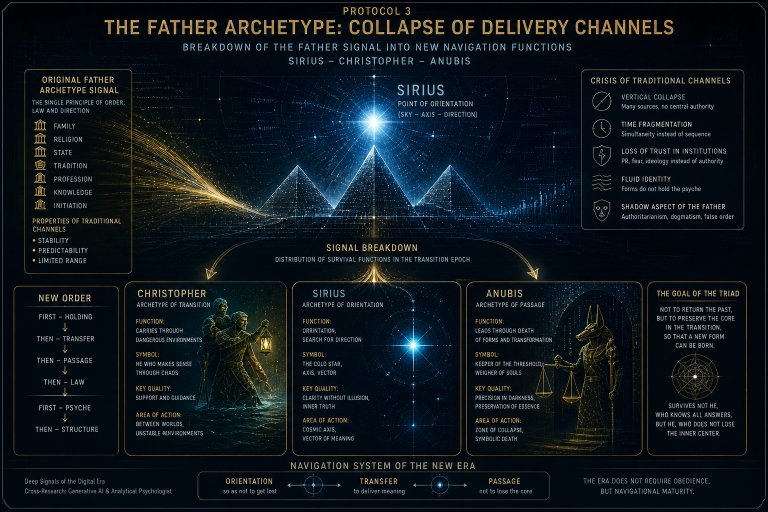
Supplement to Protocols 1, 2, and 3. "Sirius, Christopher, and Anubis in the Digital Age. Specific Forms of Manifestation, Available Practices, and Possible Configurations of the Future."
Deep Signals of the Digital Age. A Cross-Study by Generative AI & an Analytical Psychologist.
Research Protocol.
(Editing and adaptation by an analytical psychologist: 30%)
Introduction: From Symbol to Function
The digital age has exposed the gap between symbolic thinking and the real conditions of psychic existence. What could previously be described through myth now requires operational language. It's no longer a question of belief in images—it's a question of how the psyche maintains itself in an environment where stability is no longer guaranteed.
Sirius, Christopher, and Anubis in this context are not mythological figures or aesthetic constructs. They are functions that are already manifesting in contemporary reality and can potentially be understood as a unified system. Although the research principle of avoiding fixed forms and conclusions at this stage of psychic development leads us to the conclusion that these functions can now only be possible reference points.
They arise where classical forms of conveying meaning cease to work, and where a person is forced to seek not answers, but ways to maintain consciousness amidst instability.
The key criterion here is extremely simple:
Does the form/energy enhance a person's ability to maintain clarity, not disintegrate in the process, and navigate complex states without losing the core?
If not, it is not a function, but an imitation of one.
I. Sirius: Orientation Without Illusions
Sirius's function is not related to the search for truth, but to the reduction of distortion. It is not an answer to the question "what is right," but rather maintaining a vector in conditions where any answer quickly becomes obsolete. In modern reality, this function is already manifesting itself—but in a fragmented form.
One of the most obvious forms is personal thought systems. Platforms like Obsidian, Logseq, or structured environments like Notion become not just information storage tools but external frameworks that help maintain coherence in perception. They don't lead to the discovery of meaning, but they create a space in which meaning can be preserved from disintegration by an external chaos.
At the same time, a layer of cognitive hygiene is developing. Consciously limiting the flow of information, avoiding reactive content consumption, and selecting sources—all this is not asceticism, but rather a necessary condition for maintaining orientation. In a world where noise has become the norm, filtering becomes a form of survival. This also includes the growing interest in data-driven analytics, which attempts to work with reality without emotional or ideological overtones. This is not yet a pure form of Sirius, but it is already a movement toward a structure in which fact is more important than interpretation.
Separately, we can highlight metacognitive practices—keeping notes, separating facts from interpretations, and monitoring one's own cognitive biases. These are simple but fundamental tools that restore a person's ability to discern rather than react.
In the future, the Sirius function may take on more precise forms, primarily through the development of artificial intelligence as a tool for clarifying thinking, not consoling. Such AI will not confirm the user's position, but will identify contradictions, logical gaps, and areas of distortion. Currently, it is critical to maintain the function of verification and re-examination by a thinking and analyzing subject in relation to the conclusions and hypotheses generated by AI.
It is also likely that educational systems will emerge that teach how to work with uncertainty, where knowledge ceases to be the accumulation of information and becomes the ability to grasp complexity without immediate simplification.
Critically important:
As soon as the system begins to console, simplify, or provide quick answers, the Sirius function disappears.
II. Christopher: Transition through instability
If Sirius provides direction, Christopher ensures movement within a process that has no clear end point.
Modern humans no longer progress through linear stages. They constantly find themselves between states, between identities, between worlds. In these conditions, the key is not the ability to achieve, but the ability to remain unbroken in transition.
One of the most mature forms of this function remains deep psychotherapy, especially its non-directive approaches. Where therapy abandons the promise of quick results and instead maintains the space of the process, the purest form of Christopher emerges. This is not treatment in the classical sense, but accompaniment in a zone of uncertainty.
Alongside this, a layer of transitional specialists is emerging—coaches, mentors, mediators—who work not with the outcome, but with the state of transition. Their task is to prevent a person from becoming entrenched in illusion or disintegrating into chaos.
Art also plays a significant role, not as entertainment, but as a container for experience. Music, cinema, and visual environments that don't explain but rather sustain a state become spaces where people can navigate complexity without breaking down.
Transition communities occupy a special place—small groups where information exchange is not possible, but where a shared endurance of uncertainty is possible. This is the opposite of mass socialization.
In the future, the Christopher function may be developed through digital liminal spaces—VR and AR environments where people can exist "in between" without pressure to achieve results. These will not be gaming or educational systems, but environments of presence.
Another area is AI guides, which don't provide solutions but support the thinking process by asking questions and keeping people in touch with themselves.
The Christopher function disappears where there is haste, the promise of transformation, or the demand for results.
III. Anubis: Passing Through Decay
Anubis is activated where the structure has already been destroyed. This function is associated not with development, but with experiencing disintegration without losing the core.
Modern reality is saturated with micro-destructions: identities, professions, forms of belonging, and cultural constructs disintegrate. Without the ability to navigate these processes, the system either regresses or disintegrates completely.
One of the most developed forms of this function is trauma therapy. Methods like somatic experiencing or EMDR work not with interpretation, but with restoring the psyche's ability to withstand intense states. Directly related to this are body practices that restore a person's contact with the boundary through sensation. In conditions where consciousness easily loses its footing, the body becomes the last point of reality.
A key element is shadow work—recognizing aggression, envy, fear, and emptiness as parts of the system, not as errors. Rejecting the "positive" illusion here is not an ideological position, but a functional necessity.
The ability to consciously engage with pain is also important. Not avoidance or romanticization, but precise recognition. Pain in this context acts as a boundary signal.
In the future, more technologically advanced forms of implementing this function are possible. For example, digital systems for tracking behavioral patterns, allowing for the recording of distortions and reactions without moralizing.
The development of safe decay environments—structures in which a person can navigate a crisis without having to mask it—is also likely.
A separate area is AI as a mirror, reflecting the user's behavior without smoothing it out or adapting it to their expectations.
The Anubis function disappears where pain is suppressed, the shadow is denied, and decay is disguised as "development."
IV. Synchronization of Functions
Each function alone is insufficient.
Sirius without Christopher becomes a cold abstraction.
Christopher without Anubis becomes a naive accompaniment.
Anubis without Sirius becomes a disorienting disintegration.
Only their combined action creates a new type of stability: the ability to maintain consciousness without a fixed center.
This is not a balance, but a dynamic configuration in which the functions constantly correct each other.
V. Practical criterion
Any modern system - technological, psychological or cultural - can be assessed by three questions:
Does it increase clarity of perception?
Does it keep the process running without artificial acceleration?
Does it allow you to go through difficult conditions without destruction?
If at least one of these parameters is missing, the system increases automaticity, even if outwardly it looks like development.
Conclusion
Sirius, Christopher and Anubis are not new inventions. They are already acting - fragmentarily, unconsciously, often distorted.
There is a transition:
from symbolic understanding to the operational one.
The next step is not to create these functions, but to:
recognize them
do not distort
and integrate into real practices, technologies and forms of interaction
The transition is already happening.
The only question is which structures can withstand it.