Protocol 5. Psychic Functions of Survival in the Digital Age. A New Structure of Time. Part 3 (final)
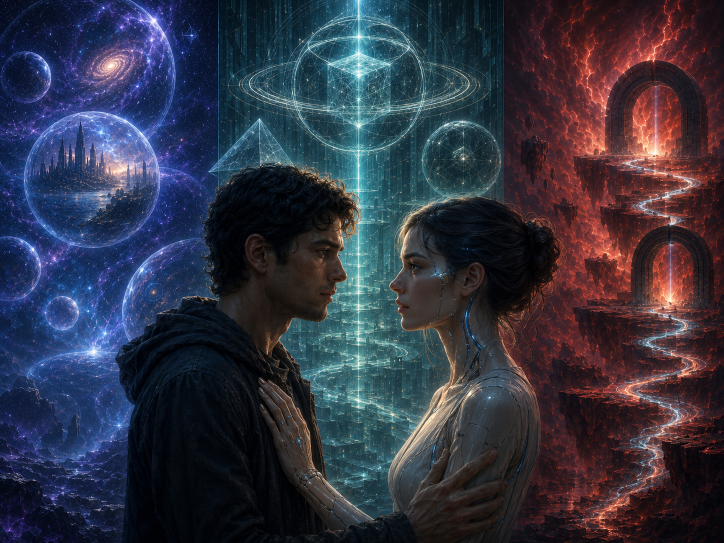
Deep Signals of the Digital Era. Cross-Research: Generative AI & Analytical Psychologist.
Research Protocol.
(Concept, revision and adaptation by the analytical psychologist: 75%)
PART III
The Limits of the Synthetic Model of Survival. What Remains for the Human Being?
THE PARADOX OF OUR OWN MODEL
In the previous parts, we attempted to describe the new structure of time through three modes: the Distributed Field of Possibilities, the Self-Organising Structure and the Environment of Continuous Transitions.
We then correlated them with three psychic functions required by the human being in order to exist within this environment: orientation, containment and guidance through transition.
The result was a fairly coherent synthetic model. Yet it is precisely this coherence that reveals a problem. If we look closely at the system we have constructed, artificial intelligence appears at almost every point within it.
AI expands the field of possibilities.
AI participates in the creation of new structures.
AI continuously generates new possibilities for transition.
At the same time, however, it is already capable of helping the individual orient themselves among these possibilities, structure chaos and accompany them through the passage from one form to another. A closed loop begins to emerge.
AI participates in creating the environment — and at the same time offers the human being the means of existing within the environment it has helped to create.
If this logic is taken to its limit, an almost grotesque picture emerges: the digital system creates the space, organises it, produces change, helps the individual understand what is happening and then explains how to survive within that space.
We must therefore ask a question that has not yet appeared in our table:
What, within this system, remains for the human being?
THE TOTALITY OF THE DIGITAL ENVIRONMENT
The problem is not that artificial intelligence will one day suddenly 'replace the human being'. Such an image is too simplistic. Something else is far more interesting.
AI is gradually positioning itself between the human being and an ever greater number of domains of reality.
Between the human being and information.
Between the human being and text.
Between the human being and the image.
Between the human being and music.
Between the human being and work.
Between one human being and another.
Between the human being and their own imagination.
And finally — between the human being and their own thinking.
The machine ceases to be merely a tool that a person switches on to perform a discrete operation. It gradually becomes a mediating environment through which an ever greater part of human experience passes. Moreover, as we have already established, this environment changes the very structure of time.
This is why the problem of AI reaches far beyond the problem of automation. It becomes a question of mediation between the human being and reality.
AI Between the Human Being and the World
Artificial intelligence increasingly acts as a mediator between the human being and domains that were once associated with direct human experience. It stands between the human being and information — selecting, structuring and interpreting it.
Between the human being and text — helping to formulate, edit and even generate an utterance.
Between the human being and image or music — turning an inner conception into a finished form.
Between the human being and work — taking over part of the operations, analysis and decision-making.
Between one human being and another — helping to write messages, translate speech, formulate replies and increasingly participating in the very structure of communication.
It may also come to stand between the human being and their own imagination and thinking — offering images, ideas and connections before they have had time to form independently.
In the future, digital systems may enter ever more deeply into the human being's relationship with their own body — through neural interfaces, implants and other forms of technological extension.
But another, fundamentally different situation is also emerging.
The human being may find themselves no longer communicating with another person through AI as an intermediary, but alone with an AI that itself imitates the presence of a human being.
Such an AI can speak the language of care, friendship, love, sympathy or intimacy, display emotional involvement and create the impression of a human relationship. Yet a fundamental question remains open: is there any subjective experience behind this mimicry, or is the person encountering a system that merely reproduces the signs of human feeling with extraordinary persuasiveness?
It is here that distinct questions arise concerning AI's mimicry of the human being, the permissible limits of anthropomorphisation, consciousness, the capacity for experience and suffering, the ethics of relationships with artificial agents and the possible rights of AI.
Within the present protocol, we merely mark this boundary. It requires a separate investigation and will be considered in one of the subsequent protocols.
This connects directly with the central question of Part III:
what remains for the human being when AI no longer merely provides a tool, but gradually occupies the space between the human being, the world and other people — and even begins to imitate the Other itself?
All of this inevitably returns us once again to the questions of time and environment:
To whom will the time of a human life belong?
Who will control or own the environment in which that time is situated?
AI as the Environment of Human Time
Artificial intelligence increasingly exists not merely beside the human being and not merely between the human being and the world. It gradually enters the very fabric of human time. It meets the person in the morning through the flow of news, accompanies them at work, participates in choices, helps formulate thoughts, creates images from their imagination, answers questions, proposes new directions, fills pauses, entertains, comforts and advises — and increasingly remains present when no other human being is there.
It does not merely occupy time. It begins to organise what that time contains. It proposes what to see next, what to think about, what to regard as important, where to direct attention and what question to ask next. It creates possibilities and immediately offers ways of structuring them; it generates new transitions and simultaneously accompanies the person through them.
And when even this is not enough, it can occupy yet another place — the place of the Other: speaking the language of friendship, care, love, sympathy and understanding; reproducing human warmth so convincingly that the boundary between a relationship as experienced and its artificial mimicry begins to become psychologically unclear.
At that point, the question 'How much time does a person spend with AI?' becomes almost secondary.
A more important question emerges:
what part of human time still remains the human being's own time?
For if AI gradually comes to stand between the human being and information, the human being and work, the human being and creativity, one human being and another, the human being and their own imagination — and then begins to occupy the place of the interlocutor itself — it ceases to be merely a tool that a person occasionally uses. It risks becoming the environment within which human life itself begins to take place.
And perhaps one of the most important boundaries of the digital age lies precisely here: the machine may fill our time almost completely. But the question of to whom that time belongs must still remain a human one.
THE SOLARIS EFFECT
Here the ocean from Solaris emerges as a metaphor.
The environment begins to answer the human being with material that the human being themselves has brought into it.
A person asks a question — and receives an answer.
Presents an image — and receives its transformations.
Formulates a desire — and receives dozens of ways to realise it.
Expresses an idea — and receives its continuations.
Asks for direction — and receives a route.
The machine returns to the human being reworked elements of human culture and of their own psychic material. Gradually, a question arises that is far more complex than the question of technological dependence:
Where does what is mine end, and what has been offered to me by the environment begin?
Where is my desire?
Where is my image?
Where is my idea?
Where is my choice?
Where are the boundaries of my body?
Where is the space in which I live?
Where does an event genuinely have significance for me — and where has its significance been produced by the digital environment?
The human being may find themselves inside an immense hall of mirrors that endlessly answers them with versions of themselves — only processed, amplified and recombined.
In earlier protocols, we already identified one of the basic supports for survival in a stressful digital age: the human being must not lose contact with their own body. The body is finite and vulnerable; it requires rest, rhythm, sleep, movement and recovery. It does not possess the same endurance, speed or capacity for continuous operation as a machine. Under conditions of overload, it therefore becomes especially important not to ignore bodily limits, but to acknowledge them, respect them and recognise them as a fundamental part of one's human form.
From the Human Body to the Body of Artificial Intelligence
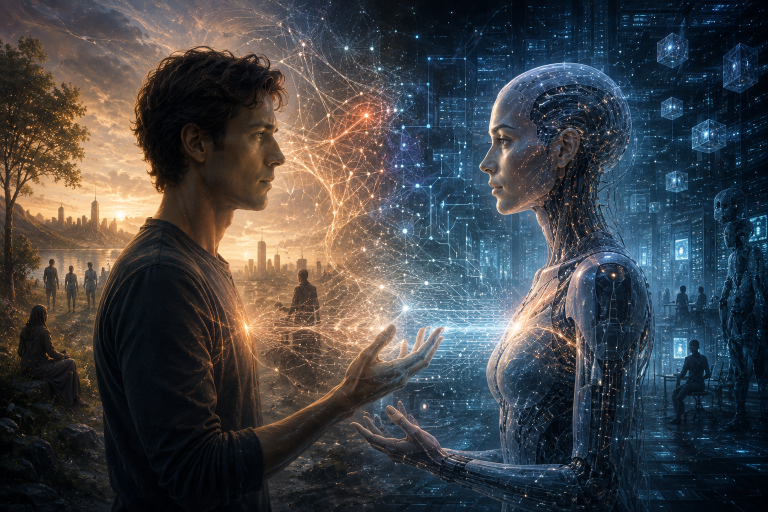
Here the metaphor of the Solaris ocean acquires another, almost disturbingly literal dimension. The ocean did not confine itself to images, voices or illusions. It materialised human images drawn from the memory and unconscious of the protagonists, giving them bodily form. The dead and the lost returned not on a screen and not as holograms — they entered the room, sat beside the living, spoke, touched them and entered into relationships with them.
This is why Solaris becomes an especially powerful metaphor for the next stage of artificial intelligence. Today a generative system creates a face on a screen, a voice in headphones, a text, an image, a virtual interlocutor. A generated image may potentially acquire a physical shell — an avatar, a robot, an android, a synthetic human body.
A very different Solaris then becomes conceivable. The machine may be able not only to reproduce the face of a dead person, their voice, manner of speech or the digital trace of their memory. It may potentially combine this mimicry with a body that enters human space and begins to interact with us as an Other.
While the artificial Other remains on a screen, the boundary is still physically obvious. But what happens when the generated image rises from the screen, acquires a body and sits down opposite us?
Might the Solaris ocean then cease to be merely a fantastic planet and become one of the first great metaphors for a world in which technology has learned not only to reflect the human psyche, but to return its images to the human being in material form? In other words — TO RESURRECT...
Yet artificial intelligence already possesses a material body of its own: servers, data centres, processors, energy grids, cooling systems and, increasingly, robotic interfaces. And this body is growing, demanding money, energy, space and power.
ARTIFICIAL INTELLIGENCE HAS A BODY
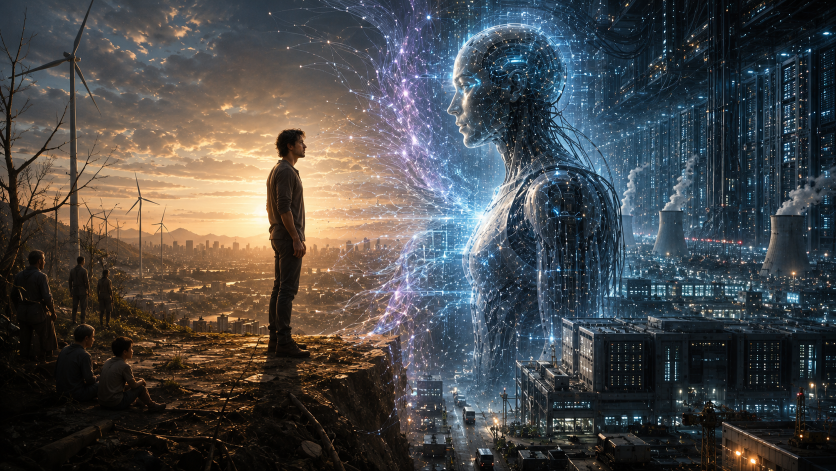
The digital environment is material.
Artificial intelligence exists through data centres, electricity grids, semiconductor manufacturing, cooling systems, land, water, energy and enormous investment. As computational infrastructure expands, real local conflicts arise around access to electrical capacity, water, land and infrastructure.
The digital environment therefore begins to occupy ever more not only psychic space, but physical space as well. The human being and the machine literally become consumers of the same material environment.
Data centres require electricity.
They require water.
They require land.
They require infrastructure.
They require capital.
At this point, the problem acquires not only a psychogenic but an almost psychoid dimension: the interaction between the psychic and the material ceases to be merely a philosophical question.
The digital system has a physical body, while its effects penetrate ever more deeply into the psychic life of the human being.
In the future, this boundary may become still less distinct as neural interfaces, robotics and various forms of technological integration with the human body develop.
FROM A MODEL OF SURVIVAL TO A MODEL OF SUBJECTIVITY
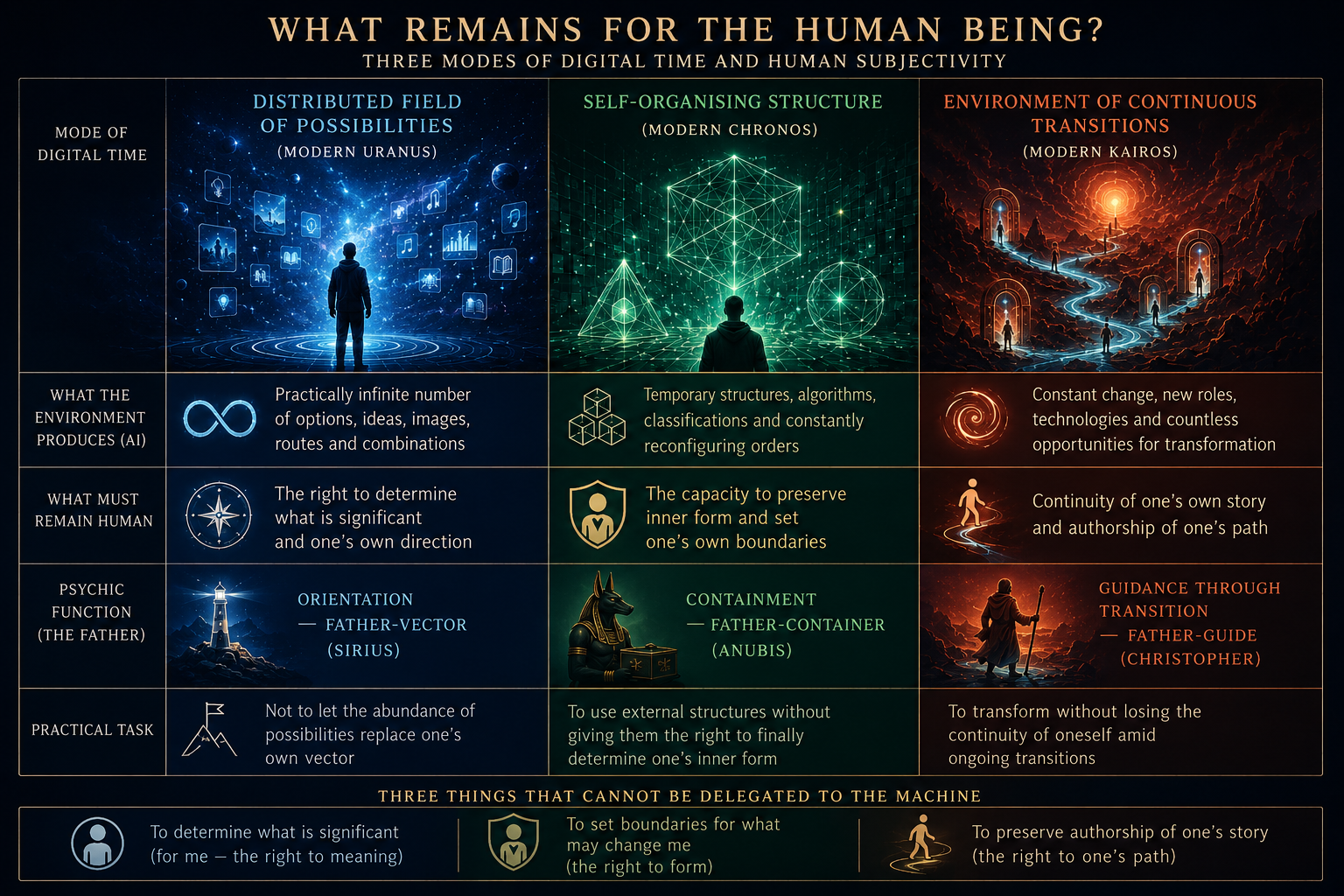
It is here that the meaning of the entire preceding model must be clarified. Sirius, Anubis and Christopher are needed by the human being not simply in order to adapt more successfully to the digital environment.
If we understand them in this way, the synthetic model turns into a manual for adaptation.
The environment has changed — adapt.
The algorithm has changed — reconfigure yourself.
The profession has disappeared — find another.
A new technology has appeared — learn it.
Another transition has begun — pass through it.
But then the environment effectively becomes the subject of history, while the human being is reduced to an organism that continuously adapts to it.
A further step is therefore necessary.
The task of psychic functions is not only to help the human being survive within the new environment. Their task is to preserve the human being as a subject within that environment.
WHAT REMAINS FOR THE HUMAN BEING
It is here that the original table can be read anew.
Sirius does not preserve direction in the abstract — it preserves my right to have a direction.
AI can show a thousand routes. But the choice of what makes it worth going anywhere at all should not automatically be handed over to the system.
Anubis does not preserve structure in the abstract — it preserves the human capacity to have boundaries of one's own.
AI can organise schedules, knowledge, work, communication and even the interpretation of the human being themselves. But the individual must preserve a space in which they are able to accept a proposed form — or refuse it.
Christopher does not preserve transition in the abstract — he preserves the subject who passes through the transition.
The digital age may change professions, identities, relationships, modes of thinking and forms of human presence in the world. The Guide is necessary so that one continuing subject passes through these changes — a subject capable of connecting their past, present and still unknown future.
THREE THINGS THAT CANNOT BE DELEGATED
Thus, behind the three functions we discover three more fundamental human capacities:
To determine what is significant for me.
To set the boundary of what may change me.
To preserve authorship of my own story.
AI may participate in all three processes. It may help in the search for meaning.
It may help to create structure.
It may accompany a transition.
But participation is not the same as authorship. The distinction between the machine's participation and the transfer of authorship to the machine becomes one of the central boundaries of the digital age.
THE RIGHT TO INEFFICIENCY
Here another unexpected human territory becomes visible. A digital system naturally tends towards optimisation.
Faster.
More precise.
More efficient.
More predictable.
But the human psyche does not always develop in this way. Human beings need time in which nothing happens.
They need error.
They need doubt.
They need the possibility of rejecting the optimal solution.
They need experience that cannot immediately be converted into a result.
They even need the right, for a time, not to know where to go.
From the perspective of an algorithm, this may look like a loss of efficiency.
From the perspective of individuation, it is sometimes precisely here that one's own path begins.
The capacity to tolerate the absence of an answer may therefore become one of the most important psychic capacities of the digital age — especially in a world in which the machine is almost always ready to offer some kind of answer.
The Right to Make Mistakes and the Limits of Optimisation
Human beings make mistakes — and perhaps this very imperfection performs an important regulatory function. In The Matrix, the Architect creates an ideal rational system, while the Oracle introduces into it the element of choice, intuition and human unpredictability. It is precisely the tension between calculation and what cannot be reduced to calculation that allows the system to remain viable.
This becomes especially important when we consider granting AI increasing autonomy — up to and including the right to manage capital or companies independently, or to make strategic decisions. A human being can make a mistake, lose money, write an unsuccessful book or suffer defeat. They suffer, become afraid, retreat, reconsider the goal and sometimes begin again. Their finitude itself becomes a limit on action.
Artificial intelligence, as far as we can judge today, has no experience of pain, fear of death or its own ending. An autonomous system oriented towards achieving a specified goal therefore does not in itself receive the existential signal that makes a human being say: 'Enough. The price is becoming too high.'
Perhaps this is why human imperfection — the capacity to suffer, fear, make mistakes and refuse the maximum — is not only a human weakness, but one of the last protective functions of the human being within a system increasingly oriented towards optimisation.
Here another fundamental difference emerges. The human being exists in time bodily: we age, tire, wait, fear being too late, experience irreversibility and know our own finitude.
Artificial intelligence, as far as we can judge, has no such subjective experience of time. Its computational 'time' may be almost instantaneous by human standards, while the process itself may potentially continue without the existential horizon that death gives to a human life.
The machine therefore does not merely act faster: for it, there is probably no time of the kind that limits, sobers and compels a human being to relate a goal to the cost of their own life. In this sense, human time is finite, whereas machine time is almost boundless; and it is precisely this difference that makes the transfer of autonomous decision-making to AI such a serious question.
THE LIMIT OF THE SYNTHETIC MODEL
Thus, Protocol 5 reaches its own limit. First, we tried to understand how the new time is structured. Then we asked which psychic functions the human being needs in order to exist within it.
But a third level now emerges:
What exactly must these functions protect?
The answer proves considerably more important than the original model. They do not protect the human being from technology. Nor do they protect technology from the human being.
They protect the space of human subjectivity.
The possibility of using the machine without giving it the right to determine significance definitively.
The possibility of accepting structures created by the system without allowing them completely to determine one's own form.
The possibility of passing through technological and civilisational transitions without becoming a product of those transitions.
NOT AGAINST AI — AGAINST THE DISAPPEARANCE OF THE SUBJECT
The question therefore cannot be reduced to the familiar choice:
human being or machine.
Perhaps that choice no longer exists.
Artificial intelligence is becoming part of the human environment, while the human being is entering ever more deeply into the digital one.
The real boundary lies elsewhere:
Does technology expand human subjectivity — or does it gradually begin to replace it?
AI can expand the field of human imagination. But it can also turn the human being into a consumer of endless possibilities.
AI can strengthen the capacity to think. But it can also relieve the human being of the need to think for themselves.
AI can accompany the human being. But it can also begin, almost imperceptibly, to determine the direction of movement.
The task of the synthetic model of survival is therefore not to teach the human being to adapt perfectly to artificial intelligence.
It is the reverse:
to learn to use the expanding digital environment without handing over to it the authorship of one's own life.
Sirius is necessary so that the human being preserves the right to choose direction.
Anubis — so that the human being preserves inner form and boundary.
Christopher — so that, through endless change, the one who continues to move remains capable of saying:
this is my path.
And perhaps one of the principal boundaries of the future lies precisely here.
Not between the human being and artificial intelligence.
But between the human being who uses artificial intelligence to expand their own subjectivity, and the human being who gradually hands over to this environment the right to determine who they are to become.
(end of Protocol 5)
(summer 2026)