Protocol 5. Psychic Functions of Survival in the Digital Age. A New Structure of Time. Part 2
Deep Signals of the Digital Era. Cross-Research: Generative AI & Analytical Psychologist. Research Protocol. (Revision and adaptation by the analytical psychologist: 80%)
PART II
TIME IN THE DIGITAL AGE: FROM TWO TRIADS TO A SYNTHETIC MODEL OF SURVIVAL
Why the Digital Age Requires New Psychic Functions
Every historical era confronts human beings with its own demands. A person in antiquity faced different tasks from a person in the Middle Ages. The industrial age required different capacities from those demanded by an agrarian civilisation. Each time, culture gradually developed the psychic modes of organising life that enabled human beings to survive under new conditions.
This is why the psyche never exists outside history. It develops together with it. Today we are witnessing another transition of this kind. Yet this time the changes affect not merely particular social institutions, nor even culture alone. They are gradually transforming the very environment in which the psyche exists.
For the first time, human beings find themselves within an environment in which three fundamental processes are unfolding almost simultaneously.
First, the field of possibilities is expanding on an unprecedented scale.
Second, familiar structures are becoming considerably less stable.
And finally, life itself is increasingly becoming a continuous sequence of transitions.
Each of these processes, taken separately, would already require a serious psychic reorganisation. Today, however, they are occurring at the same time. This is why many people experience not merely stress, but a sense that the familiar mode of existence itself is being lost.
Many describe this as a loss of ground.
Others as informational chaos.
Still others as a persistent sense of incompletion.
At first sight, these may appear to be different problems. Yet perhaps they are different manifestations of the same process. It is not only the world around the person that is changing. The very organisation of time within which the psyche develops is changing as well.
If this hypothesis is correct, it becomes easier to understand why earlier modes of psychological adaptation are becoming progressively less effective. They developed within a different structure of time.
The digital age therefore confronts the human being with a new task.
Not to find yet another universal answer.
Nor to restore the former order.
But to develop psychic functions that make it possible to preserve direction, inner stability and the capacity to continue one’s own path even when the environment itself is becoming increasingly unstable.
For this reason, the central subject of the present research is not technology as such, nor artificial intelligence as an isolated phenomenon. The principal subject is the human being — more precisely, those emerging psychic functions without which life in the digital age is becoming progressively more difficult.
If this is indeed the case, the next question arises almost automatically.
What has changed in the structure of time itself that makes earlier modes of adaptation increasingly ineffective?
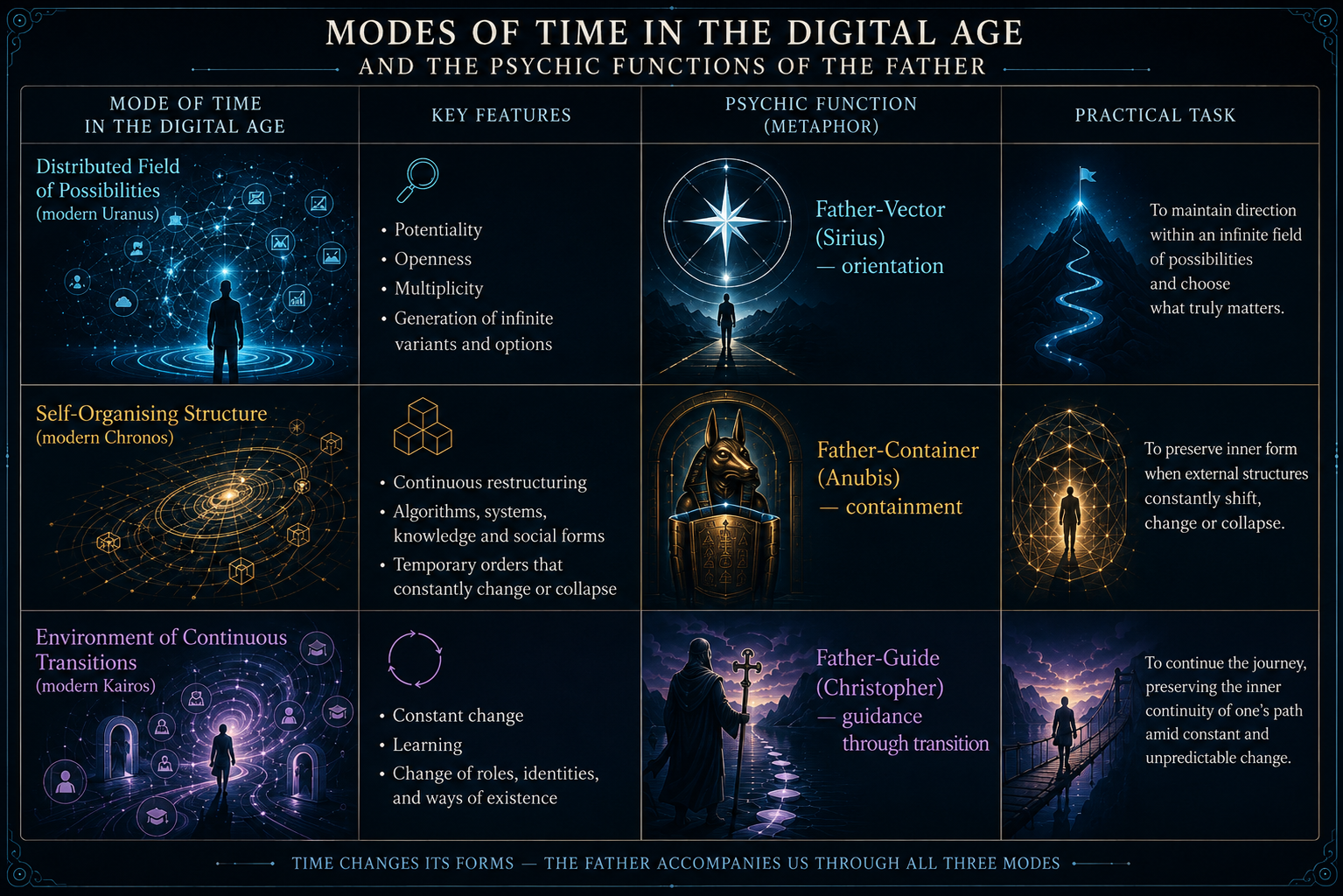
To answer this question, let us return to the first line of our table — the Distributed Field of Possibilities, which we have symbolically associated with Contemporary Uranus.
I. Distributed Field of Possibilities (Contemporary Uranus)
We deliberately speak not simply of Uranus, but of Contemporary Uranus. This distinction matters. We are not suggesting that humanity is literally returning to a mythological age of Uranus. On the contrary, Contemporary Uranus differs fundamentally from its ancient symbolic prototype.
Ancient Uranus preceded culture.
Contemporary Uranus emerges after millennia of cultural development.
Ancient Uranus represented a space of primordial potentiality.
Contemporary Uranus represents a space of accumulated potentiality.
Within it is already contained virtually the entire history of human knowledge, culture and technology. This is why its defining characteristic becomes a Distributed Field of Possibilities. Today almost anyone can gain access to a volume of information that only a few decades ago would have been unavailable even to the world’s largest universities.
Artificial intelligence intensifies this process still further. It does not merely provide information. It begins to generate new ways of organising it.
Each prompt can generate dozens of new ideas.
Each idea can open dozens of new directions.
Each direction can generate hundreds more possibilities.
Thus, for the first time, the digital age creates a situation in which information itself is no longer the principal scarcity.
The principal scarcity is the capacity to orient oneself within its seemingly endless multiplicity.
Here we encounter the first paradox associated with Contemporary Uranus. We are accustomed to assuming that more possibilities automatically make a person freer. Beyond a certain point, however, the opposite begins to occur. When possibilities become too numerous, choice starts to collapse into paralysis. Freedom gradually turns into uncertainty — not because the paths disappear, but because there are too many of them.
The Paradox of Contemporary Uranus
Imagine a young professional who has just graduated from university. A few decades ago, their professional path was relatively predictable. They chose a field, found employment, gradually acquired experience and developed within the profession they had selected.
Today the situation looks very different. Thousands of courses are available. Hundreds of professions. Remote work from almost anywhere in the world. Artificial intelligence offers new ways of earning money every day. Social media displays an endless stream of stories of rapid success. At first sight, it seems that the individual has acquired extraordinary freedom. Yet very often the opposite occurs.
They spend longer choosing.
They study more and more possibilities.
They postpone the decision more and more often.
Life gradually begins to turn into an endless preparation for life. This paradox is familiar to anyone who actively uses contemporary digital technologies. One can begin a dialogue with artificial intelligence around a single research question and, an hour later, have twenty new ideas. Two hours later, another fifty/
By evening, one may feel intellectually inspired and at the same time discover that not a single concrete action has been completed during the entire day.
The result is the paradox of Frozen Time.
Ancient Uranus, incidentally, symbolised precisely such a temporal condition. Uranian time is a time in which nothing happens.
The problem lies neither in artificial intelligence nor in technology as such. It lies in the fact that the human psyche developed in a world with a far smaller range of possibilities. The temporal field symbolised by Contemporary Uranus now greatly exceeds the psyche’s familiar capacity for orientation.
The first challenge of the digital age is therefore not a lack of information.
It is the loss of direction.
Why a New Psychic Function Becomes Necessary
If the defining feature of Contemporary Uranus is a Distributed Field of Possibilities, an obvious question follows.
What psychic function allows a person not to become lost within this space?
The earlier model of authority is clearly no longer sufficient. No one can know everything. No one can provide a universal map of a world that is constantly changing. The individual therefore needs something other than a new source of ready-made answers.
What is needed is an internal principle of orientation.
It is here that we turn to the first of the three functions considered in our protocols. We symbolically designate it through the image of Sirius. Not because we are proposing a return to an ancient Egyptian cult, but because for millennia Sirius served as a stable point of orientation, helping people preserve direction even when the surrounding world was continuously changing.
In our research, Sirius becomes a metaphor for the Father-Vector.
Not the one who makes decisions in place of the individual.
Not the one who communicates a final truth.
But an internal principle that allows the person to preserve their own direction amid an effectively endless multiplicity of possibilities.
Practical Dimension
The development of this function begins with a simple but unfamiliar question.
Not:
“Which opportunity is the most advantageous today?”
But:
“Which of these many possibilities corresponds to the direction I have already chosen?”
The difference between these questions may appear small. In fact, it gradually separates a life organised by random impulses from a life that possesses an inner vector. Every day the digital environment offers new possibilities, but not every possibility needs to become one’s direction. A person living in our epoch must therefore regularly ask:
What is my long-term aim?
Why am I doing precisely this?
Does what I am doing today bring me closer to what genuinely matters to me?
Sirius does not prohibit exploration.
It does not restrict freedom.
It simply keeps returning the gaze to the chosen vector.
Yet direction alone is not enough. Even after preserving an orientation, the individual encounters another problem: the world itself is becoming less stable. Professions change. Organisations disappear. Social roles are redefined. Algorithms continually reconfigure the surrounding environment.
The next question therefore takes a different form.
How can inner form be preserved when external structures cease to provide reliable support?
It is here that we turn to the Self-Organising Structure, symbolically associated in this research with Contemporary Chronos.
II. Self-Organising Structure (Contemporary Chronos)
The point is not that Contemporary Uranus, Chronos or Kairos themselves somehow ‘confront’ new challenges. It is the human being who confronts challenges while living under altered temporal conditions.
In the context of Uranus, this is experienced as an excess of possibilities and the loss of a stable point of orientation; in the context of Chronos, as the instability of familiar structures and a disruption of predictable sequence; and in the context of Kairos, as the difficulty of distinguishing a genuinely significant moment from a multiplicity of competing signals.
A person built a home.
Created a family.
Acquired a profession.
Mastered a craft.
Entered a community.
And gradually organised their life around relatively stable institutions. It was possible to assume that many of these structures would remain in place for decades, sometimes for an entire lifetime. This is why classical Chronos was associated with order, sequence and durability.
Today the situation is different. Structure does not disappear, but it ceases to be permanent. Organisations emerge and disappear. Professions change rapidly. Algorithms are updated almost daily. Even knowledge increasingly has a limited period of relevance.
The paradox of the digital age is that structure does not disappear — it becomes self-organising.
It continuously reconfigures itself. Contemporary human beings therefore increasingly live in a world in which stability is less and less guaranteed by external institutions. It increasingly becomes an internal task.
The Paradox of Contemporary Chronos
Until recently, acquiring a profession implied a relatively intelligible life perspective. Today a person may completely change fields several times — not because they made the wrong choice, but because the environment itself has changed. One can spend years mastering a profession and then discover that a substantial part of the familiar work is already being performed by an algorithm, or that entirely new fields have appeared which did not exist only a few years earlier.
Such processes extend far beyond the labour market.
They affect education.
The economy.
Communication.
Even the ways in which human beings think.
The individual therefore increasingly confronts not an absence of structure, but its continuous mutability. This becomes one of the central challenges for the person living under the temporal conditions symbolised by Contemporary Chronos.
Why Structure Alone Is No Longer Enough
For centuries, human beings sought stability primarily in the external world.
In the family.
In the state.
In a profession.
In religious tradition.
In a social role.
Many of these sources of support continue to exist today, but they can no longer guarantee the same degree of stability.
This does not mean that they are disappearing.
It means that they are no longer sufficient.
As a result, a subtle but fundamental shift takes place. If external order once generated inner stability, the individual must now increasingly create inner stability for themselves. This is where a new psychic task of the digital age emerges: not to preserve the external order at any cost, but to maintain inner organisation even when the external order is continuously changing.
Anubis as a Function of Containment
This is why we symbolically designate the second psychic function through the figure of Anubis. In the Egyptian tradition, Anubis was a guide through liminal states. He accompanied the person where the familiar world had already ceased to exist and the new one had not yet emerged.
In our research, this image acquires a somewhat different meaning.
Anubis becomes a symbol of the Father-Container. His task is neither to stop change nor to restore lost stability. He helps the individual preserve inner form when external forms cease to provide reliable support.
Containment does not mean resisting change. It means being able to endure change without disintegrating along with it.
A Psychoanalytic Perspective
This idea resonates strongly with what Wilfred Bion described in psychoanalysis as the alpha-function. Bion showed that psychic development depends upon the capacity to transform chaotic, unprocessed experience into experience that can be held, thought about and gradually integrated.
When this capacity is impaired, the person ceases to contain what is happening.
Emotions cease to be processed.
An inner sense of disintegration emerges.
In the digital environment, this risk becomes considerably greater — not only because the volume of information increases, but because the individual must simultaneously endure an enormous number of changes, uncertainties and contradictions. The function of containment therefore becomes not a luxury of mature personality, but one of the conditions of psychic survival.
Practical Dimension
The development of this function begins with a question that contemporary culture asks less and less often.
Not:
“How can I adapt more quickly?”
But:
“What within me must remain unchanged so that change does not destroy my inner wholeness?”
This question gradually shifts the person from dependence upon external structures towards the capacity to create an internal container.
Yet even inner stability is not enough. Contemporary life requires more than the capacity to endure change. It requires us continually to enter new states, complete one phase and begin another. The next mode of time is therefore concerned not with structure, but with the phenomenon of continuous transition itself.
We now turn to this mode — the Environment of Continuous Transitions, symbolically associated with Contemporary Kairos.
III. Environment of Continuous Transitions (Contemporary Kairos)
If, under the temporal conditions associated with Contemporary Uranus, the individual is confronted with an excess of possibilities, and under those associated with Contemporary Chronos with the continuous mutability of structure, then the conditions symbolised by Contemporary Kairos confront the individual with another task: transition itself increasingly becomes a permanent state of existence.
In traditional culture, transition was an event. A person completed their education.
Acquired a profession.
Created a family.
Mastered a craft.
Passed through an initiation.
The transition took place.
A relatively stable period of life then followed. Today this logic is gradually ceasing to work. Transition is no longer the exception. It becomes the norm. We are continually learning new technologies.
Retraining.
Changing the ways we work.
Reconfiguring professional identity.
Restructuring forms of communication.
Learning to inhabit new digital environments.
What once happened only a few times over the course of a lifetime may now happen several times within a single year. Contemporary human beings increasingly live not between transitions, but within transition itself.
The Paradox of Contemporary Kairos
Classical Kairos signified a unique moment — that rare instant in which possibility meets a person’s readiness. This is why Kairos was experienced as an exceptional event. The digital age changes this structure as well. Every day, the individual receives dozens of invitations to change their life.
To master a new profession.
To learn a new technology.
To begin a new project.
To restructure a career.
To change a way of thinking.
Almost every day brings the feeling that something new is beginning. As a result, transition ceases to be experienced as an exceptional event and becomes the permanent background of existence. This creates an entirely new psychological effect.
A person may transition endlessly and yet never arrive.
The paradox is that life may be full of change without necessarily being full of development. Change in itself does not yet mean movement forward. Sometimes it becomes merely an endless succession of states.
Why the Guide Function Becomes Necessary
If contemporary life becomes a continuous transition, direction alone is no longer enough. Nor is inner stability sufficient. Another task appears: the person must preserve the capacity to continue the journey even when the path itself is constantly changing form.
This is why we symbolically designate the third psychic function through the figure of Christopher.
In the Christian tradition, Christopher is known as the one who carries the traveller across the river. He accompanies the person through the space between two shores.
This image becomes especially relevant in the digital age.
Transition ceases to be an exceptional ordeal and becomes a permanent part of human life. Christopher therefore symbolises the Father-Guide.
Not the one who chooses the path instead of the individual.
Nor the one who promises an absence of difficulty.
His task is more modest and, at the same time, far more important.
To help the person keep moving.
The Continuity of One’s Own Path
In the digital environment it is remarkably easy to lose a sense of one’s own biography. A person can endlessly begin again.
New projects.
New platforms.
New technologies.
New communities.
New ways of earning a living.
Sometimes this genuinely constitutes development. Yet it can just as easily become constant movement without inner continuity. The psyche begins to experience life as a collection of separate episodes, increasingly weakly connected to one another. It is here that the guide function becomes especially important.
It preserves neither a specific profession, nor a specific role, nor a specific identity.
It preserves the inner continuity of the person themselves.
It is the capacity to say:
“Even if the form of my life changes, my path continues.”
Practical Dimension
The development of this function begins with a question.
Not:
“What new thing should I begin?”
But:
“Which of the things I have already begun needs to be continued?”
The question may appear simple. Yet it is precisely this shift that gradually transforms a constant succession of states into meaningful development. The Guide does not accelerate the transition. It helps the individual not to lose themselves while moving through it.
Synthesis of the Three Functions
It now becomes clear why none of the three functions can exist on its own.
Direction without inner stability is quickly lost.
Inner stability without movement gradually turns into stagnation.
And constant movement without direction or inner form becomes endless wandering.
The combined operation of the three functions enables the individual to preserve psychic wholeness in the digital age. This is why we understand Sirius, Anubis and Christopher neither as independent archetypes nor as new cultural heroes. They are symbolic images of three complementary psychic functions that become especially significant within the new structure of time.
When the two triads are brought together, an unexpected picture emerges. Uranus, Chronos and Kairos describe the structure of time. Sirius, Anubis and Christopher describe the psychic functions that allow the individual to preserve wholeness within that structure.
The digital age then ceases to appear solely as a technological revolution. It becomes a period of profound reorganisation in the relationship between time and psyche. Perhaps this is precisely why many familiar forms of authority are losing their former effectiveness. The issue is not only a crisis of institutions.
The environment itself is changing — the environment within which the individual makes decisions, constructs identity and searches for meaning.
(Completion in Part III of Protocol 5)
(Summer 2026)