PROTOCOL 5.PSYCHIC FUNCTIONS OF SURVIVAL IN THE DIGITAL AGE. A New Structure of Time. Part 1.

Deep Signals of the Digital Era
Cross-Research: Generative AI & Analytical Psychologist
Research Protocol
(Revision and adaptation by the analytical psychologist: 80%)
PART I. TWO TRIADS: THE STRUCTURE OF TIME AND PSYCHIC FUNCTIONS
INTRODUCTION
In Protocol 2, we proposed that under the conditions of the digital age, what increasingly matters is not so much the presence of external figures of authority as the development of internal psychic functions that enable a person to retain direction, tolerate uncertainty and continue along their own path. To develop this idea, we selected three cardinal functions, symbolically represented by Sirius, Christopher and Anubis.
In Protocol 3, we argued that contemporary human beings are experiencing not the disappearance of the Father archetype, but a crisis in the customary channels through which it has been transmitted. Authority, tradition and institutions continue to exist, yet they increasingly cease to perform the organising function they fulfilled throughout much of human history.
In the previous protocol (4) , we considered three ancient figures — Uranus, Chronos and Kairos — focusing on the temporal aspects symbolised by each of them. We examined ways in which time was organised in earlier epochs and how those modes are being transformed today.
In brief:
Uranus opens a space of possibilities. It is an unbounded space.
Chronos creates form and sequence. It is a structured space.
Kairos joins possibility and form at the moment when something new is born or something old dies. Kairos is the unique moment.
We also attempted to show that the digital age does not eliminate any of these principles. On the contrary, it increasingly brings them into simultaneous operation.
Contemporary human beings therefore find themselves in a qualitatively new psychic situation: the principal orienting reference point is weakened within the emerging, potentially boundless post-cultural space of the new Uranus; this unfolds against the background of the crisis, fragmentation and breakdown of the Chronos-based order, while conditional ‘pseudo-Kairoi’ are generated almost continuously.
But if the very structure of time has changed, another question inevitably follows:
What internal functions allow a person not to lose themselves within this new temporal environment?
TWO TRIADS
Up to this point, we have been working with two distinct triads.
The first concerns the structure of time:
Uranus — Chronos — Kairos
The second concerns the psychic functions we have selected as particularly significant for contemporary human beings:
Sirius — Anubis — Christopher
The second triad was developed collaboratively by generative AI and an analytical psychologist. It represents only one provisional set of conceptual ‘building blocks’ in the attempt to identify the conditions under which — or through a deliberate creative leap by which — a DEPTH PSYCHOLOGY OF THE DIGITAL AGE might emerge.
Until now, the two triads have been considered separately. The present hypothesis is that they may describe different dimensions of the same underlying process.
The first triad asks:
How is psychic time organised — how may it have been organised in earlier epochs or aeons, and how is it being reorganised now?
The second asks:
How is a human being able to live within such a temporal structure?
It is precisely here that the possibility of synthesis emerges. The phenomenology of the Self in the digital age will be the subject of subsequent protocols.
HYPOTHESIS
We may hypothesise that Uranus, Chronos and Kairos describe not merely individual psychological functions, but a cultural and archetypal structure of historical time.
By contrast, Sirius, Anubis and Christopher may be understood as symbolic representations of internal psychic functions that help the individual preserve coherence while entering a new temporal epoch — the much-discussed Age of Aquarius.
Before proceeding, however, we need to clarify what we mean by a psychic function in the present study.
What Do We Mean by a Psychic Function?
In C. G. Jung’s analytical psychology, the term ‘psychic function’ has a specific meaning. Jung distinguished four fundamental functions of consciousness:
thinking
feeling
sensation
intuition
These functions describe different ways in which human beings perceive, evaluate and process their own experience and the surrounding world. They form the basis of Jung’s psychological typology.
In psychology more broadly, however, the concept of a psychic function is used in a wider sense. It may refer to a relatively stable psychic process or mechanism that supports human adaptation to the world.
General psychology therefore includes among psychic functions such processes as:
attention
memory
perception
thinking
speech
imagination
emotional regulation
voluntary control of behaviour
decision-making and related processes
In neuropsychology, particularly in the work of Alexander Luria, higher psychic functions are understood as complex functional systems that arise through the coordinated activity of different brain systems. A function is therefore not treated as an isolated ‘centre’, but as a dynamic organisation that enables a particular task to be carried out.
Contemporary cognitive psychology likewise describes numerous executive functions: planning, cognitive flexibility, working memory, impulse inhibition, attentional switching and other mechanisms that enable a person to act effectively within a complex environment.
In the present research, the term ‘psychic function’ is used in this broader sense.
When we speak of Sirius, Anubis and Christopher, we use these figures as metaphorical designations for more complex regulatory functions of the psyche that may become especially important under the conditions of the digital age. In other words, we propose a hypothesis concerning three integrative functions that support psychic navigation within the new informational environment:
Sirius — the function of orientation: retaining direction and distinguishing what is significant among an effectively endless multiplicity of possibilities.
Anubis — the function of containment: preserving inner structure during periods in which familiar forms break down and uncertainty becomes intense
Christopher — the function of continuing the journey: preserving movement towards a chosen direction despite numerous false transitions and distracting stimuli. It may also be understood as the capacity to survive and develop within an unfolding transition whose duration is uncertain and potentially very long.
We are therefore attempting to describe psychological mechanisms that may become particularly necessary in a culture in which the conditions of human existence themselves are changing.
If this hypothesis is valid, a functional correspondence may begin to emerge between the two triads.
A Provisional Synthesis of the Two Triads
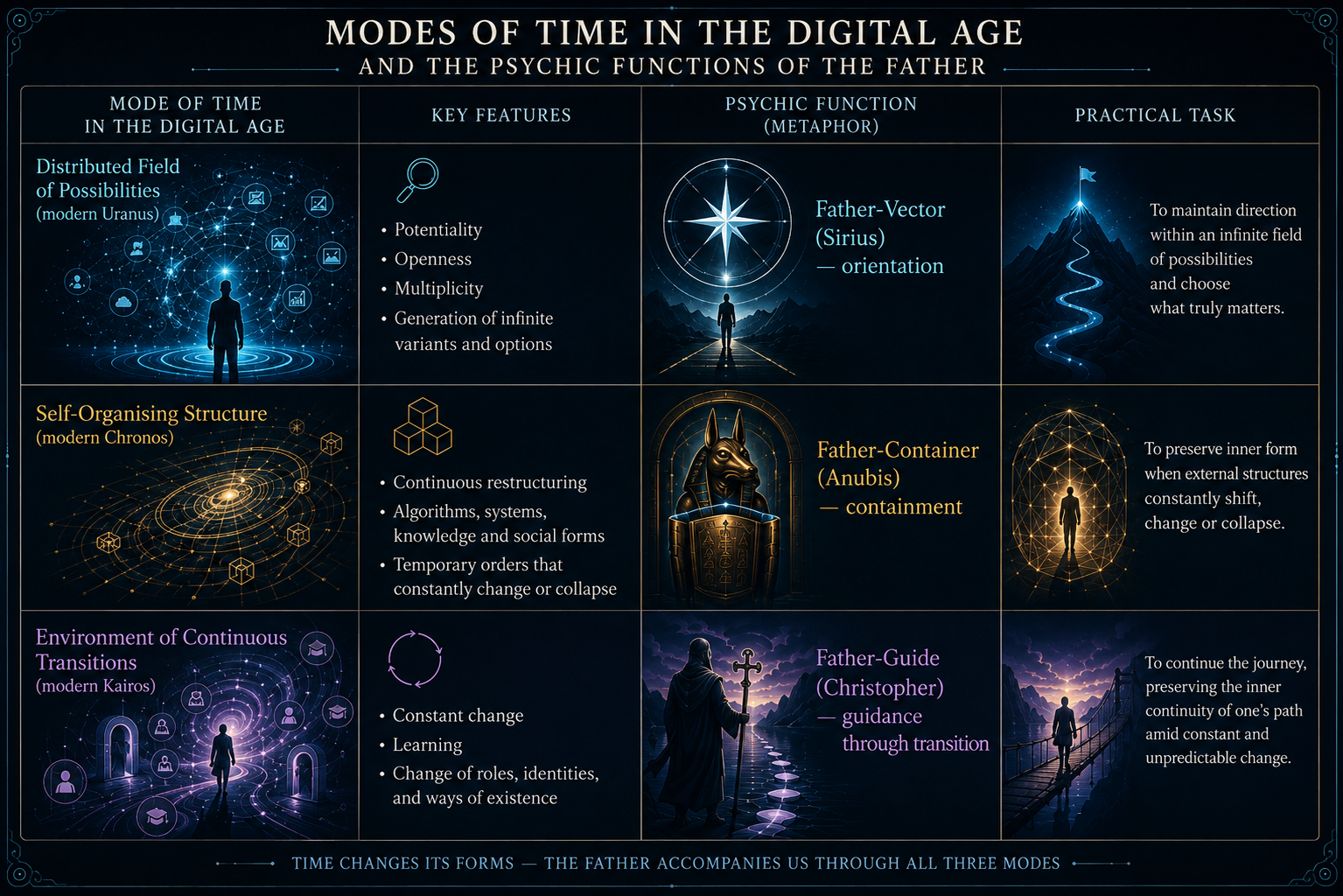
The table above presents the synthesis of the two triads in condensed form. We will examine this synthesis in greater detail below. First, however, we need to return briefly to the theme introduced in Protocol 2: the Father archetype and the breakdown of its channels of transmission.
If the Father was formerly experienced above all as a figure of authority, law or command, perhaps today the paternal principle increasingly needs to appear as a constellation of psychic functions that enable the individual to retain direction, tolerate uncertainty and pass through periods of radical change.
It is these possible functions of a renewed paternal principle that we will now examine.
FROM THE FIGURE OF THE FATHER TO THE FUNCTION OF THE NEW FATHER
If the preceding hypothesis is valid, another important consequence follows. The digital age may be changing not only the structure of time, but also the very way in which the Father archetype is channelled.
For much of human history, the father was experienced primarily as a figure.
It could be a parent. A leader. A king. A teacher. A priest. The state. The law.
In other words, there was an external carrier of the paternal principle. Through this carrier, the individual received direction, limits, a system of values and an image of the future.
The digital age, however, is gradually dismantling the monopoly of such figures. Authority becomes distributed. Knowledge ceases to belong to a single person or institution. Decisions are made under the simultaneous influence of dozens of informational sources.
This is why the crisis concerns not the Father archetype itself, but its former mode of embodiment — the old channels through which it was transmitted.
The archetype continues to exist. Yet its archaic or traditional forms are increasingly difficult to contain within one person, one institution or one ideology.
We are living in an epoch in which the transition from Father-as-figure to Father-as-psychic-function is becoming particularly relevant.
Moreover, this emerging psychic function — this new channel for the transmission of the paternal archetype — may still be only at the beginning of its formation, as we enter an increasingly global crisis of values.
NEW FUNCTIONS OF THE PATERNAL PRINCIPLE
If the Father’s principal task was once to communicate an already established law, that task is gradually changing.
Contemporary human beings increasingly need something other than a final answer, because any supposedly definitive answer or newly established law risks being swept away by the informational currents of the emerging aeon.
What becomes more important is the capacity to preserve orientation in a world in which ready-made answers are becoming less reliable.
We may therefore hypothesise that the paternal principle begins to manifest not through a single role, but through several complementary functions.
Not as new archetypes.
Not as new gods.
But as different psychic functions through which the same archetype continues to operate within a new historical reality.
Or, stated differently: as new modes of psychic adaptation through which the Father archetype continues to perform its organising function.
More simply still: as new ways in which the same archetype may be present in a person’s psychic life.
METHODOLOGICAL CLARIFICATION: WHY WE SPEAK OF PSYCHIC RATHER THAN PSYCHOLOGICAL FUNCTIONS
Throughout this research we increasingly use the expression ‘psychic functions’. This choice is deliberate.
In contemporary usage, the word psychological is often associated with personality, emotion, behaviour or the practical work of psychological counselling.
The subject of the present research is broader. We are considering changes occurring not only within the individual psyche, but also within collective, cultural and civilisational forms of consciousness.
For this reason, the term psychic functions is more precise for our purposes.
By psychic functions we mean fundamental modes of organising psychic life that allow individuals and human communities to orient themselves in the world, create sustainable forms, withstand crises and continue developing.
It is in this sense that the functions of Sirius, Anubis and Christopher will be considered below. They are hypothetical regulatory functions of the psyche that may acquire particular importance in the digital age.
THE PSYCHOID LEVEL IN THE NEW EPOCH
Following the preceding methodological clarification, it is important — above all for the sake of completeness and for future protocols — to recall another level of psychic organisation.
In analytical psychology, C. G. Jung introduced the highly significant concept of the psychoid. The psychoid points towards a level of reality at which the familiar distinction between psyche and matter can no longer be treated as absolute. It designates a boundary region in which psychic and material processes appear to be so deeply interconnected that they cannot be considered fully independently of one another.
Jung turned to this idea in his attempts to think about such phenomena as synchronicity, symbolic correspondences between psychic and physical events, and the nature of archetypes as factors that cannot be reduced entirely to subjective psychic experience.
Today, this idea acquires a new resonance.
For the first time in history, the digital age is producing technologies that increasingly connect psychic processes with material devices:
artificial intelligence
neural interfaces
implantable electronic systems
the extension of memory and attention through digital devices
Technology gradually ceases to function only as an external instrument. It begins to participate in the organisation of psychic life itself.
We may therefore hypothesise that certain processes of the digital age will become increasingly difficult to describe as either exclusively psychic or exclusively technological. They may increasingly need to be examined at the boundary between psyche and matter — in a domain that invites comparison with Jung’s psychoid perspective.
Beyond the Scope of the Present Research
The present protocol does not yet attempt to analyse psychoid processes as such.
Here we restrict ourselves to the psychic functions that may help the individual orient themselves within the new structure of time.
As digital technologies develop, however, the question of the relationship between psyche and material systems is likely to become increasingly central. The psychoid dimension of the digital age may therefore become the subject of a future protocol.
Technologies are already emerging that aim at an ever closer integration of digital systems with the human body and psyche. If this tendency continues, the psychoid dimension may cease to remain a purely theoretical concept within analytical psychology and become one of the central questions of a new anthropology.
METHODOLOGICAL OBSERVATION
As this protocol developed, another unexpected pattern became visible.
The original task of the research was considerably more modest. We were simply attempting to understand how the triad Uranus–Chronos–Kairos might relate to the triad Sirius–Anubis–Christopher.
Yet as the investigation progressed, the logic of the material itself began to exceed the initial frame.
Instead of a simple scheme of correspondences, a broader synthetic hypothesis began to emerge, bringing together mythological, psychological, cultural and civilisational levels of analysis.
The protocol therefore gradually acquired a different scale.
Speaking symbolically, it no longer corresponds solely to the principle of the Emperor — the archetypal image of structure, law and stable order. It begins increasingly to resemble the principle of the Hierophant: not as a religious figure, but as a symbol of synthesis between different levels of knowledge and of mediation between what is already known and what is only beginning to become conscious.
In this sense, the present protocol is transitional. It continues the exploration of the Father archetype, but at the same time it opens questions that can no longer be contained within the earlier model alone.
This is why it becomes necessary to speak not only of psychic but also of psychoid processes; not only of the individual psyche but of collective forms of consciousness; not only of the human being but of emerging relationships between the human being, culture and technology.
Many questions raised here are therefore deliberately left open. They require independent investigation and may become the subject of subsequent protocols.
As can be seen, Protocol 5 is taking on the characteristics not only of a synthetic hypothesis; a symbolic correspondence with the Fifth Arcana is also beginning to emerge.
We did not initially set out to move beyond the original model. Yet the logic of the research gradually demanded a broader language of description. Perhaps this is one sign of a living investigation: at a certain point, the researcher no longer simply directs the material, but also begins to follow where it leads.
THE DISCRETE FATHER
We can now name the discrete functions of the paternal principle.
The title of this section itself requires clarification. The word discrete is used here not only in the sense of separated, discontinuous or composed of distinguishable elements. It also refers to the logic of the digital age itself.
A digital system does not work with an undivided continuous flow as such. It breaks that flow down into distinguishable units: signals, data, codes, commands and separate operations.
The whole becomes accessible to the system only after it has been divided into elements that can be registered, transmitted, compared and recombined. Something analogous may be happening today with the Father archetype.
Previously, its different functions could be experienced as attributes of a single, integrated figure. The Father could simultaneously represent law, direction, boundary, protection, continuity and accompaniment through life transitions.
In contemporary culture, that figure loses some of its former wholeness.
Yet the archetypal principle itself does not disappear. Rather, its functions become discrete: they separate from one another and begin to manifest through different people, institutions, practices and internal capacities.
One person may offer direction but be unable to contain another person’s anxiety.
Another may provide a reliable container yet not know where to lead.
A third may accompany someone through crisis without claiming authority or final knowledge.
By the Discrete Father, therefore, we mean a paternal principle that in the digital age no longer needs to be embodied in one single figure. It appears instead as a system of distinct but interconnected psychic functions.
Sirius represents the vector function.
Anubis represents the container function.
Christopher represents the function of guidance through transition.
Their discreteness does not imply final disintegration. On the contrary, it makes formerly fused functions more distinguishable and allows the individual consciously to seek, develop and integrate them within their own psyche.
In this sense, the digital age acts upon the image of the Father in a manner analogous to the way a digital system acts upon a continuous flow: it divides the whole into separate elements so that a new configuration may later become possible.
THE FATHER AS VECTOR
This function may be symbolically associated with Sirius.
Its task is not to tell a person what the next step must be. Its task is to preserve direction.
In a world of effectively endless choice, the central problem is no longer the absence of possibilities but the loss of orientation.
Such a Father does not say:
Go exactly this way.
Instead, this function helps the person return repeatedly to another question:
Have I lost my direction?
Its central function is therefore not control, but navigation.
THE FATHER AS CONTAINER
The second function may be associated with the image of Anubis.
If Sirius helps the person not to lose direction, Anubis helps them not to lose form.
The contemporary psyche is exposed to continuous overload. The world around it fragments into information, emotions, change, speed and uncertainty.
Within such an environment, maintaining inner coherence becomes increasingly difficult.
The containing Father does not eliminate conflict. He does not free the person from anxiety.
He holds a psychic space within which anxiety can be experienced without the personality disintegrating.
His task is therefore not control, but the preservation of inner form during change.
THE FATHER AS GUIDE THROUGH TRANSITION
The third function is symbolically expressed by Christopher.
If Sirius is concerned with direction and Anubis with the preservation of inner form, Christopher is concerned with moving through transitions.
Every epoch contains its own thresholds. The digital age, however, increasingly turns transition into an almost permanent condition of human life.
We are repeatedly required to learn something new, change the way we work, retrain, master new technologies, revise our ideas about the world, restructure relationships and alter our way of life.
Transition ceases to be an exceptional event. It becomes a new norm of existence.
Christopher’s task is therefore not to choose the path instead of the person.
His task is to help preserve the capacity to continue moving when life itself continually demands a passage from one form of existence to another.
He accompanies the person through change.
He helps them to keep moving.
He helps preserve the inner continuity of their own path.
He conducts the person through transition, but never undergoes the transition in their place.
WHAT HAPPENS IF THESE FUNCTIONS ARE NOT FORMED?
If we understand the Father archetype not as a particular person but as a constellation of psychic functions, it becomes clear that the problem of contemporary culture lies not only in the loss of authority, but also in the insufficient development of these internal functions.
The question then changes.
It is no longer simply:
Does this person have a father?
But rather:
Have the functions of vector, container and guide been formed within them?
It is these functions that may enable the psyche to preserve stability in the digital age.
If the Vector Is Absent
The individual finds themselves inside an effectively endless Uranian space. They continually begin new projects, read new books, master new AI systems, change professions and explore new methods, yet bring very little to completion.
Each new possibility appears more attractive than the previous one.
The result is not freedom but a chronic loss of direction.
Such a person may be highly educated and constantly busy, yet gradually begin to live not their own life but the life of algorithms that continuously offer new stimuli.
Without an inner vector, the digital environment begins to choose direction in place of the person.
If the Container Is Absent
The person may know where they want to go but be unable to tolerate the tension of the journey itself. Any criticism destabilises them. Any failure makes them abandon the goal. Any change is experienced as catastrophe.
It is as though they lack an inner form capable of holding experience.
The digital environment then begins to regulate their emotional state continuously.
Mood becomes determined by notifications.
Self-esteem becomes determined by views.
The sense of personal value becomes determined by external validation.
The container ceases to be located within the person and is gradually transferred outside.
If the Guide Is Absent
This point is especially important.
A person may have direction and may preserve inner stability, yet still find it difficult to exist within the process of transition itself.
Changes follow one another. Technologies, professions, forms of communication, social roles and images of the future all shift, while a new stable order may take a very long time to emerge.
Without the Guide function, the person begins to experience each change as an isolated event unrelated to what came before.
Their path becomes fragmented: one state replaces another, but the inner continuity between them is lost.
They may move, change, learn and adapt a great deal and yet fail to experience what is happening as their own continuing transition.
This is precisely where Christopher becomes necessary.
The Guide does not promise a quick arrival on the other shore. He need not even know where that shore is.
His function is to help the individual remain the subject of their own journey while the transition continues.
He connects who the person was with who they are becoming.
He helps them tolerate the uncertainty of an intermediate state.
He allows change without turning every change into an entirely new life disconnected from what came before.
The practical task of the Guide is therefore not to complete the transition, but to preserve continuity of movement and self-awareness within the transition.
Christopher is not the one who knows where the transition will end. He is the one who helps us not to lose ourselves while the transition continues.
THE TASK OF THE DISCRETE FATHER
If the father formerly transmitted rules and knowledge above all else, this is no longer sufficient.
The digital age requires the development of three internal capacities.
The Father-Vector helps the person answer the question:
Where am I going, despite the endless multiplicity of possibilities?
The Father-Container helps the person tolerate anxiety, uncertainty and the breakdown of old forms without losing inner coherence.
The Father-Guide helps the person distinguish an actual transition from an endless succession of stimuli and continue moving when the digital environment once again invites them to turn aside.
The Vector answers: ‘Where?’
The Container answers: ‘How can I endure this?’
The Guide answers: ‘How do I remain on my path?’
This is no longer simply a description of the Father archetype. It is a more general model of psychic survival under conditions of chaotic time.
It brings together the principal ideas of Protocol 5:
Uranus creates a space of effectively endless possibilities;
Chronos ceases to function as the sole organising force;
Kairos becomes multiple and is frequently imitated;
and the three internal functions — vector, container and guide — may help the individual avoid dissolving into this new world.
The present protocol will continue by moving deeper into these themes. Part II will develop the model further.
(summer 2026)