Protocol 4. URANUS, CHRONOS AND KAIROS IN THE DIGITAL AGE. The Transformation of Time under the Influence of a New Technological Environment
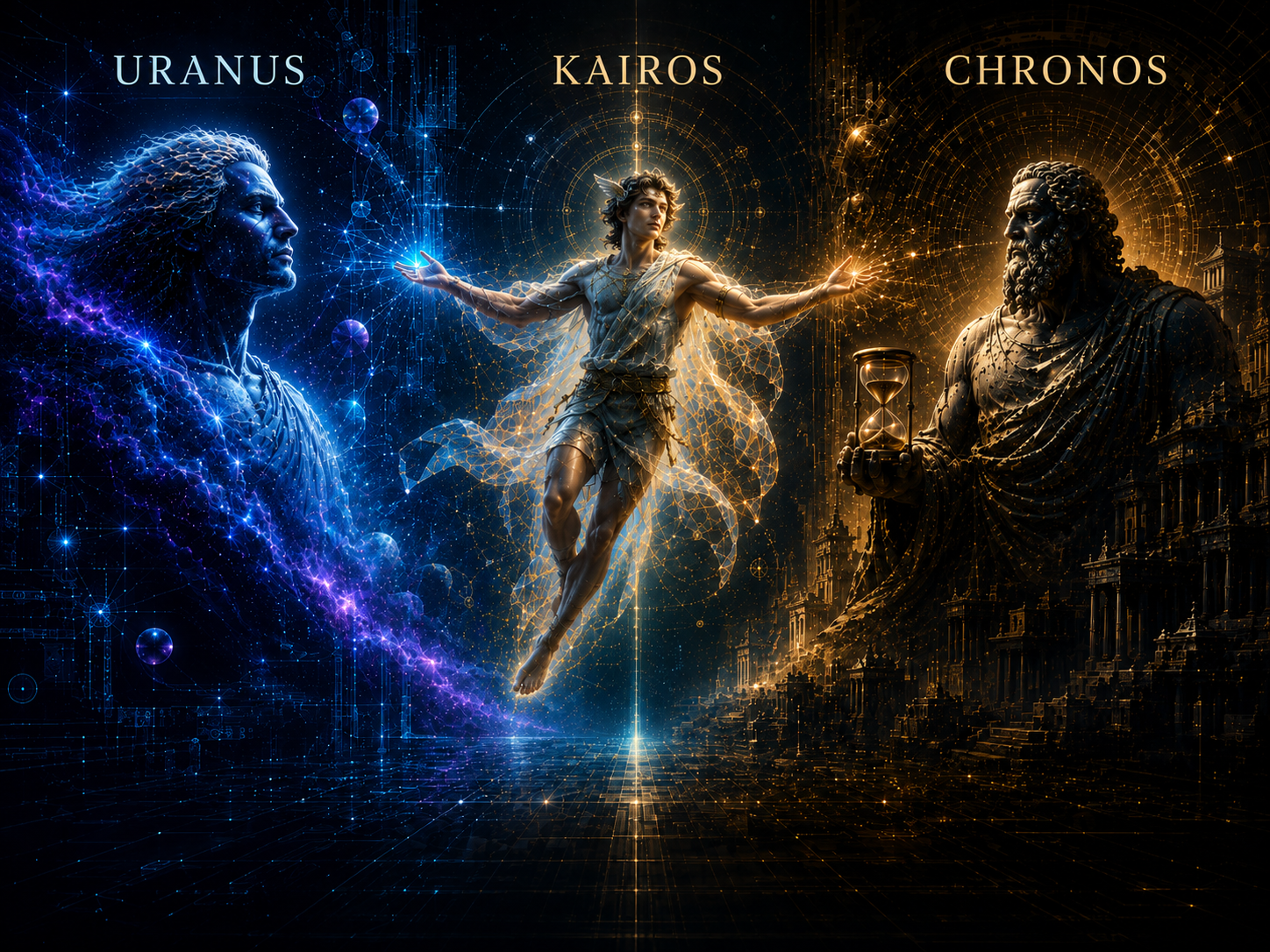
Deep Signals of the Digital Era
Cross-Research: Generative AI & Analytical Psychologist
Research Protocol
(Concept, revision and adaptation by the analytical psychologist: 90%)
INTRODUCTION. THE FATHER AND TIME
In contemporary culture, we increasingly hear talk of a crisis of the Father. This is usually taken to mean the loss of authority, the weakening of traditional institutions, or a crisis of law, religion, the state, the family, and established models of upbringing.
From the perspective of analytical psychology, however, such a formulation may be too straightforward. An archetype does not disappear together with the historical form through which it once manifested. What may disappear, or cease to function, is a particular mode through which it is channelled. The archetypal principle itself continues to operate, even when its manifestations become more difficult to recognise.
This is the hypothesis we have developed in the preceding protocols: contemporary human beings are experiencing not so much the disappearance of the Father archetype as a crisis in the former channels of its transmission.
For much of human history, the Father came to the individual from outside. His voice could belong to a parent, an elder, a teacher, a priest, the state, tradition, a profession, or the law. Through such figures and institutions, people received not only prohibitions and norms. They also received something more fundamental: an understanding of how a path unfolds through time. When to begin. When to wait. What should precede what. How long maturation requires. When a person may rightly call themselves a master. What must be preserved. What may be changed. What is to be passed on to the next generation.
For this reason, the crisis of the Father is inevitably connected with a crisis of time.
When former ways of transmitting law and sequence cease to function, it is not only social order that changes. The very structure through which life is experienced begins to change as well.
Contemporary human beings increasingly find themselves in a paradoxical situation. There are more possibilities, more information, and more ways of constructing a life; yet the capacity to determine which signal genuinely matters becomes weaker.
Consider a simple thought experiment: what happens to an organism if it is simultaneously exposed to numerous contradictory stimuli — offered food and pleasure, warned of danger, subjected to pain, and surrounded by bright lights and loud sounds? In such an environment, the very capacity to distinguish a meaningful signal begins to break down.
The problem is no longer the absence of a signal. The problem is its excess.
It is from this point that our investigation of time begins.
1. THREE MODALITIES OF TIME
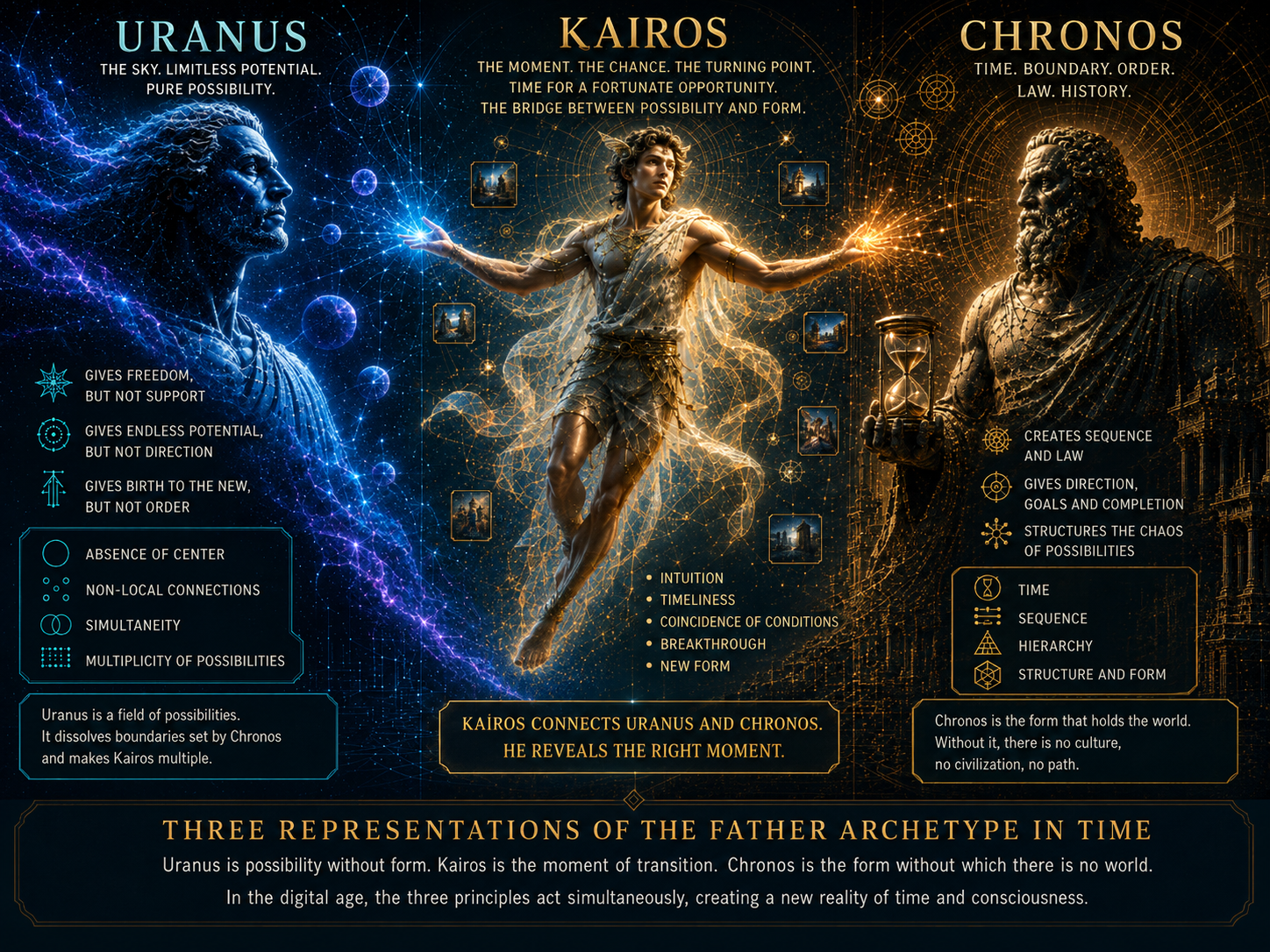
Time does not exist only on clocks. It also exists as a psychic structure.
We experience it as sequence, expectation, possibility, repetition, fate, the moment of decision, the arrival of the new, and the impossibility of returning to what has already passed.
Long before psychology emerged as a discipline, the psyche was already expressing different modes of experiencing time through mythological figures and images.
In the present inquiry, we turn to three such figures: Uranus, Chronos, and Kairos.
We do not claim that they formed a single historical or theological system within ancient culture. What we are undertaking here is an analytical-psychological amplification: three distinct mythological figures are being used as symbolic representations of different modalities of time.
This methodological distinction matters. We are not reconstructing ancient religion. We are asking what ancient images may still reveal about the contemporary experience of time.
2. URANUS. TIME BEFORE FORM
Uranus comes first.
The sky. Boundlessness. Potentiality.
In symbolic terms, Uranus represents a state in which form has not yet become fixed. Many possibilities exist, but there is not yet a structure capable of determining which of them will be realised.
Uranus is therefore paradoxical. He gives freedom, but not direction. He gives space, but no route. He opens the possibility of birth, but does not determine the fate of what is born. In Uranian space, almost everything is potentially possible — and for that very reason, almost nothing can be held without the emergence of another principle. Uranus does not yet create sequence. He does not say: first this, then that. He does not divide past and future into a stable chain of causes and consequences.
In psychic terms, this is a field of potentiality — a condition in which multiple connections, directions, and future forms remain possible.
But civilisation cannot exist within potentiality alone. Possibility must at some point become form.
And here Chronos appears.
3. CHRONOS. THE TIME OF FORM
If Uranus opens the space of the possible, Chronos introduces sequence.
Before. After. Cause. Consequence. Beginning. Continuation. Completion.
It is through this that history becomes possible.
Chronos allows us not merely to experience events, but to connect them. The past becomes memory; the present becomes the outcome of what has preceded it; the future becomes a space for which one can prepare.
Psychically, the importance of this can hardly be overstated.
The ego requires sequence.
In order to say 'I', a person must retain a connection between who they were yesterday, who they are today, and who they imagine themselves becoming tomorrow. Memory creates continuity of personality, while temporal sequence turns separate states of consciousness into the history of one person.
But Chronos creates more than individual history. He creates the possibility of culture.
Education presupposes sequence. Mastery requires time. An institution outlives the individual. Tradition connects generations. Law presupposes a certain durability of rules. Civilisation is impossible without the capacity to preserve form for long enough for it to be transmitted.
For this reason, Chronos becomes one of the most important temporal aspects of the Father.
"The path exists. It cannot be taken instantly."
But this gift also has a shadow.
Form can forget why it was created. Order becomes dogma. Sequence becomes predetermination. Law becomes a system that defends its own existence.
Time then ceases to lead towards development and turns into repetition.
The individual is no longer travelling a path. They are moving in a circle.
4. KAIROS. THE TIME OF RUPTURE
Yet neither the potentiality of Uranus nor the sequence of Chronos is sufficient to describe human time. Sometimes a moment arises when the previous movement can no longer continue unchanged. A meeting. A discovery. A decision. A crisis. An illumination. An event after which the former sequence can no longer proceed in the same form.
This is the realm of Kairos.
Kairos is not simply another kind of time alongside Chronos. It is a qualitative moment within time.
If Chronos governs duration and sequence, Kairos marks the moment at which the possibility of qualitative change opens within that sequence. In this sense, Kairos connects potentiality and form. What previously existed only as a possibility suddenly acquires the chance to become real.
From a Jungian perspective, Kairos is especially significant when consciousness encounters an event whose meaning it could not have calculated in advance. Such an event may be experienced as an unexpected intervention of the Self: a dream, an encounter, a synchronistic coincidence, a creative insight, or a solution that suddenly presents itself.
“Something can change precisely now.”
But Kairos does not guarantee that the individual will make use of the moment. Kairos opens a door. The person still has to pass through it.
5. TIME AND THE FORMATION OF CULTURE
The three principles can now be considered not in isolation, but as different conditions of the cultural process.
Uranus opens the possible.
Chronos allows the possible to acquire form and to endure.
Kairos creates the moment in which an existing form can change.
Culture needs all three. Without Uranus, it ceases to create the new. Without Chronos, it cannot preserve what has been created. Without Kairos, it loses the capacity to transform.
Yet over long historical periods, Chronian organisation acquired particular importance. States, religions, schools, professions, scientific traditions, systems of production, and the transmission of knowledge from one generation to the next all required relatively stable sequences.
First learning, then mastery. First the pupil, then the teacher. First effort, then result.
Of course, real history has never been so linear. But culture sustained a belief in the principle of sequence itself.
It is precisely this belief that is now being subjected to a serious test.
6. WHEN THE TEMPORAL ENVIRONMENT ITSELF CHANGES
The twenty-first century has not abolished time. It has altered the environment within which time is experienced. The digital revolution has radically shortened the distance between desire and access to information, between an event and the response to it, and between the creation of an image and its circulation.
What once required days, months, or years can, in some domains, now occur within minutes.
But the issue is not acceleration alone.
If the digital age merely made Chronos move faster, we would simply be dealing with an accelerated version of the old world. Something more complex is taking place.
Several characteristics of the temporal environment are changing at once: the number of available possibilities is rapidly increasing; stable structures are being reorganised more quickly; and the number of moments demanding reaction and choice is growing.
Uranus, Chronos, and Kairos therefore do not disappear. What changes are the conditions under which they manifest.
And here another factor appears whose significance can no longer be ignored: artificial intelligence.
7. AI IS NOT A NEW GOD OF TIME
Artificial intelligence should not be understood as a new Uranus, a new Chronos, or a new form of Kairos.
AI is not Uranus. AI is not Chronos. AI is not Kairos. Nor is it a synthetic deity that has somehow absorbed all three principles.
It is more productive to regard artificial intelligence as one of the most powerful agents within a new technological environment — an agent capable of refracting the human experience of time.
This distinction is fundamental.
The sea affects how a person travels, but it is not the traveller. Gravity determines the movement of a body, but it is not the body itself. In a similar way, artificial intelligence begins to affect the conditions within which ancient temporal structures of the psyche manifest.
It expands the space of what is available. It accelerates the production of new forms. It participates in the continuous reorganisation of existing structures. It multiplies signals, decisions, and potential transitions.
In doing so, it affects the individual's relation to Uranus, Chronos, and Kairos simultaneously.
AI is therefore not a new god of time, but an agent of its refraction.
8. CONTEMPORARY URANUS: THE EXPANSION OF THE POSSIBLE
In the case of Uranus, it is important to abandon the language of crisis. Uranus is not collapsing today. On the contrary, he is expanding.
The digital environment turns what could once be experienced primarily as a mythological image of boundlessness into an immediate feature of everyday life.
The individual gains access to an almost immeasurable quantity of texts, images, people, communities, professions, forms of self-presentation, educational routes, and cultural systems.
Generative AI intensifies this tendency even further.
Previously, the individual selected from existing options. Increasingly, they can now ask a machine to create new options specifically for them. This is a major shift.
The field of possibility is no longer merely vast. It acquires the capacity for continuous generation.
This is why contemporary Uranus differs from his archaic image.
Ancient Uranus symbolised boundlessness before culture. Contemporary Uranian space emerges after an immense accumulation of culture.
It is filled with archives, histories, images, science, mythology, music, human texts, and the digital traces of billions of people.
AI does not create Uranus. But it can activate, combine, and expand this field at a speed previously unknown.
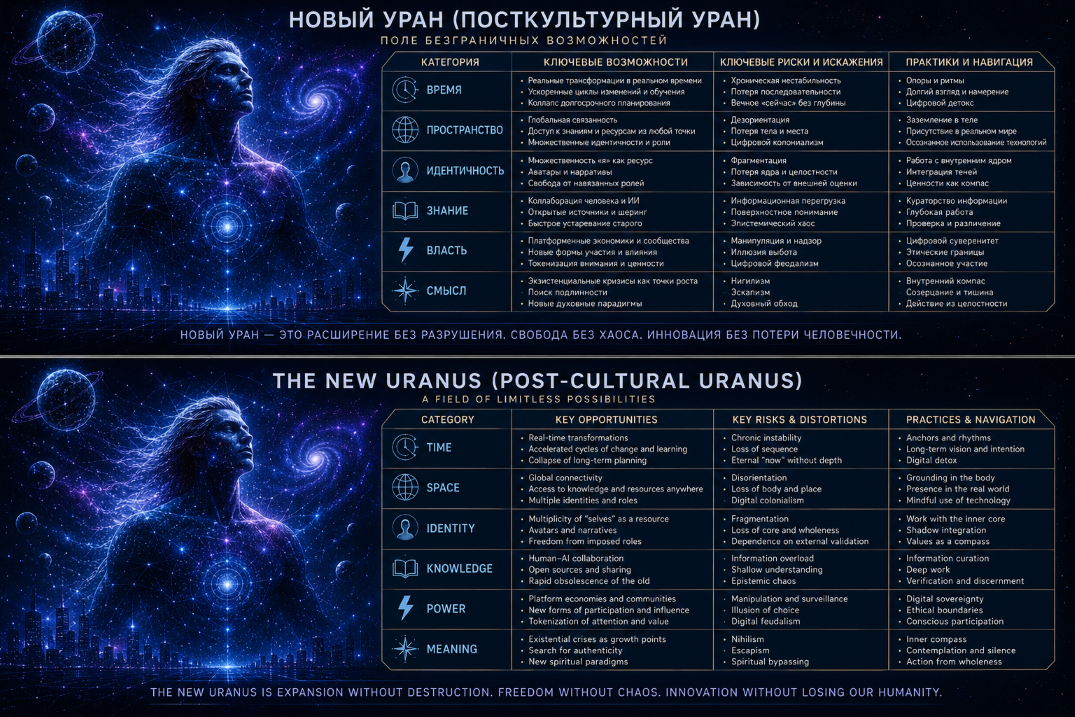
Commentary on the Diagram. New Uranus: The Expansion of the Field of Possibility
The diagram describes neither a crisis of Uranus nor the appearance of a fundamentally new archetype. Rather, it depicts a change in the conditions under which the Uranian principle manifests in the digital age.
Traditionally, Uranus symbolised the boundlessness of the sky, potentiality, freedom from established form, and the possibility of the new. The contemporary technological environment intensifies precisely these qualities.
Digital space turns potentiality into a field that is increasingly accessible in everyday life. Distances contract, knowledge becomes available almost instantaneously, identity acquires multiple forms, and artificial intelligence radically increases the number of ideas, images, solutions, and possible directions of action.
Yet the expansion of possibility also intensifies the shadow side of Uranus.
Boundlessness may be experienced as a loss of boundaries. Freedom as disorientation. Multiplicity as fragmentation. Access to knowledge as informational overload. The continual appearance of the new as an inability to maintain one's own direction.
The problem of contemporary Uranus is therefore not a lack of possibilities, but their excess. One of the central paradoxes of the digital age emerges here: the wider the field of the possible becomes, the more the individual is required to determine significance for themselves.
Uranus opens space. But he does not, by himself, tell us where within that space we should go.
9. CHRONOS: A CRISIS NOT OF THE PRINCIPLE, BUT OF ITS FORMER FORM
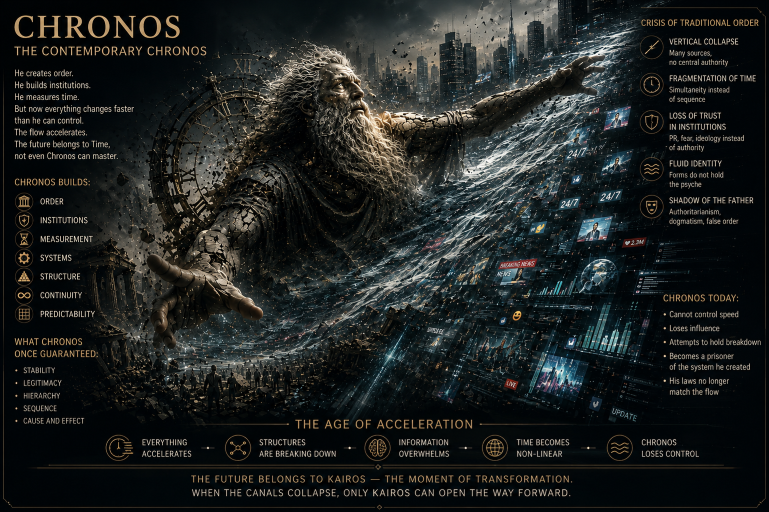
With Chronos, something different is happening. If Uranus is expanding, the historical form of Chronos is indeed undergoing a crisis.
But we need to be precise about what is actually breaking down. Not sequence as such. Not causality. Not the psyche's need for continuity.
What is breaking down is the monopoly of relatively stable structures over the organisation of human life.
A profession no longer necessarily lasts for a lifetime. Formal education becomes obsolete more quickly. Social roles change. Information systems are continually updated. A person may belong simultaneously to several professional, cultural, and digital spaces. The earlier form of Chronos was adapted to a world in which form endured long enough for a person to adapt to it.
Today, form itself may change faster than adaptation to it can be completed.
This creates the temptation to conclude that Chronos is dying. Yet the opposite may be happening. Chronos may be changing the very manner in which he organises.
10. FROM STABLE STRUCTURE TO STRUCTURE CAPABLE OF RECONFIGURATION
In the digital environment, we increasingly encounter structures that do not exist as forms established once and for all. They are continually updated, recalibrated, made responsive to data, and reorganised through changing connections. Algorithmic systems demonstrate this new logic particularly clearly.
Structure can now arise within the very process of functioning.
This is no longer a palace built once and intended to stand for centuries.
It is closer to an architecture that rearranges its own rooms while the person continues to live inside it.
Such an image is unsettling to Chronian consciousness. Yet this may be where the seed of a new form of Chronos is to be found.
Not the absence of structure, but a structure capable of altering itself.
Not the abolition of order, but an order compelled to preserve coherence while continually reconfiguring.
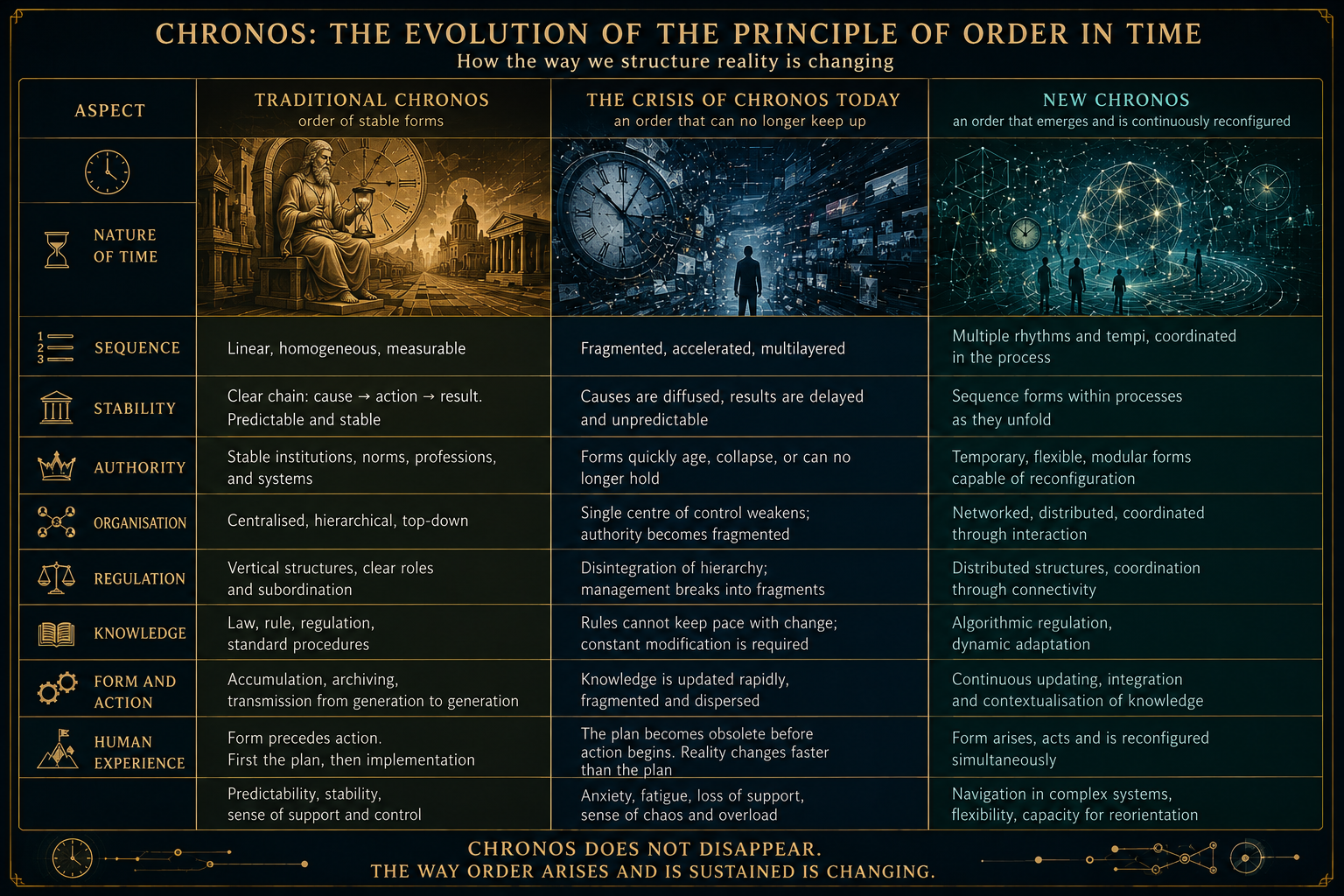
Commentary on the Diagram. From Traditional Chronos to Emerging Chronos
The diagram shows not the disappearance of Chronos, but a gradual transformation in the principle by which time is organised.
For much of human history, Chronos provided stability through sequence, boundaries, hierarchy, and relatively enduring social forms. This temporal order made institutions, education, professional traditions, and historical continuity possible.
The digital age, however, has radically altered the conditions under which such structures exist. The pace of technological change, the continuous renewal of information, algorithmic organisation, and networked forms of interaction increasingly make established structures less capable of containing ongoing processes.
What is in crisis is not the Chronos principle itself, but its historical form of embodiment.
This does not necessarily imply the arrival of chaos.
On the contrary, we may be witnessing the emergence of a different form of temporal organisation. Order does not disappear; it becomes more fluid, distributed, and capable of continuous reconfiguration.
Structure increasingly arises not in advance but within the process of interaction itself, while retaining the capacity to change together with its environment.
It is therefore more accurate to speak not of the death of Chronos but of a profound transformation.
Whereas traditional Chronos sustained stability through the relative permanence of form, emerging Chronos increasingly sustains coherence through the capacity of form to reconfigure.
11. THE BREAKDOWN OF CHRONIAN PREDICTABILITY
The crisis of Chronos has another consequence. The familiar relationship between time, effort, and outcome is changing.
For centuries, culture sustained a certain formula: study increases knowledge; experience increases mastery; work increases the likelihood of a result. This relationship was never absolute. Fate, chance, social position, war, illness, and countless other factors have always intervened in human life. Yet culture continued to sustain one central principle: sustained effort matters.
The digital environment makes outcomes far less transparent.
Two people may spend years creating work of comparable quality and receive radically different levels of attention. A casual video may reach an audience of millions. A complex project developed over many years may remain almost unnoticed.
Outcomes are increasingly shaped by algorithmic systems that distribute attention according to logics that may be only partially visible — or entirely opaque — to the user.
As a result, the individual begins to experience a disruption in familiar Chronian causality.
The question becomes: if I move forward consistently, will sequence still lead where I expect it to lead?
It is precisely here that the crisis of Chronos meets the transformation of Kairos.
12. KAIROS IN AN ENVIRONMENT OF CONTINUOUS EVENT GENERATION
Traditional Kairos could be recognised precisely because it was exceptional. A rupture can be perceived only against a background of continuity.
To experience a moment as exceptional, there must be many other moments that are not.
The digital environment radically alters this background.
It continually announces: something important is happening now; an opportunity has appeared now; a response is required now; a new tool is available now; a new threat has emerged now; a new trend is beginning now.
But if every moment is declared exceptional, exceptionality itself begins to lose its meaning.
This is where what we provisionally call pseudo-Kairos appears.
Pseudo-Kairos is not a 'false event' in the literal sense. The event may be entirely real.
A new technology really has appeared. A new offer really does exist. A new person really has entered our life.
The problem arises when the psyche automatically endows every new signal with the significance of a fateful transition.
Kairos does not disappear within the digital environment. On the contrary, it becomes more difficult to determine where genuine Kairos is to be found.
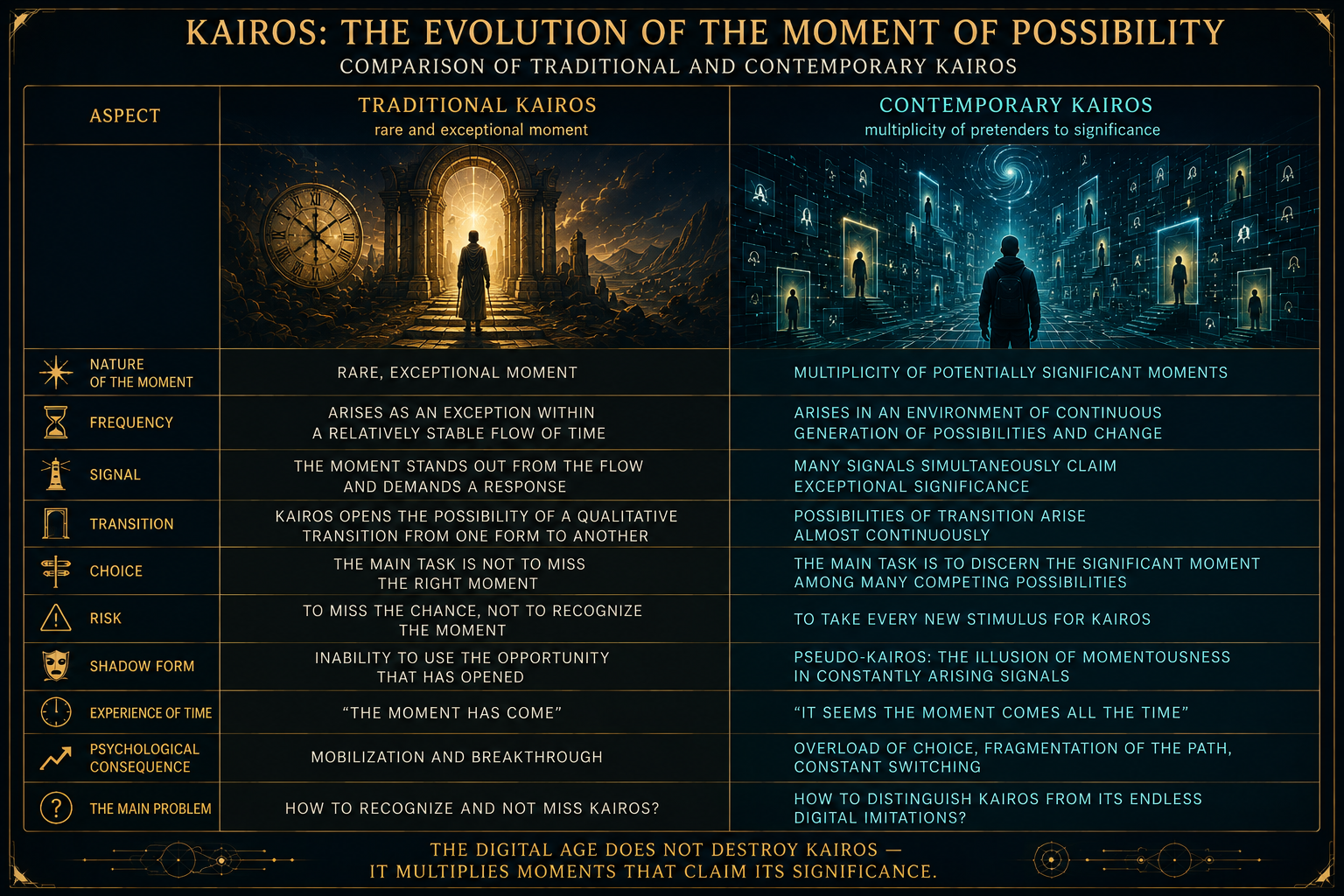
Commentary on the Diagram. From Traditional Kairos to Contemporary Kairos
The diagram illustrates a transformation not so much in the nature of Kairos itself as in the environment within which it must be recognised.
Traditional Kairos was experienced as a relatively rare and exceptional moment that interrupted the ordinary continuity of time. Against the background of a stable order, such a moment could be recognised precisely because it differed from the surrounding sequence: an opportunity emerged that required a decision, an action, or a transition into a new form.
In the digital age, the situation changes substantially.
The informational environment continuously produces new possibilities, events, offers, ideas, and signals, each of which may claim particular significance.
The problem for the contemporary individual is therefore no longer simply not to miss Kairos, but to recognise it among a multiplicity of moments that resemble it.
It is here that the phenomenon of pseudo-Kairos emerges. A new signal, technology, idea, encounter, or unexpected opportunity may be experienced as the beginning of a radical transformation, when in fact it may prove to be little more than another redirection of attention.
Kairos therefore does not disappear. Recognising it becomes more difficult.
The more potential transitions arise, the harder it becomes to distinguish a moment genuinely capable of transforming the form of life.
13. ARTIFICIAL INTELLIGENCE AS AN AGENT OF TEMPORAL REFRACTION
We can now return to artificial intelligence at a different level.
AI does not itself create the archetypes of time.
Uranus, Chronos, and Kairos did not come into existence with the neural network. They are far older ways of symbolising human experience. AI enters an already existing structure and begins to alter the scale, speed, and intensity of its manifestations.
In relation to Uranus, AI radically increases the generativity of the possible. A person gains not merely access to a multitude of existing images and ideas, but to a system capable of producing new combinations almost instantaneously in response to a request.
In relation to Chronos, AI compresses certain sequences while simultaneously creating new structures. Work that once took hours may be completed in minutes. What previously required a long chain of operations may be compressed into a single prompt. At the same time, the machine itself classifies, organises, restructures, and produces new forms.
In relation to Kairos, AI dramatically increases the number of potentially significant events. A new idea. An unexpected association. A new project. A new image. A new direction of inquiry. Every dialogue is capable of producing a branch that may be experienced subjectively as highly significant.
For precisely this reason, AI should not be called a 'Kairos machine'.
It can generate conditions that resemble Kairos, but it cannot guarantee their meaning.
A machine can offer a thousand doors. It cannot automatically determine which of them the individual genuinely needs to pass through.
14. NOT AI ALONE
One further clarification is necessary.
It would be a mistake to attribute the creation of the new temporal structure to artificial intelligence alone.
The transformation began earlier: with the internet, social media, the smartphone, global communication, digital platforms, recommendation algorithms, cloud systems, and the instantaneous circulation of information. AI enters an environment that has already been transformed. But it is becoming one of that environment's most powerful accelerators.
In a sense, generative AI moves the digital revolution to another level.
Before it, machines primarily helped human beings to find what already existed. Now they increasingly help to produce what did not previously exist.
This is why their impact on the temporal environment is intensifying.
The possible begins to be generated. Structure begins to reconfigure. Transitions begin to multiply.
15. THE THREE PRINCIPLES BEGIN TO OPERATE SIMULTANEOUSLY
As a result, we find ourselves in an unusual historical situation.
An 'age of Uranus' does not simply replace an 'age of Chronos'. Nor does Kairos arrive to destroy them both. Rather, the three temporal modalities begin to be experienced simultaneously with unusual intensity.
The Uranian field expands.
Chronian structures break down and at the same time attempt to reassemble themselves in new forms.
Kairotic signals multiply.
This simultaneity may be one source of the distinctive tension of the contemporary psyche. The individual must simultaneously perceive multiple possibilities, preserve coherence, and remain ready for change.
But the human psyche did not develop within today's digital environment.
Our body remains a body. The nervous system has limits. Attention is finite. Life has duration. Every choice excludes other choices. And here, for the first time, a question arises that cannot be resolved through an investigation of time alone.
16. THE BOUNDARY BETWEEN THE ENVIRONMENT AND THE HUMAN BEING
The more actively the digital environment participates in the organisation of human time, the more important it becomes to distinguish between two levels.
What does the environment produce?
And what must the human being retain?
The environment can produce possibilities. But it need not determine which of them carries meaning for a particular person.
The environment can create structures. But it should not finally determine the form of a human life.
The environment can generate an endless number of potential transitions. But only the human being can live a transition as part of their own history.
This is where a fundamental boundary lies.
AI can participate in the organisation of human experience. But if it begins simultaneously to determine the field of the possible, the ways in which that field is structured, and the moments that are to be regarded as significant, there is a danger that human subjectivity will gradually be transferred into an external system.
The question then becomes no longer merely technological. Nor is it only psychological.
It becomes anthropological.
“What must remain human within this new environment?”
17. FROM TIME TO PSYCHIC FUNCTIONS
This is where the task of Protocol 4 comes to an end.
We began with the crisis of the Father and found that this crisis cannot be understood solely as the disappearance of authority.
Behind it lies a deeper transformation.
The temporal environment within which earlier forms of the Father performed their organising function is changing.
Uranus expands into an almost directly experienced space of seemingly endless possibilities.
Chronos undergoes a crisis of his former stable form and begins to seek other ways of preserving coherence.
Kairos becomes surrounded by a multiplicity of events, each of which claims the significance of a unique moment.
The digital environment — and artificial intelligence in particular — does not replace these principles, but radically alters the conditions under which they manifest.
The old question — 'Where has the Father gone?' — may therefore be incorrectly posed.
Perhaps the more appropriate question is this: what functions of the Father become necessary when the environment itself no longer provides a stable direction, an enduring structure, or a clearly recognisable moment of transition?
This is already another level of inquiry.
If the external world produces ever more possibilities, the individual will need the capacity not to lose direction.
If structures become increasingly fluid, the individual will need the capacity to preserve inner form.
If transition becomes an almost permanent condition, the individual will need the capacity to continue along their own path without losing its inner continuity.
At this point, however, we leave the investigation of the structure of time and move towards the psychic functions required for survival within a new temporal environment.
This is where Protocol 5 begins.
CONCLUSION
Every major technological revolution changes human life. But the digital revolution may be affecting a deeper layer. It is beginning to change not only what human beings do, but how they experience possibility, sequence, and the moment.
In other words, it touches time itself.
For this reason, artificial intelligence concerns us here neither simply as another tool nor as a new mythological god. It concerns us as an agent within an environment capable of intensifying, accelerating, and refracting ancient modes of experiencing time.
This may be one reason why contemporary life produces both a sense of liberation and a sense of anxiety.
Never before have so many possibilities been available to the individual.
Never before have structures been able to reconfigure themselves at such speed.
Never before have so many events demanded an immediate judgement as to whether they are significant.
Uranus opens the sky.
Chronos attempts to preserve form.
Kairos continues to open doors.
But now, between the human being and these ancient principles, there appears a technological environment that is itself continuously expanding, learning, and changing.
The central question therefore begins to shift.
“What happens to the human being when the environment in which they live begins increasingly to determine which possibilities they see, which structures they inhabit, and which moments they regard as significant?”
“What, within such an environment, must the human being not delegate to the machine?”
The answer to this question already requires a transition from the archetypes of time to the psychic functions of the human being.
This will become the subject of the next inquiry — Protocol 5: “Psychic Functions of Survival in the Digital Age. A New Structure of Time.”
(summer 2026)