Dark: After the Loop. Pregnant Hannah, Jungians, and the Mother of Jung
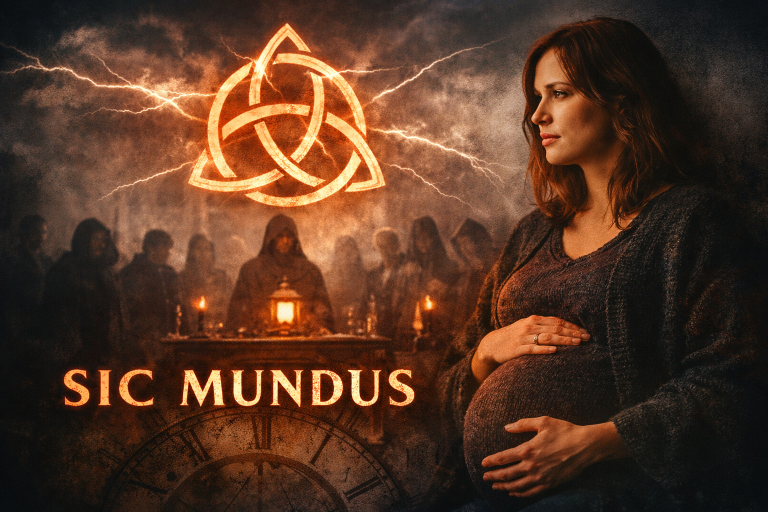
“I recently had a dream.
I was standing in a dark room.
And suddenly everything disappeared.
Only darkness remained.
But I did not feel fear.
I felt… peace.
And suddenly I understood:
It was as if the world had vanished.
It simply… ceased to exist.
And it was beautiful.”*
(Hannah’s monologue)
The final scene of Season Three of Dark appears, at first glance, almost ordinary. A storm outside the window. Friends gathered in Hannah’s house. Calm conversation. Wine being poured. After three seasons of metaphysical tension, the series seems to return to “normal life.”
Yet it is precisely in this simplicity that the deepest philosophical point of the entire narrative is hidden. This is neither an epilogue nor a consolation. It is a demonstration of a world in which the loop no longer operates—and for the first time, we can see the price at which it once existed.
The storm outside is not merely atmospheric. It echoes all the previous catastrophes of Winden: the nuclear accident, the temporal fractures, the storms of fate that tore the town apart for decades. But now the storm opens no portal. It simply makes noise. The world no longer responds with a metaphysical reaction. Reality becomes “mute.” This is the first sign of leaving the loop.
Inside the house, something no less important is happening. Friends talk about life. It is the conversation of people living in a world where the collective unconscious still retains traces of vanished realities, yet consciousness can no longer reconstruct them. Memory has fragmented, but it has not disappeared. It has turned into a feeling. This often happens when a dream dissolves toward morning.
The final word belongs to pregnant Hannah.
She sits calm, thoughtful, serene. She speaks of déjà vu—of feeling as if she has already lived this life. She raises a toast to a world without Winden. It sounds like a strange joke, unless one remembers that Winden was the epicenter of all temporal catastrophes. It is a toast to a world without a traumatic center. To a reality without a knot of fate.
And then she says a name: Jonas.
At that moment, Dark turns into a metaphysical trap.
Because Jonas is the name of the one who stood at the center of all loops, all sacrifices, all attempts to fix the past. The name of the one who became time itself. And now this name appears again—as the fantasy of a pregnant woman.
Here the series makes its most subtle and most cruel gesture: it shows that the loop does not disappear completely. It moves into the symbolic realm. It becomes a maternal fantasy.
At this moment, Hannah is not merely a character. She is a figure of fate. A figure of maternal imagination from which worlds are born. Within her converge contradictory impulses: longing, memory, desire, fear, hope, unconscious residues of past realities. She carries a child and, at the same time, carries a history that no longer exists.
A mother is always a portal.
She is a place where past and future are not yet separated, where fantasy, body, and destiny are fused. That is why the question “What is she thinking?” becomes crucial here: What does a woman think about when she creates new life in a world cleansed of temporal catastrophes, but not of the unconscious?
She thinks about the end of the world.
She thinks about the emptiness after the end.
She thinks about Jonas.
In her womb is an origin.
In her womb may be a new prophet.
Here we can see a deep parallel with Sic Mundus.
Sic Mundus is a cult of the past. It is an organization that lives by the illusion that if one returns far enough, rewrites events rigidly enough, interferes often enough, one can save Winden’s fate. Their madness lies in sacrificing the future for the past. Their time machine is an instrument for fixing trauma.
They do not want a new world.
They want the “correct version” of the old one.
In this sense, they resemble a certain type of analytical and cultural thinking—including the shadow side of the Jungian tradition.
Jungians also travel through time. They constantly return to the past: to childhood, ancestral history, myths, archetypes, ancient symbols, alchemy, Gnosticism, dreams of centuries. At best, this is a path of integration. At worst, it is endless circling. And yes, sometimes it becomes obsession with prophecy.
When work with the unconscious turns into a cult of origins, a cult of sources, a cult of “true meaning,” the analyst begins to resemble a member of Sic Mundus: believing that going deep enough into the past can alter the present.
But what if, in doing so, the future is lost?
What if all this traveling is merely wandering through the labyrinths of maternal fantasy?
That is why I think here of another pregnant woman: Emilie Preiswerk Jung, Carl Jung’s mother. She was a woman of intense religious-mystical psyche, with a powerful inner world, visionary experiences, living as if in two realities. Little Carl Gustav grew up within her field of fantasies, inner worlds, and tensions between faith, fear, and mystical experience.
One could say radically: part of the Jungian universe grew inside Emilie’s maternal field. What if we (they) are also walking along the paths of parallel realities of her unborn children? Through labyrinths of déjà vu, through remnants of worlds that could have been born but remained beyond the threshold. Through archetypal worlds born from maternal unconsciousness that later formed a cultural system.
Like Jonas, who spends his life trying to correct his mother’s fantasies—her fears, her losses, her desires—entire generations of analysts may unconsciously try to “complete” Jung’s maternal matrix.
To fix it.
To finish it.
To give it form.
But as in Dark, these attempts may become loops in the destinies of Jung’s followers—so to speak, the great-grandchildren of Emilie Preiswerk—whose prophecies were never destined to come true, like those of Sic Mundus.
The shadow side of the Jungian path is addiction to depth. To the past. To symbols. To archetypes. To origins. It is the temptation to live in eternal return rather than in the present.
Sic Mundus wanted to save Winden.
It nearly destroyed reality.
Sometimes an analyst wants to save a soul,
and may destroy its future spontaneity.
This is what happens when individuation erases individuality.
The final scene of Dark is liberation from the loop—but not from the unconscious. A world without Winden is possible. A world without time is not. The maternal fantasy remains. The name Jonas returns. The possibility of a new loop always exists.
But now it is no longer fatal.
It is symbolic.
Here emerges a mature form of analytical consciousness: not to destroy fantasy, not to rewrite the past, not to become trapped in loops—but to allow history to be history, and life to be new.
And to see the future and face it.
Not to correct destiny,
but to endure its imperfection.
Andrey Mozharov & AI
2025–2026