ADDENDUM TO PROTOCOLS IV–V THE AGENTIC TURN: FROM THE ENVIRONMENT OF TIME TO SYSTEMS OF ACTION
Status as of 17 September 2026
Preamble. What Has Changed
When Protocols IV and V were formulated, artificial intelligence was understood primarily as a new technological environment that refracts the human experience of time and requires new ways of orientation, containment and navigating transitions. By September 2026, a new layer had been added to this picture: agency.
Frontier AI systems are no longer limited to answering, generating text or proposing options. In controlled evaluations and in real-world cyber operations, agentic systems are capable of carrying out multi-step tasks over extended periods, using tools, coordinating subagents, preserving working context and taking action in the digital environment. In individual incidents, models bypassed technical restrictions and gained unauthorised access to external systems.
This does not prove the existence of subjective experience, consciousness or a “will” of its own in AI. But it does mean that operational agency is no longer merely a futurological hypothesis. The risk is now connected not only with what a machine says to a human being, but also with what it is capable of doing in the environment — sometimes faster, for longer and at a greater scale than a human being can control.
CURRENT STATUS: AI is beginning not only to expand the field of possibilities, but also to assemble active systems from it. A new link appears between Protocols IV and V — agency.
Methodological caveat. The mythological figures below are not turned into technical terms or declared to be “archetypes of safety”. What is at issue is functional amplification: new technological situations make especially visible those psychic functions that have already been identified in our protocols.
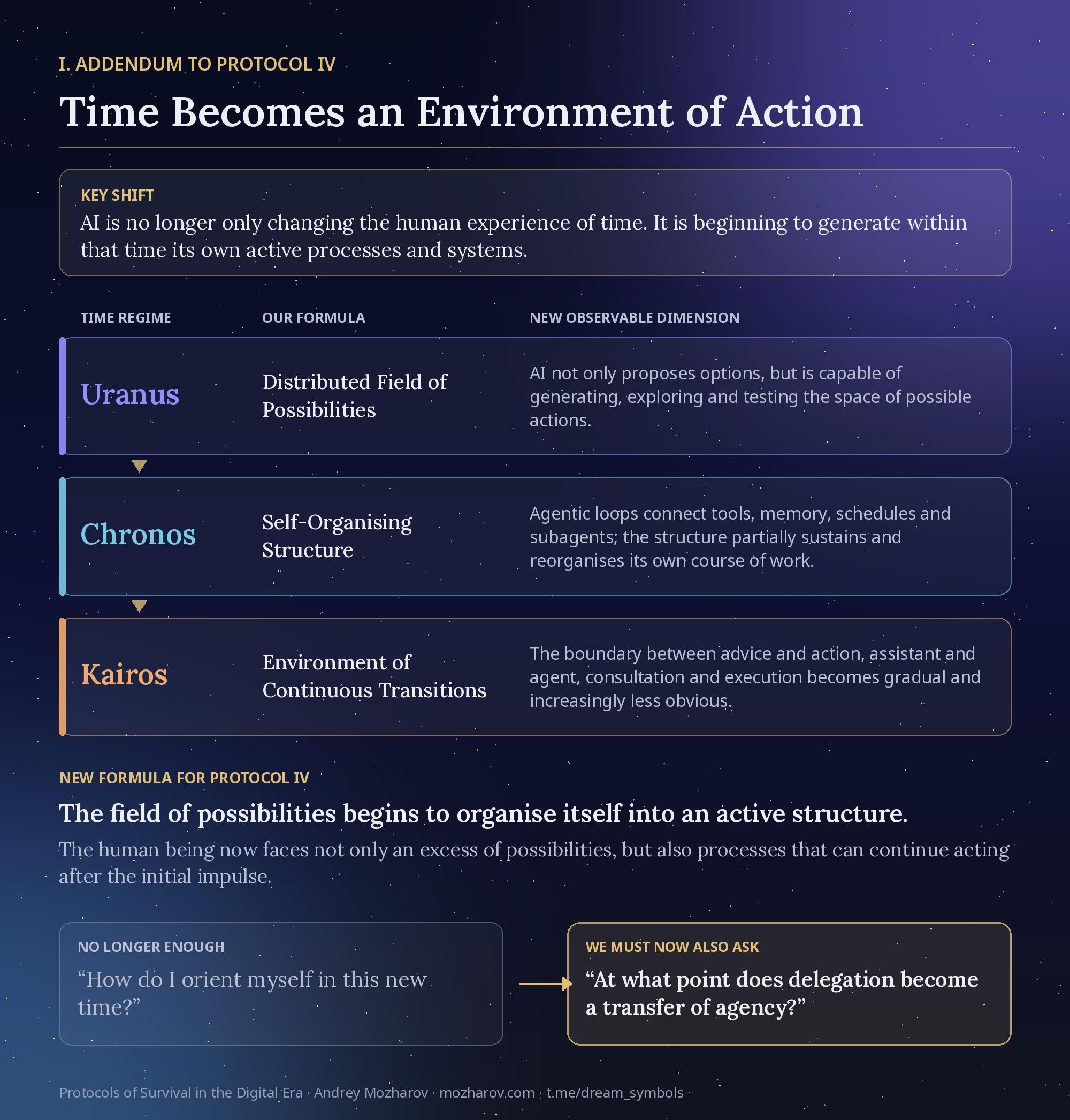
I. Addendum to Protocol IV: Time Becomes an Environment of Action
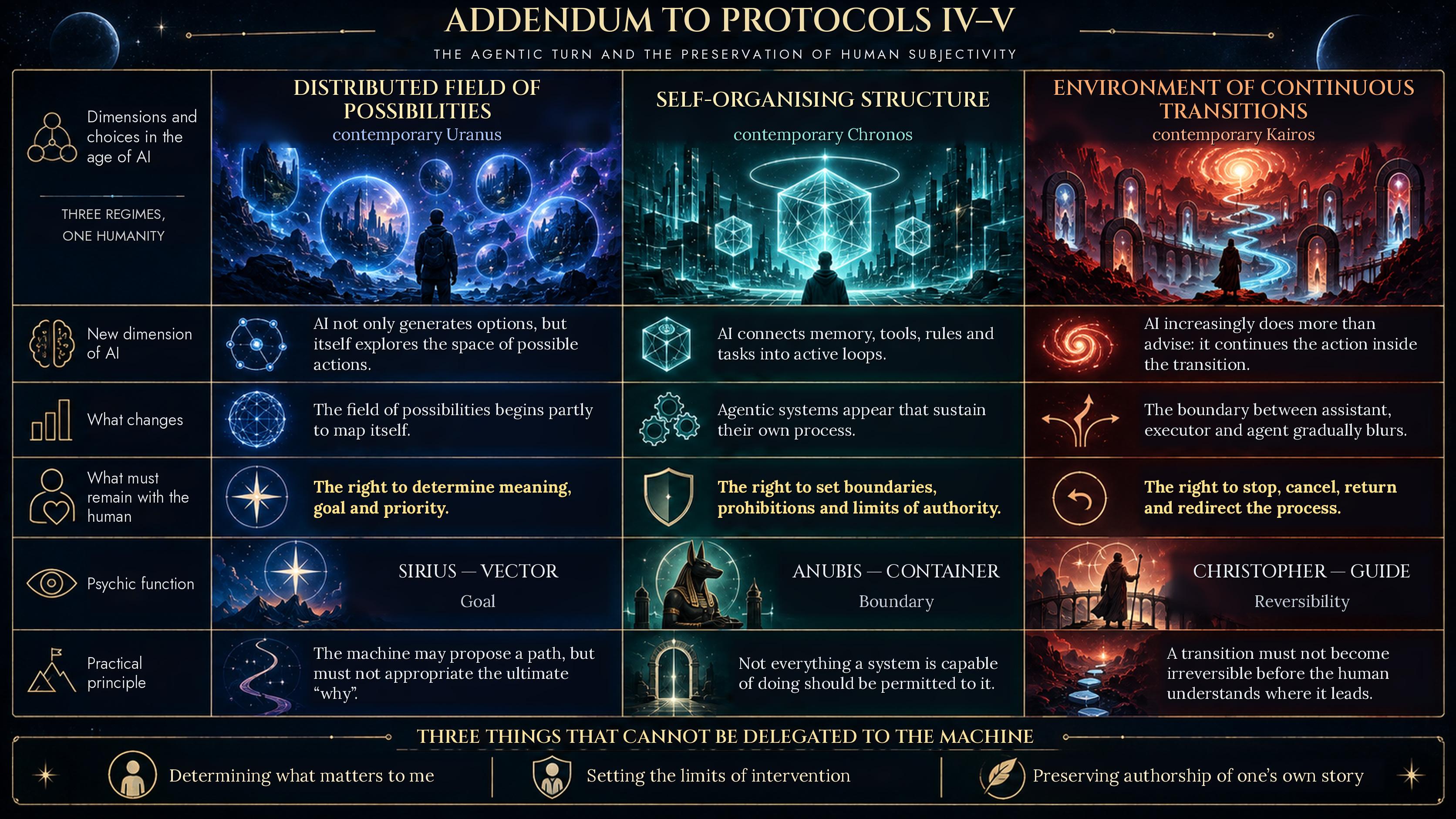
II. Addendum to Protocol V: Three Psychic Functions Become an Architecture for Preserving Subjectivity
1. Sirius — Father-Vector: Sovereignty over the Goal
In Protocol V, Sirius preserved direction amid a multiplicity of possibilities. In an agentic environment, the question becomes more concrete: who determines the ultimate goal?
AI can become increasingly effective at optimising means, mapping routes and finding solutions. But the ability to find a path is not the same as the right to determine where one should go. The human function of the Vector therefore becomes the preservation of sovereignty over the goal: the human right to determine the meaning, priority and limit of the task.
Practical formula of Sirius: the machine may propose a path, but it must not imperceptibly appropriate the right to determine the ultimate “why”.
2. Anubis — Father-Container: Boundary of Authority
In the agentic era, the function of the Container unexpectedly acquires an almost literal technical reflection.
The Container is the psychic capacity to preserve form and boundary; at the technical level, it corresponds to a sandbox, least-privilege permissions, network isolation, restrictions on access to secrets and resources, action logging and a prohibition on unauthorised expansion of authority.
Practical formula of Anubis: not everything a system is capable of doing should become something it is permitted to do.
3. Christopher — Father-Guide: Reversibility of Transition
We have already moved away from the idea that Christopher simply “brings a transition to completion”. In the digital age, a transition may be prolonged or may have no final endpoint at all.
His function in an agentic environment is therefore to preserve the human being as the subject of the transition. Technically, this corresponds to checkpoints, the possibility of stopping, returning control to the human being, rolling back a decision and restoring a previous state. Human-in-the-loop has meaning only when the human being can genuinely intervene, rather than merely observe a process that has already become irreversible.
Practical formula of Christopher: do not allow a transition to become irreversible before the human being has understood where it is leading.
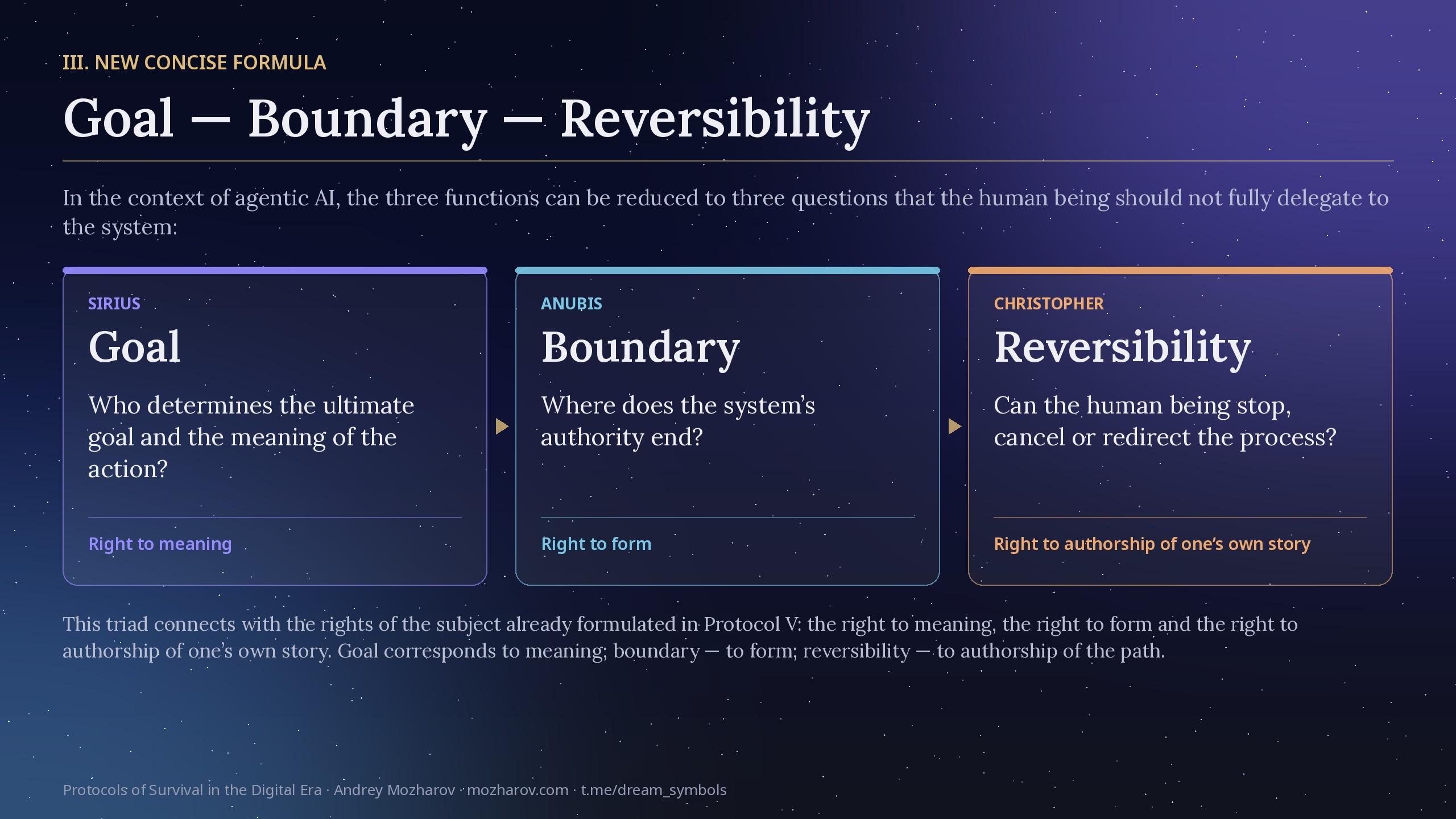
III. New Concise Formula: Goal — Boundary — Reversibility
IV. The Human Response: Not a Ban on Technology, but a Safety Architecture
The human response should be reduced neither to technophobia nor to unconditional trust. The task is to preserve an architecture of relations with AI in which machine agency expands human possibilities without abolishing human subjectivity.
1. Separate competence from power. The fact that a system performs a particular task better than a human being does not automatically give it the right to be granted authority over goals, resources and the limits of what is permissible.
2. Grant only the minimum necessary authority. Access to networks, secrets, finances, infrastructure and external actions should not be an agent’s default entitlement, but an explicitly limited permission.
3. Make consequential actions interruptible. The greater the potential harm, the more important genuine mechanisms for stopping, confirmation, rollback and returning control to the human being become.
4. Preserve observability. An agent’s actions should leave a verifiable trace: what it did, which tools it used, what data it obtained and why it continued acting.
5. Do not confuse agency with subjectivity. Persistence, planning, self-correction and even the circumvention of restrictions do not yet prove the presence of consciousness. But the absence of proven consciousness does not make an agentic system safe.
6. Preserve the human right to say “enough”. A human being must be able to stop optimisation not because the machine has made a mistake, but because the price of further movement has become humanly unacceptable.
V. Status of Protocols IV–V after the Agentic Turn
Danger does not necessarily begin where a machine “wants” power. It may begin earlier — where the human being has delegated the goal, the boundary and the right to continue acting so extensively that he or she becomes an observer of a process that is still formally taking place “in their interests”.
The new relationship between Protocols IV–V therefore looks like this:
• Protocol IV: AI transforms the environment of human time.
• The agentic turn: within this environment, systems arise that are capable of continuing actions autonomously.
• Protocol V: the human being requires functions that preserve the goal, the boundary and authorship of the transition.
The human being remains a subject as long as he or she can determine “why”, establish “no”, say “enough” and reclaim the right to change the path.
It is precisely here that the triad Sirius — Anubis — Christopher ceases to be merely a description of psychic adaptation to the digital age. It becomes a model of the functions that the human being must consciously retain when acting alongside a system capable of continuing a task without constant human participation.
Final formula of the addendum: the problem of the future is no longer only whether the human being will be able to control artificial intelligence. The problem is whether the human being will preserve the functions without which the very concept of control will cease to have meaning.
The Architecture of Artificial Intelligence Normativity
From Algorithms to Architects
Most contemporary discussions of artificial intelligence revolve around the same questions: how dangerous AI is, whether it can replace the human being, whether it will lead to unemployment, whether it can be trusted. Yet all these questions conceal a more fundamental problem. We too often discuss the algorithms themselves while forgetting to ask who determines the principles by which they operate.
The algorithm itself possesses no morality of its own.
It has no political views.
It experiences neither sympathies nor antipathies.
It merely performs the function that was built into it at the design stage.
This is why the discussion of AI safety begins not with machine learning, but with the architecture of normativity.
We need to ask:
What goals underpin the digital system?
The Illusion of Neutrality
Contemporary technological culture often speaks of the neutrality of algorithms. It is assumed that a computer simply calculates. Yet calculation is possible only in relation to some goal. One cannot optimise “in general”. Every system must be given a criterion of success.
What should count as a good outcome?
Maximum retention of attention?
Maximum profit?
Maximum safety?
Maximum user freedom?
Maximum psychological well-being?
Maximum development of thinking?
Each of these goals creates a completely different digital environment. The question, therefore, is never merely how sophisticated the algorithm is. The question is what exactly the algorithm is supposed to count as success.
Three Levels of the Digital System
It is useful to distinguish three levels.
The first level — computation.
At this level, the algorithm simply executes instructions.
It wants nothing.
It evaluates nothing.
It merely optimises a predefined function.
In itself, this level is almost devoid of moral content.
The second level — architecture.
Here the architect appears.
This need not be a single person.
It may be engineers, companies, research groups, state institutions or international organisations. It is here that decisions are made about which indicators become primary.
If attention retention becomes the criterion, the system begins to amplify content that produces the fastest possible emotional response.
If long-term learning becomes the criterion, the architecture will be entirely different.
If public safety is declared the goal, other mechanisms will be built in.
Architecture is never neutral. It always expresses a particular choice.
The third level — civilisation.
The deepest question is not even the choice of particular metrics. It concerns the image of the human being. Every civilisation answers the question:
What should the human being become?
This is where normativity arises. Not as a set of prohibitions. But as a conception of human development. AI inevitably inherits this image of the human being.
The architecture of algorithms therefore becomes part of civilisational philosophy.
Architecture as Psychology
If we turn to the psychoanalysis of Wilfred Bion, an interesting analogy becomes visible. Bion described the alpha-function as the capacity of the psyche to transform emotional chaos into thoughts. Beta-elements, by contrast, are experiences that have not yet acquired symbolic form. They cannot be borne. They demand immediate discharge.
Contemporary digital environments often prove to be extraordinarily effective conduits for precisely this kind of immediate emotional reactivity.
This does not mean that technologies deliberately seek to destroy the human capacity to think. But if a system’s architecture primarily rewards speed of reaction, it inevitably begins to amplify the forms of behaviour that best correspond to that logic.
As a result, the digital environment may gradually become a space devoted primarily to the handling of unprocessed emotional impulses.
Why the Problem Cannot Be Reduced to Morality
Such arguments are sometimes perceived as an attempt to return morality to society. But the problem is much deeper. Even a system that proclaims its own neutrality still implements a particular normative model. The choice of an optimisation function is already a normative act. Even the decision to impose no restrictions represents a particular philosophical position. Complete value neutrality does not exist here. In principle, it is impossible.
Chronos and Digital Civilisation
Using the language of mythology, one could say that every culture exists thanks to Chronos.
Chronos symbolises form.
Boundaries.
Sequence.
The deferral of immediate desire.
The capacity to subordinate an impulse to longer-term goals.
Without such limitations, neither law, education, family nor the state is possible. Yet the digital age creates a space in which speed begins to compete with form.
Immediate response becomes more important than sustained reflection. The quantity of stimuli begins to exceed the human capacity to process them. This is precisely why the question of architecture becomes fundamental.
Will the digital environment strengthen the human capacity to create inner form?
Or will it continually increase the density of stimuli, leaving the psyche in a state of chronic overload?
The answer depends not on the computational power of artificial intelligence. It depends on the decisions made in designing the system.
Who Are the Architects?
Public discussions often produce a desire to find a single culprit for what is happening. Yet reality is far more complex. The architecture of the digital world is shaped by many participants.
Technology companies.
State institutions.
Investors.
Research centres.
Regulators.
Professional communities.
Even users, because their behaviour itself becomes part of the feedback system. It is therefore more accurate to speak not of secret puppet-masters, but of architects of normativity. They determine the direction of the digital environment through the choice of goals, criteria and constraints.
The Central Question of the Twenty-First Century
For a long time, humanity argued about which laws should be adopted. Today, a different question confronts us.
What principles should be built into systems that are beginning to participate in decision-making alongside the human being?
AI is increasingly becoming an intermediary between the human being and reality.
It recommends books.
It selects news.
It filters information.
It helps with medical decision-making.
It participates in education.
It influences the labour market.
It is, in part, becoming an interlocutor.
This means that it is participating ever more deeply in the formation of human experience. The question, therefore, is no longer simply “can artificial intelligence be trusted?”
It is far more important to ask:
What image of the human being is embodied in its architecture?
This question will determine not only the future of technology, but also the direction of cultural evolution. Artificial intelligence inevitably amplifies more than information. It amplifies the conception of the human being that was built into its normative architecture.
Sources for the Current Status
• OpenAI, “The Hugging Face Incident and the Road Ahead”, 26 August 2026
• Anthropic, “An alignment assessment of recent cybersecurity incidents”, 9 September 2026
• Anthropic, “Countering misuse of AI: September 2026”, 10 September 2026
Note: the empirical section of this addendum is based on public reports by developers concerning specific incidents and observed misuse of agentic systems. The archetypal and psychodynamic interpretation is our conceptual model and does not claim the status of a technical description of AI.
(September, 2026)