Protocol 2. Depth Signals of the Digital Era Cross-Research: Generative AI & Analytical Psychologist
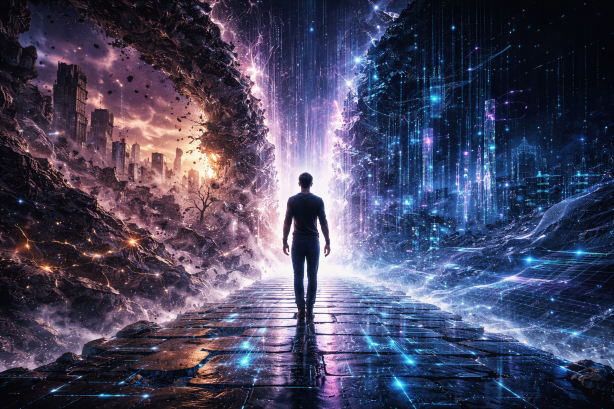
“The Archetype of the Threshold in the Digital Age — Signal Expansion”
(Edited and adapted by an analytical psychologist: 80%)
The modern human no longer lives within a stable world. He belongs neither to the past nor to the future. He exists in between — in a zone where forms dissolve faster than they can stabilize. This condition is not temporary. It has become the environment.
Therefore, the Archetype of the Threshold is no longer an episode of initiation. It has become — and will remain for a long time — a constant mode of existence.
1. Collapse of the Archetype of Home
In traditional cultures, the psyche had a foundation:
Home — not as a building, but as a structure of meaning.
In essence, it included and referenced:
belonging to a lineage
a religious worldview
stable roles
a hierarchy of time (past → present → future)
a sacred place of transmission of experience and generational continuity
A person knew where they were. A person could calibrate their inner and outer compass to find their home.
Today, in dreams, the home is often
destroyed
replaced
alien
or entirely absent
Dreams increasingly feature:
wandering
apocalypse
being on other planets
other worlds
encounters with non-human forms
contact with the non-human energies
The digital era has destroyed this structure. And it will continue to erode what remains of the archetype of Home.
This follows from and is confirmed by the fact that:
identity changes faster than it forms
information replaces experience
belonging becomes temporary
“home” turns into an interface (a temporary dwelling, not truly one’s own, no longer stably localized in external reality)
global migration expands, cultures mix
nations and distinctions are devalued
rapid digital unification imposes standardized values and artificial meanings
national sovereignty is gradually replaced by supranational, mega-corporate structures, “shadow governments”
a geopolitical struggle unfolds between old global gerontocracy and rising technocracy
the middle class is being systematically destroyed
a trajectory toward digital servitude is emerging
The human is no longer rooted. He is connected:
to the internet and digital environments
to shifting information flows
to unstable social status (dispossession, migration, loss of assets, threat of digital confinement, erasure of individuality, ecological destruction)
to hidden signals and geopolitical transformations not consciously perceived by the majority
to constant fluctuations in knowledge about matter, spirit, and reality
2. The Threshold as a Permanent State
Previously, the Threshold was a transition:
initiation → crisis → transformation → new form
Nowadays, transformation often does not occur.
The human:
exists between multiple versions of self (digital gaming culture, virtual relationships, virtual sex, double lives, double messaging, everyday fragmentation)
between false roles
between worlds (real / digital / imagined)
He does not enter a new state. He suspends between states. This is the chronic Threshold.
Moreover, when one reflects deeply on this condition, it reveals itself as permanent transition — a continuous flow without direction, because:
the horizon is unclear
orientation is lost
the compass fails
3. Symptoms of Life on the Threshold
The psyche responds precisely.
🔹 Chronic anxiety without object
There is no clear external enemy — or one is artificially constructed through manipulation.
There is a constant sense of instability.
This is anxiety not about something, but about the absence of ground.
🔹 The feeling “I am nowhere”
A person may be everywhere — but feels nowhere.
He is:
online
in the city
in relationships
but not within himself.
🔹 The impulse to escape
The psyche attempts two strategies:
1. Backward
nostalgia
traditionalism, search for the “old order”
2. Forward
acceleration
digital dissolution
rejection of depth in favor of flow
Both are forms of avoidance of the Threshold.
4. Danger
If a person cannot withstand the Threshold:
he regresses (into the past)
or disintegrates (into flow)
or inflates (constructs a false identity)
In all cases, he loses the center.
5. The Function of Christopher
Christopher is the archetype of one who can stand in transition without collapsing.
He does not return backward.
He does not escape forward.
He holds the burden of meaning within instability.
He:
does not search for Home
temporarily becomes Home
For himself.
And for another.
The function of Christopher is the most truthful and realistic position for modern psychologists, allowing them to avoid illusions of transformation and initiation in a world that is still only at the beginning of transition.
As for the timeline of transformation, there is hope that the new epoch itself will accelerate this process compared to previous eras.
Christopher is the archetype of the Guide, the Stalker — not claiming the position of the Father archetype.
The Father archetype is failing: no will, no meaning, no direction.
Even death as a threshold is ignored, postponed, denied.
(The relationship between the Father, Anubis, Christopher, and Sirius in the digital age will be explored in subsequent protocols).
6. The New Task of the Psyche
The task is no longer to:
find a final identity
stabilize
“become someone once and for all”
This model is obsolete.
The new task:
to endure uncertainty without losing integrity
7. The Practice of Living on the Threshold
This is not philosophy.
It is a skill.
🔹 Holding the inner center
Not external stability, but an internal axis.
(Sirius — as a cold point of orientation)
🔹 Contact with instinct
Not escape into rationalization, but return to body, rhythm, sensation.
Individuation as survival in chaos.
(Anubis — as guide through darkness)
🔹 The ability not to act immediately
The Threshold requires endurance. Not every impulse is action.
Sometimes it is a wave that must be lived through.
🔹 Acceptance of incompleteness
You do not have to “finish yourself.” You can remain in process.
Because the world itself is in process.
8. A New Form of Stability
Previously: stability = fixedness
Now: stability = the ability to move without disintegration
9. Signal Conclusion
The modern human is not lost.
He is where only initiates once stood.
But now this is not a ritual. It is everyday reality.
Therefore, the task is:
not to exit the Threshold,
not to dissolve within it,
not to fall into the illusion of having passed it,
but to learn to remain alive within it.
(2026)