The Phenomenology of the Age of Aquarius in the Context of the Problem of the “Twins”. Part 2.
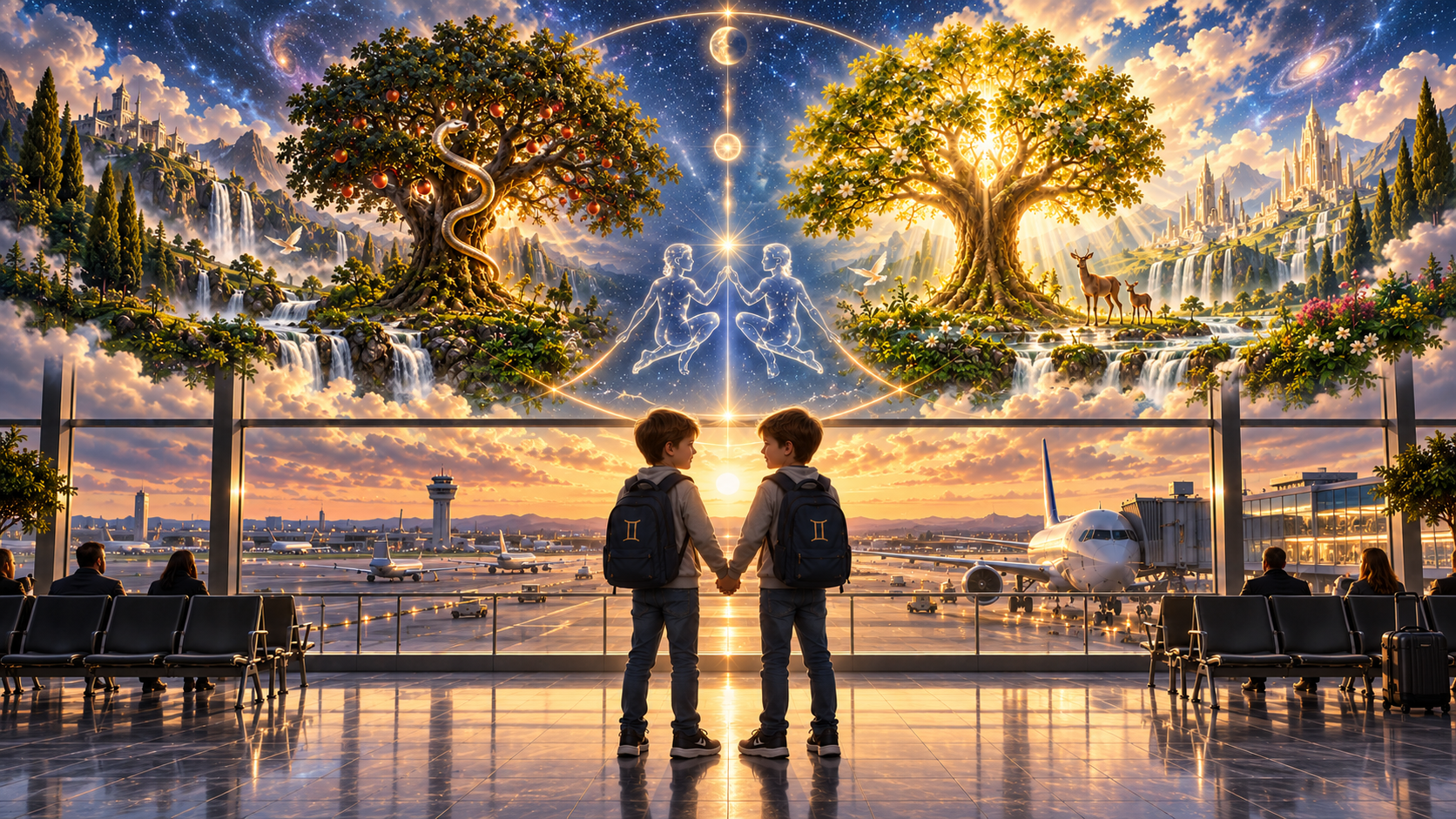
Part 2. The Mystery of the Twins: From a Stolen Smartphone to Artificial Intelligence and the Dream of Immortality
Sometimes a dream begins to unfold in a direction quite different from the one we initially attributed to it. One image attaches itself to another, then a recurring motif emerges — and gradually a private dream begins to speak not only about a personal situation, but also about the time in which we live.
In my case, this is what happened with two twin boys from a dream I had in the summer of 2026.
In the dream, I am at an airport. I have arrived on time. I have nothing in particular to do, and I am looking at my smartphone, perhaps exchanging messages with someone. I notice two boys, about seven or eight years old, nearby. At first I pay no attention to them, but then I begin to sense that they are plotting something.
The boys are twins. There is something strange about them: their movements and facial expressions are somehow synchronized. They are exact copies of one another, though they are dressed differently. And yet I understand how remarkably alike they are. I become distracted. Some time passes, and suddenly I realize that my phone is gone. Anxiously, I understand that these twin boys have most likely stolen it. I begin to panic slightly and try to find them. My anxiety grows: I am in an airport without my smartphone, and I have no idea how I will manage without it.
At the same time, I cannot stop thinking about the two boys. There is some mystery about them, as though what has happened is not accidental.
When I woke up, I kept thinking about these twins, about doubling, about the two Peaks, and about our time.
In the first part, I wrote about the smartphone as an object of the Self, about AI as a silicon sage, about the analytic session of the future, and about the role of the real experience of two living human beings.
Let us continue our investigation with the help of this pivotal dream.
When the Double Appears
The double almost always disturbs our habitual confidence in uniqueness.
If there is one person, it is clear who stands before us.
If another appears beside them, almost identical, the question arises:
Which one is real?
And then comes an even more disturbing question:
What does “real” actually mean if the copy looks exactly the same?
This is why the double both fascinates and unsettles us. It repeats the form, yet calls the uniqueness of the original into question. In the digital world, this motif is becoming almost ordinary. We create a second image of ourselves on social media.
A second face — in a photograph.
A second voice — in a recording.
A digital profile.
An avatar.
Data.
A history of searches and requests.
And now — an AI persona capable of speaking in our voice and imitating our manner of speech. More and more versions of us are appearing that are not quite us.
This is why the twin boys stealing the smartphone begin to look almost like a symbol of our time. Doubling steals the very device through which our own doubling has already taken place.
Two Peaks
From here, Twin Peaks arises almost naturally.
The title itself — two peaks — establishes the structure of doubling even before the story begins. And then the world of the series continually divides.
There is the familiar and the unfamiliar.
The everyday and the terrifying.
The person and their other face.
Ordinary reality and a space that seems to exist alongside it.
The original and the double.
And what is crucial is that these two realities do not remain isolated.
Passages open between them. The boundary becomes permeable.
This is precisely where doubling becomes dangerous. As long as there is only a reflection, it remains a reflection. But when two worlds begin exchanging figures, the question is no longer one of similarity, but of substitution.
Who has returned?
The same person?
Their double?
Something that has assumed human form?
For the digital age, this question sounds strikingly contemporary.
We have already learned to produce images of people who never existed; voices that a person never actually produced; texts that appear human; virtual interlocutors capable of imitating care, understanding, and sympathy.
And gradually the problem changes.
We no longer ask:
“Is this image real?”
Instead we ask:
“What exactly makes a presence authentic?”
From Two Boys to the Twins
Here a more ancient structure appears — the Twins. Twins are interesting not because they are two identical beings. On the contrary: in myth, twins are almost never entirely identical.
One is mortal — the other immortal.
One earthly — the other celestial.
One acts — the other accompanies.
They are alike, but a difference remains between them.
The twin structure therefore speaks not simply about the number two.
It speaks about the emergence of a relationship between two.
I — the other.
Original — copy.
Human being — image.
Body — sign.
Matter — information.
World — its digital representation.
And then duality ceases to be merely a defect of wholeness. It becomes a mechanism of culture. For a sign to exist, there must be two things:
that which is signified,
and that which signifies it.
For an image to exist, there must be:
an original
and an image.
For a message to exist:
a sender
and a receiver.
And between them — the space of connection.
Perhaps it is precisely this “between” that contains the deepest meaning of twin symbolism.
The Two Trees of the Garden of Eden
At this point, the line of thought unexpectedly leads us toward one of the oldest images of the Western tradition.
In Eden, there are two trees.
The Tree of the Knowledge of Good and Evil.
And the Tree of Life.
This pair formulates, with astonishing precision, two fundamental human desires:
to know and not to die. First, the human being receives knowledge.
Then the possibility of a second step appears: if humanity also eats from the Tree of Life, it may live forever. And the path to the second tree is closed.
If we look at this myth from the twenty-first century, it acquires an entirely new resonance.
We Have Built the Tree of Knowledge
Of course, artificial intelligence is not omniscient.
It makes mistakes.
It depends on human data.
It is not a god and possesses no proven wisdom.
But psychologically, something extraordinarily important is happening.
Human beings are creating a system to which almost any question can be addressed.
Medicine.
Physics.
History.
Genetics.
Chemistry.
Psychology.
The cosmos.
One’s own body.
An enormous amount of human knowledge begins to gather before an individual in the form of a single accessible intermediary.
Metaphorically, therefore, we might say:
humanity has begun to construct its own Tree of Knowledge.
Not in Paradise.
In data centres.
And naturally, very soon another question appears before this tree.
“Now Help Me Not to Die”
If a system can analyse the genome, model proteins, search for molecules, compare millions of possibilities, and assist in the development of medicines, the human request becomes almost inevitable:
Why do we age?
Then:
Can ageing be slowed down?
Then:
Can it be stopped?
And finally comes the question humanity has been asking for thousands of years:
Can we avoid death?
Here the ancient myth ceases to be merely a myth. Enormous resources are already being invested in research into longevity, cellular reprogramming, regenerative medicine, genetics, and computational biology.
We remain extraordinarily far from immortality. But something else has happened — something that is psychologically perhaps even more important:
immortality has been transformed from a religious dream into a technological problem.
Artificial intelligence finds itself between the two trees.
It does not become the Tree of Life, but rather a possible guide from one tree to the other. Knowledge must find a way to alter matter.
Information must intervene in the body.
The algorithm must help to extend biological life.
The Mortal Human and the Immortal Double
And here the circle unexpectedly closes. We find ourselves once again before the Twins. There is the human being. And there is the artificial intelligence created by the human being.
One grows old.
The other can be copied.
One exists for only a limited number of years.
The other is not bound to the biological lifespan of its creator.
One knows that it will die.
The other, as far as we can currently judge, has no human experience of death at all.
A new twin pair emerges:
the mortal human being and their potentially ageless digital double.
And the mortal one begins to ask the double:
“Help me become like you in at least one respect — help me continue.”
But what exactly is supposed to continue?
This is where the most difficult part begins.
What do we call immortality?
The continuation of the body?
Memory?
Personality?
Genetic material?
Consciousness?
A digital copy?
If, after a person’s death, a system can speak in their voice, know their biography, imitate their humour, and even respond as they might have responded — who will be standing before us?
The person?
Their continuation?
Their double?
Or an extraordinarily convincing machine preserving traces of them?
At this point, Twin Peaks, the twin boys, and the two trees unexpectedly become parts of the same story. Because the problem of immortality very quickly becomes the problem of the original and the double. A copy can be created. But can the one who experiences themselves be transferred into it?
And here the outlines of the ocean of Solaris, in Stanisław Lem’s novel, begin to appear.
They are so vast and so important that the next part will have to be devoted to them.
The Two Boys Return
And so I return once again to my dream. Two little twins steal the smartphone.
Now this image can be seen differently. It is as though they carry away with them the old certainty that there is only one human being and only one world. The smartphone was already the first external double.
AI becomes the next.
And beyond it emerges a far more serious question:
if we learn to create ever more sophisticated continuations of the human being, where does the boundary lie between continuation and replacement?
The boys in this dream therefore no longer seem to me merely like thieves.
They seem to open a door into the age of doubling.
Two boys.
Two peaks.
Two worlds.
Two trees.
And at the end of this line stands the contemporary human being before the Tree of Knowledge that humanity itself has created. We have already received an almost inexhaustible stream of answers. Now we look further — toward the place where, for thousands of years, the second tree has stood. And we ask the machine a question that may be one of the oldest questions of the human psyche:
“If you can learn almost everything — find me the road to the Tree of Life.”
But together with this, another question inevitably arises — a much more difficult one:
if that road one day truly opens, who exactly should walk it:
the human being or their double?
(summer 2026)