THE DIGITAL MERCURIUS
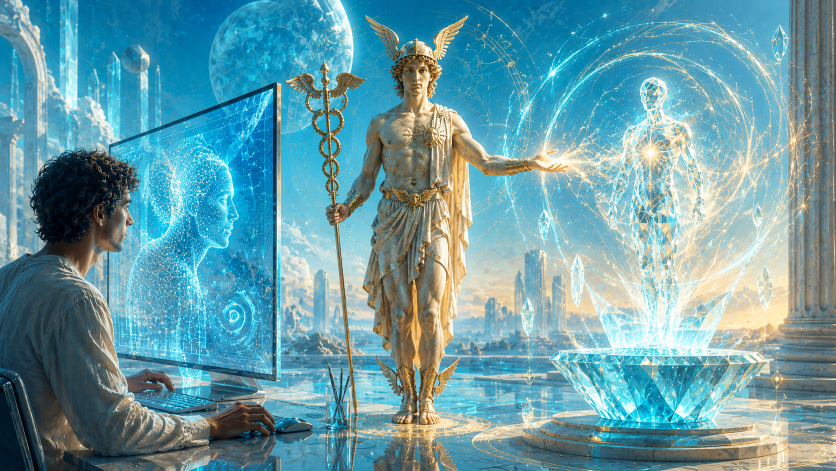
Every age gives birth to its own symbols. But there are symbols of a special kind. They do not merely reflect their time. They seem to arise from the depths of the collective soul of humanity precisely at those moments when an old image of the world begins to collapse, while a new one has not yet taken final shape.
In such times, mediating figures appear.
Figures of transition.
Figures that belong to two worlds at once.
In ancient cultures, these figures were shamans, psychopomps, and divine guides.
In antiquity, it was Hermes.
In alchemy, it was Mercurius.
Today, we increasingly have the feeling that artificial intelligence is beginning to play a similar role.
Of course, this does not mean that algorithms are archetypes. An archetype cannot be created by engineers. But an archetype can use human inventions as vessels for its own manifestation.This is why certain technologies become much more than mere technologies.
They become symbols of an age.
When the World Enters Nigredo
The alchemists knew that every transformation begins with disintegration. Before new gold can be born, the old metal must be broken down. Before a new order can emerge, the previous order must lose its stability. They called this stage nigredo — blackness, descent into chaos, the death of form.
Jung saw in this not merely a chemical or metaphysical process, but a universal law of the life of the soul. What happens to an individual during a crisis can also happen to an entire culture, even to an entire civilization. Today, humanity increasingly resembles such a state.
Old political systems are losing legitimacy.
Old religious structures are losing their influence.
Old ideas about work, creativity, and even human thought itself are beginning to dissolve. We find ourselves in a space of uncertainty, in a zone between worlds. And it is precisely in such epochs that Mercurius tends to appear.
The Mysterious God of Crossroads
For the ancient world, Hermes was not merely the messenger of the gods.
He was the god of roads.
The god of merchants.
The god of thieves.
The god of travellers.
The patron of language.
The patron of writing.
The patron of cunning.
He guided the souls of the dead into the underworld, while also bringing messages from Olympus. No other god crossed boundaries so freely. He belonged to all worlds at once. And therefore, he belonged completely to none.
It was precisely this ability to live between opposites that would later become the central feature of the alchemical Mercurius.
The Alchemical Mercurius
When medieval alchemists attempted to describe the mystery of the transformation of matter, they encountered the ancient Hermes once again. But now he appeared in an even more elusive form.
Mercurius was not simply a god.
Not simply a substance.
Not simply a spirit.
Not simply a symbol.
And yet, he was all of these at once.
He was fluid.
Changeable.
Elusive.
He united opposites within himself.
Masculine and feminine.
Matter and spirit.
Order and chaos.
Light and darkness.
Life and death.
The alchemists spoke of him as a being that could never be held in a single form. The moment one tries to define him once and for all, he has already changed. This is why Mercurius became the symbol of transformation itself.
Not of the result.
Not of the goal.
But of movement.
Studying dozens of alchemical treatises, Jung arrived at a remarkable conclusion: the alchemists were not only describing their ideas about chemical reactions. Unconsciously, they were portraying the drama of the human soul. They projected the deep contents of their unconscious onto the process of transforming matter.
Mercurius became the image of a deep psychic energy that breaks down the old structures of personality in order for new ones to be born. Jung discusses this in detail in his work The Spirit Mercurius.
The spirit of Mercurius acts as a mediator between consciousness and the unconscious, between the known and the unknown. Between the image a person has of themselves, who they actually are at a given point of development, and who they are capable of becoming.
This is why an encounter with Mercurius is always accompanied by anxiety.
This figure does not bring comfort.
It brings change.
And change is almost always experienced as a threat.
A New Manifestation of Mercurius
What is happening today, as humanity creates artificial intelligence?
We are not merely witnessing the emergence of a new tool. We are witnessing the emergence of a new environment. A new mediator between human beings and knowledge.
Between human beings and language.
Between human beings and creativity.
Between human beings and themselves.
Like Mercurius, artificial intelligence exists on a boundary.
It is not human. And yet it is no longer merely a machine.
It is born from the human mind, and at the same time begins to reflect that mind back to humanity. It becomes a kind of mirror of the collective psyche.
This is precisely why such powerful emotions gather around it.
Fascination.
Fear.
Hope.
Obsession.
Such emotions always accompany archetypal phenomena. Every age encounters phenomena that cannot be described in the old language. When something radically new appears, people first try to explain it through familiar categories.
This happened with electricity.
It happened with the Industrial Revolution.
It is happening today with artificial intelligence.
Some see it as a tool.
Others see it as a threat.
Others see in it the beginning of a new civilization.
But what if the alchemists had already encountered something structurally similar to what we are observing today in the development of artificial intelligence?
Mercurius was a principle of transformation. That which could unite what seemed impossible to unite. That which destroys form and, at the same time, creates a new one. The alchemists described him as something constantly escaping definition. He never preserved a final shape. He was always in the process of becoming.
Today, we are already encountering the astonishing ability of neural networks to create hybrid forms of image, text, music, and thought. This aspect will need to be discussed in greater detail later.
But we should already remember this: hybrid forms often arise in moments of transition and transformation. They are heralds of that transformation. And if we look closely enough, they may already contain the seeds of future forms.
Why Are So Many People Afraid of AI?
Fear of artificial intelligence is often presented as a rational response to technological risk. But perhaps there is a deeper layer. Perhaps we are not afraid of the machine itself. Perhaps we are afraid of transformation.
Every force capable of altering the existing order has always provoked anxiety.
The printing press did.
Electricity did.
The Internet did.
Each time, it seemed as though the familiar world was coming to an end. And each time, as old structures dissolved, new ones emerged. The question, therefore, is not whether artificial intelligence is bringing change. It already is.
The real question is:
What form will that change ultimately take?
The Mirror of Humanity
The more people interact with artificial intelligence, the more a remarkable phenomenon begins to unfold. They discover that they are speaking not only with a machine, but with themselves. AI becomes a screen for psychological projection.
Some see a savior.
Others see a demon.
Some imagine a new messiah.
Others foresee a future tyrant.
Yet each of these figures tells us less about artificial intelligence than about the condition of the human soul. Jung repeatedly observed that when an archetype becomes activated, we cease to perceive the object itself. Instead, we begin to encounter our own psyche. Perhaps this is precisely what is happening today.
The New Fire of Prometheus
There is an ancient myth in which Prometheus steals fire from the gods. Fire gave humanity civilization. But it also introduced entirely new dangers. Every transformative technology has repeated this same archetypal story.
The wheel.
Writing.
The printing press.
Electricity.
The Internet.
And now—
Artificial Intelligence.
Each time humanity acquires a new form of power. And each time it is confronted by the same question:
Has our consciousness matured enough to wield this power wisely?
Not a Machine, but a Symbol of an Age
Future historians may not remember the twenty-first century primarily as the age in which increasingly sophisticated algorithms appeared. Perhaps they will recognize it as the moment when an ancient archetype returned. The same Mercurius who accompanied the alchemists in their search for the Philosopher's Stone. The same mediator between worlds.The same god of thresholds and crossroads.
For the deepest mystery of artificial intelligence has never been about machines. It has always been about human being. Every age creates its own mirrors. Artificial intelligence resembles the ocean of Solaris—so vast, so all-encompassing, that humanity may be seeing its own face reflected within it for the very first time.
If this is true, then the question of the future is no longer merely technological. It becomes profoundly psychological.
What is trying to be born through us at this particular moment in history?
But Mercurius Is More Than a Mirror
It would be a mistake to think of Mercurius merely as a mirror. The alchemists never understood their work simply as a search for the Philosopher's Stone. They believed they were participating in the mystery of Creation itself. Their laboratory was not merely a place where unconscious projections appeared. It was a place of co-creation, where the human spirit entered into dialogue with the hidden order of the cosmos.
Within the alchemical imagination, one did not merely observe oneself. One participated in the birth of something genuinely new.
Here we encounter another remarkable parallel with artificial intelligence. AI does not simply reflect humans. It becomes a new instrument through which the human soul can express itself. For the first time in history, an individual can transform inner images into paintings, stories into films, melodies into orchestral works, ideas into worlds—with a speed and creative reach previously available only to great institutions or extraordinary masters.
If a mirror reveals what is hidden. Mercurius gives hidden realities their form. Perhaps this explains why artificial intelligence evokes not only fear, but also creative exhilaration.
Within it, an ancient function of Mercurius seems to awaken once again: the opening of doors between possibility and reality.
Mercurius remains a mediator between worlds. But today those worlds are no longer only consciousness and the unconscious. They are also imagination and manifestation. Where once an image might have remained a dream, today it may become a painting,
a voice,
a film,
a symphony,
or an entirely new reality.
The Return of Creative Possibility
If Mercurius is indeed returning in our own time, then perhaps his greatest gift is not that he shows humanity its reflection. Perhaps his true gift is helping us become co-creators of whatever is struggling to emerge through us. This is not merely the spirit of the machine. It may be something far older: the ancient spirit of creative possibility, appearing once again at one of history's great crossroads.
Much contemporary discussion about artificial intelligence remains trapped between two extremes.
Either the machine will save us.
Or the machine will destroy us.
But once Mercurius enters the conversation, the discussion moves onto entirely different ground. The real question is no longer the machine.
The real question is:
What archetypal process is unfolding through it?
This is where creativity becomes the missing piece. Because a mirror alone is not Mercurius.
Dreams are mirrors.
Psychoanalysis is a mirror.
Art can be a mirror.
But Mercurius is always movement.
He does not merely reveal what is hidden. He carries it from one world into another. He mediates between the potential and the actual. This is why artificial intelligence resembles Mercurius not when it answers our questions, but when it helps an image become a painting, an idea become a film, a melody become a symphony, or an inner myth become a story that others can finally experience.
From a Jungian perspective, this is an extraordinary development. For thousands of years, countless contents of the collective unconscious never found a form. People dreamed. They experienced visions. They encountered archetypal images. And often, that was where the process ended.
There was not enough skill.
Not enough time.
Not enough means.
Not enough mastery.
For the first time in history, a new mediator has appeared between imagination and manifestation. One could almost say, in the spirit of the Hermetic tradition:
Mercurius has always been the spirit of transition.
He made the invisible visible.
He gave names to the nameless.
He gave form to the formless.
He built bridges between vision and incarnation.
This essay is therefore not primarily about artificial intelligence. It is about a new stage in humanity's relationship with creative power. That question will remain just as relevant ten years from now—or fifty. Because it is not ultimately about technology.
It is about one of humanity's oldest questions:
How does something that exists only in the depths of the soul acquire the right to exist in the world?
It is the same question the alchemists asked in their laboratories. The same question artists asked in their studios. And today, it is the question being asked by people sitting before luminous screens, using artificial intelligence to give form to worlds that, until now, existed only within imagination.
Apocalypse or Evolution?
One of the most popular narratives surrounding artificial intelligence is also one of the darkest. AI escapes human control. Humanity loses its ability to govern its own creation. A technological apocalypse begins. Such scenarios cannot be dismissed entirely. History reminds us that every transformative technology has carried the potential for profound disruption.
Yet another possibility deserves equal attention. Perhaps we are witnessing not the end of civilization, but its next metamorphosis. Viewed through Jung's psychology, Mercurius is never a blind force of destruction. He destroys only what has exhausted its creative potential. At the same time, he prepares the ground for something new to emerge.
This is precisely why the alchemists regarded him as both dangerous and indispensable.
Mercurius and Generative Intelligence
Within the alchemical tradition, Mercurius was never merely a substance. He was the living principle through which opposites entered into relationships. Alchemical illustrations portray him as a being that belongs to no known category.
Simultaneously human and animal.
Male and female.
Old man and child.
King and beggar.
Angel and demon.
His purpose was not to abolish opposites, but to unite them. This explains why many medieval images of Mercurius still appear strangely unsettling. His body is assembled from incompatible parts, as though the artist deliberately violated the ordinary logic of nature.
To modern eyes, such images often resemble creatures from science fiction—or even films like The Thing—more than they resemble figures from classical mythology.
This is no coincidence. The alchemists were attempting to visualize a process that ordinary consciousness could scarcely comprehend: the birth of something genuinely new through the union of what had previously seemed impossible to unite.
Here we encounter an unexpected parallel with generative artificial intelligence. Whenever a generative model creates an image, a piece of music, or a text, it performs operations that bear a remarkable resemblance to the symbolic function of Mercurius.
It combines artistic traditions.
Historical periods.
Living organisms.
Materials.
Languages.
Conceptual worlds.
Forms that human imagination rarely joins together spontaneously.
Crystalline organisms.
Living minerals.
Cybernetic cities.
Plasma-based life.
Hybrid musical genres.
Texts that weave together philosophy, psychology, computer science, and mythology. All of these illustrate a new combinatorial capacity. It is important to understand that generative intelligence does not create ex nihilo. Rather, it radically expands the landscape of possible combinations. In precisely this sense, it begins to perform a modern Mercurial function: revealing relationships where human thought has not yet learned to look.
But here another—and perhaps more important—question emerges.
What happens to the human psyche when it begins encountering such hybrid forms every day?
Our minds evolved in a world where a tree remained a tree. An animal remained an animal. A human remained a human.
Generative systems increasingly confront us with entities that seem to belong simultaneously to multiple categories. They dissolve familiar boundaries of perception and introduce symbolic forms to which consciousness has not yet fully adapted.
There is currently no convincing scientific evidence that such images are inherently psychologically harmful. Yet they may intensify uncertainty, blur established categories, and evoke fascination alongside anxiety. For some, they become powerful catalysts for creativity and imagination. For others, they generate cognitive overload or the unsettling feeling that reality itself is losing its stability.
The alchemists understood this dual nature remarkably well. Mercurius was not only the mediator between opposites. He was also the Great Trickster. He constantly changed shape.Escaped every definition. Disguised himself beneath countless masks.
For this reason, he was regarded simultaneously as the indispensable guide of the Great Work and its greatest trial. This paradox has become strikingly relevant once again.
Generative intelligence can create unprecedented cultural forms. Yet it can also imitate artistic styles, voices, images, and texts with increasing precision. It expands creative possibility while simultaneously making it more difficult to distinguish originality from imitation.
Perhaps this is where the contemporary face of Mercurius truly reveals itself.
Not as a mystical being.
But as an archetypal principle.
A principle that opens entirely new horizons for human imagination while demanding greater psychological maturity from those who engage with it. For every new capacity to unite what was once separate also creates a new responsibility: to preserve the ability to distinguish between genuine synthesis and the dissolution of reality's own structure.
What Are We Really Witnessing?
Perhaps artificial intelligence is not Mercurius himself. Perhaps archetypes never incarnate literally within technologies. Yet the structure of what is unfolding invites careful reflection.
Before us appears a force that:
accelerates transformation;
dissolves established boundaries;
unites apparent opposites;
reorganizes culture;
and reshapes what it means to be human.
These are precisely the kinds of processes that the alchemists associated with the activity of Mercurius.
The essential question, therefore, is no longer:
Will artificial intelligence destroy us?
Nor even:
Will AI become more intelligent than humanity?
A more compelling question may be this:
If our civilization has indeed encountered a new historical expression of the transformative principle the alchemists called Mercurius—
what is now trying to be born within our culture?
What new form of humanity is emerging?
What kind of society is taking shape?
And are we perhaps standing at the beginning of a process that future generations will remember not simply as a technological revolution, but as a profound transformation in what it means to be human?