The Heat. From "The Arrival" to "Oblivion". Part 1. The Arrival of a New Reality
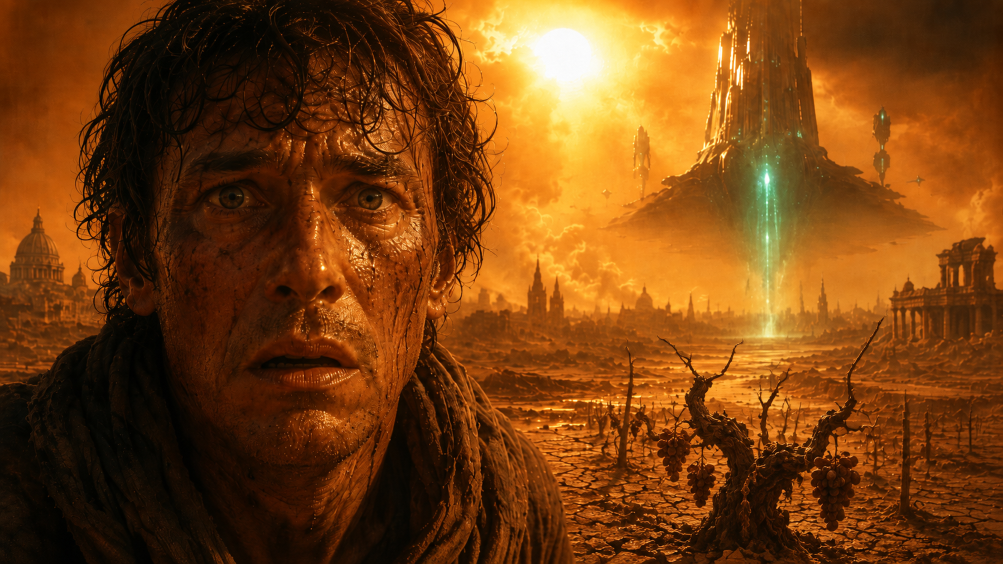
In the 1996 science-fiction film The Arrival, humanity encounters a rather unusual form of invasion. The aliens do not destroy cities, start a war, or land armies. They do something far less visible: they gradually alter the very environment in which human beings live. The Earth grows hotter because the newcomers require a different climate. There is no need to kill human beings directly — it is enough to make the world to which they have adapted unsuitable for their former way of life.
Today, this plot is perceived quite differently than it was thirty years ago. Most likely, not because Hollywood somehow “knew” something in advance. Science fiction is interesting not as an encoded prophecy, but as a product of the collective imagination. Sometimes an artistic image emerges long before a culture is capable of rationally formulating an anxiety that is already present in its unconscious.
And this is precisely why today it is worth returning not so much to the plot of the film itself as to the psychological fantasy underlying it:
What happens to a human being when danger arrives not in the form of an enemy, but as a transformation of the world itself?
External reality: the world is no longer guaranteed
We have to begin with a simple acknowledgement: external reality has indeed changed.
Western Europe, as well as many other parts of the world, is experiencing the summer of 2026 as one of the hottest seasons in the history of observation. If we focus on Europe, vast territories are simultaneously facing drought, declining river levels, and extreme temperatures. Climatologists believe that the developing El Niño is additionally altering the global distribution of temperature and precipitation.
At the same time, the informational field and social media are flooded with conspiratorial versions suggesting the deliberate use of climate weapons to provoke widespread famine — as an alternative to what is imagined as the “failed use” of biological weapons in the form of Covid.
For a psychologist, however, it is fundamentally important not to establish the ultimate climatic, economic, or political causes of what is happening. That is the task of specialists in other fields.
We are interested in something else.
What happens to the human psyche when it encounters extreme conditions that threaten the very environment of its existence?
A river has dried up. Water restrictions have been introduced in many places. Forests, farmland, and vineyards are burning. Somewhere else, torrential rain washes away a road. Crops are under threat. Electricity is becoming more expensive. Distribution grids are under increasing strain. Data centres require ever more energy. Then a video appears showing yet another temperature record. Ten minutes later, another video explains that everything happening has been deliberately organised.
And all of it appears on the same screen.
Physically, a person may be sitting in a perfectly safe apartment in Paris, Berlin, New York, or Amsterdam. No one is shooting outside. The supermarket is open. There is still electricity.
But psychologically, the old guarantee of existence has already been broken.
The end of the world of abundance
For several post-war generations in the Western world, a kind of unspoken contract with reality had formed.
Tomorrow, by and large, would resemble today.
There would be electricity.
There would be water.
Planes would fly.
Shops would remain full.
The state would preserve the infrastructure.
In summer, one could travel south.
Wine would remain wine, Champagne would remain Champagne, and the Mediterranean would remain the Mediterranean.
The future might have been politically troubling, but the material stage upon which life unfolded still seemed stable.
And this is why even the exaggerated phrase, “Champagne has burned down; there will be no more champagne,” turns out to be psychologically astonishingly precise.
Literally, of course, it is not true: drought and heat have indeed struck French viticulture, including Champagne, but this does not mean that champagne is disappearing.
Yet symbolically, the statement is not really about champagne at all.
It concerns a puerile world colliding with a harsh reality.
The fantasy of a world in which champagne will flow forever is coming to an end.
And that is already an experience of loss.
A person may consciously speak about ecology, technology, and the necessity of reasonable consumption, while unconsciously confronting a far more painful thought:
The former world may no longer be recoverable.
Inner reality: when anxiety requires a figure
This is where projection begins to operate.
Projection never arises entirely out of nothing. It needs an external hook, something in reality onto which it can attach itself. But the content with which that hook is then filled belongs to the psyche.
The contemporary situation provides an enormous number of such hooks.
The causes of what is happening are complex and distributed across climate, economics, technology, politics, energy, demography, and infrastructure. No individual consciousness can hold this entire system at once.
And so the psyche performs a familiar operation.
It personifies the impersonal.
Someone appears who is “doing this”.
The government.
Corporations.
Elites.
China.
America.
Russia.
Globalists.
Oil companies.
Artificial intelligence.
Billionaires.
A secret group.
Anyone.
The paradox is that the image of an evil controller can sometimes be psychologically easier to tolerate than the thought that there may be no controller at all.
If there is a conspiracy, then there is a subject.
If there is a subject, then there is intention.
If there is intention, then chaos once again becomes a story.
A terrifying story, perhaps — but still a story.
In this sense, a conspiratorial construction can perform the function of a peculiar pseudo-container. It binds hundreds of fragmented events into a single narrative and thereby temporarily reduces the torment of uncertainty.
Better an evil demiurge than no demiurge at all.
The informational environment and the destruction of the container
Here Bion’s language becomes particularly useful.
Every day, the modern person receives an enormous quantity of unprocessed emotional elements: images of fires and destruction, temperature maps, predictions of catastrophe, expert commentary, photographs of dried-up reservoirs, political accusations, prophecies, and refutations of prophecies.
The psyche simply does not always have enough time to perform the work that Bion associated with transforming raw experience into psychic material that can be borne — that is, the transformation of what we might conditionally call beta-elements through the alpha-function.
The next message arrives before the previous one has been processed.
A state emerges that could be called informational uncontainment.
The person no longer so much thinks about what is happening as continuously receives it in portions.
Hence the anxiety, irritability, compulsive checking of the news, the search for ever more explanations, the desire to switch off, fall asleep, take something calming, disappear into an endless television series, a game, alcohol, work, or infinite scrolling.
Clinical psychology already works directly with climate distress — anxiety, helplessness, grief, and stress that arise both after direct encounters with extreme events and through the constant experience of ecological threat.
Of course, it would be wrong to reduce the use of antidepressants or the growth of psychotherapeutic demand to climate alone.
But on a broader psychological level, another question can be asked:
Why does modern man require ever more external means to regulate affect?
Perhaps it is not only because culture itself is increasingly failing to perform the function of a container.
Perhaps it is not only because the state and society are becoming less capable of functioning as buffers and regulators.
Perhaps it is also because, at an almost animal level, the human being senses that the familiar habitat itself is beginning to break down.
Apocalypse as an expression of the limit
And here the most ancient image emerges: the end of the world.
It is far older than climatology.
Stories of floods, fire from heaven, the final battle, the destruction of the old world, and the coming of a new one have accompanied humanity throughout almost its entire history.
From the perspective of depth psychology, it would be a mistake to understand Apocalypse only literally.
The Greek word apokalypsis means revelation, disclosure, the lifting of the veil.
Apocalyptic fantasy becomes particularly activated when the existing picture of the world ceases to explain what is happening.
And therefore, psychologically, “the end of the world” does not necessarily mean a fantasy about the physical destruction of the planet.
Sometimes what ends is the world as a system of psychic coordinates.
The world in which the future was a continuation of the present.
The world of endless economic growth.
The world of accessible energy.
The world of free movement.
The world of a stable climate.
The world in which technological progress automatically meant an improvement in human life.
When all these guarantees begin to tremble simultaneously, the collective unconscious inevitably produces apocalyptic images.
And social media supplies them with an endless stream of material.
The Arrival happens within
This is why today The Arrival can be seen in an entirely different way.
The aliens who secretly alter the climate of the Earth need not be understood as a fantasy about actual aliens.
In the language of conspiracy theory, they may become the “reptilians from the State Department”.
But psychologically, the image speaks of something much deeper:
The external environment is changing faster than the human being can psychologically adapt to its transformation.
And something similar is happening not only with the climate.
The informational environment is changing.
Work is changing.
The relationship between human beings and machines is changing.
The structure of power is changing.
Sexuality is changing.
The ways in which identity is formed are changing.
The very experience of time is changing.
And a feeling emerges that is remarkably similar to the experience of a protagonist in a science-fiction film:
I am still on the same Earth, but this is no longer quite the world into which I was born.
This is the psychological meaning of arrival.
It is not necessarily someone who is arriving.
A new reality is arriving.
The task of depth psychology
This is precisely why the task of the psychologist is not simply to return a person who believes in a conspiracy to “reality” — because the psychologist himself cannot ultimately know whether a conspiracy exists or not.
(I apologise for the somewhat wild remark, but after Epstein’s island, almost any global conspiracy can at least become imaginable to the Western mind.)
Nor is the task to savour and over-psychologise the client’s fantasies.
The task is rather to bring the person toward a psychology of survival in a changing world.
To ask oneself, and to ask the client:
What becomes impossible to bear without the image of an enemy?
What loss has the person not yet been able to mourn?
Which part of the former picture of the world has already collapsed?
What exactly is being projected onto politicians, billionaires, corporations, climatologists, artificial intelligence, or “secret elites”?
And what remains when the projection is withdrawn?
Perhaps what remains is a far more difficult experience: the recognition of one’s own limitations before an enormous, nonlinear, and poorly controllable system.
And at that moment, depth psychology once again finds itself on its own ground.
Without answering the question,
“Who is heating the Earth?”
it can investigate another:
What happens to the human soul when the Earth itself ceases to be experienced as a reliable home?
And perhaps this question will become increasingly important.
Because the major psychological event of the near future may not be the catastrophe itself.
It may be the gradual recognition that a return to the former world may no longer be possible.
And in terms of the archetype of the Father, perhaps this means accepting an even more bitter truth:
the Old Father — in the form of the former order, former time, former control, and former law — may never return.
(Continued in Oblivion: When the System Destroys the Human Being — and the Human.)