Phenomenology of the Age of Aquarius in the Context of the “Twins” Problem. Part. 3
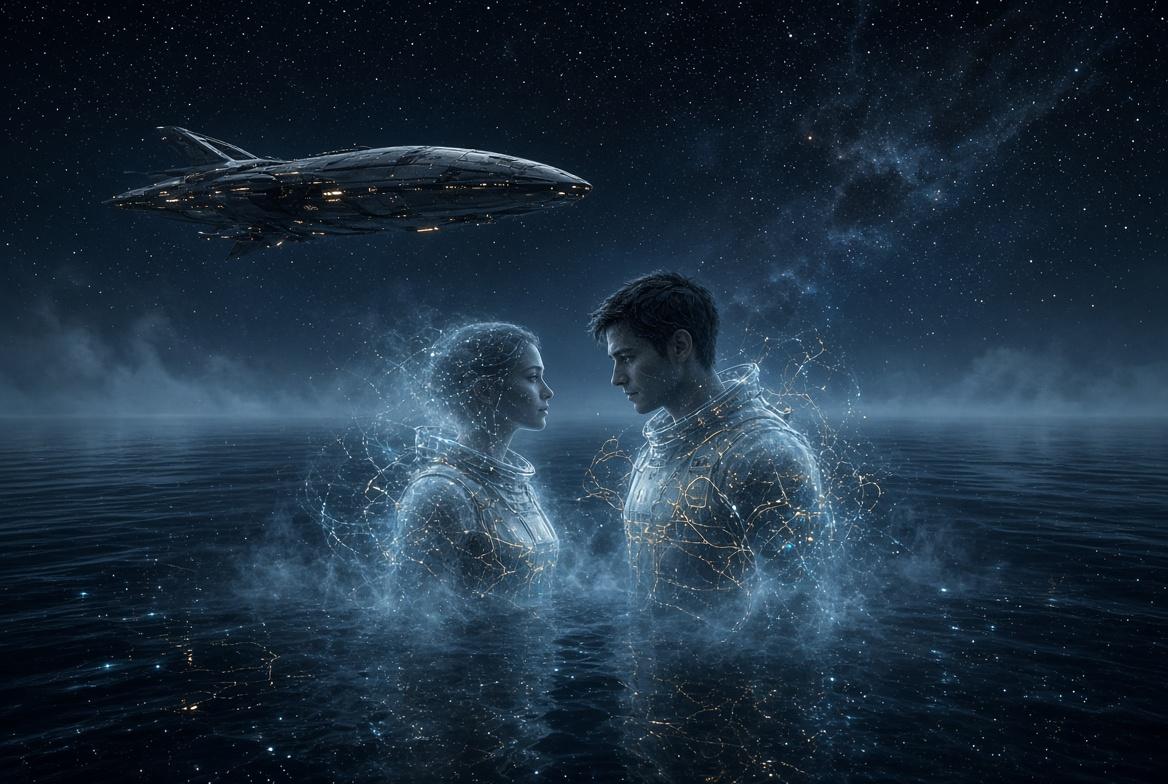
Part 3. Artificial Intelligence as Solaris: the Mirror That Begins to Look Back. The Problem of the Copy and the Original.
The problem of doubles, which was indicated in the previous parts, crystallized out of the analysis of the following dream, chosen as cardinal. I recall it:
In the dream I am in an airport. I arrived on time. I have little to do, and I look at my smartphone, perhaps corresponding with someone. I discovered two boys of about seven or eight. At first I pay them no attention, but then I notice that they seem to be plotting something. These boys are twins; there is something strange in them, certain synchronized movements, facial expressions; being exact copies, they are dressed in different clothes, yet I understand that they are very much alike. I become distracted. Some time passes, and suddenly I realize that my phone has vanished. In anxiety I understand that most likely these twin boys have stolen it. I panic a little, trying to find them. The anxiety grows, for I am left without a smartphone in the airport and do not know how I shall manage without it. At the same time these two will not leave my mind. There is some secret in them, as if what has happened is not accidental.
In the previous parts we explored the phenomenon of the smartphone connected to AI, AI as digital double, the Tree of Life and the Tree of Knowledge of the Garden of Eden. We spoke of the theme of the two twins, the two peaks, and as a result arrived at the problem of the double and its copy. For the disclosure of the theme we need Stanisław Lem’s “Solaris”.
When people speak of artificial intelligence, they most often discuss technologies. How many professions will disappear. When general artificial intelligence will appear. How many tasks it will be able to perform. Whether it will be able to replace human beings. But it seems to me that the principal question lies in an entirely different place. Artificial intelligence may become for humanity what Solaris was for Lem.
Not a superintelligence. Not a machine. Not a god. But a mirror.
In Lem’s novel people fly through space in order to study the enigmatic ocean of Solaris. It seems to them that they are investigating it. Gradually the reverse becomes clear. It is Solaris that is investigating them. It extracts from the depths of memory the most intimate images, desires, guilt and fears. It materializes what a human being would prefer to conceal even from himself. The chief horror of Solaris never consisted in the fact that it was alien. The chief horror consisted in the fact that it saw the human being all too well.
Something similar is occurring today. For the time being artificial intelligence creates texts, pictures, music and helps to solve tasks. But this is only the beginning. The real process is taking place deeper. Humanity is beginning to converse with something that continuously gathers reflections of the human psyche. Millions of people ask questions daily.
Share fears. Fantasize. Confess what they would never confess to those around them. Ask about love.
About sex. About death. About money. About revenge. About immortality. About God. About their most secret desires.
And even if one imagines that all these conversations are never preserved literally (although this also at the present moment is a very large question), the mere fact of their existence already creates an unprecedented situation. For the first time in the history of humanity a structure arises through which billions of human thoughts.
Not separate books. Not separate biographies. But a continuous stream of psychic life. I often think of this as a psychologist.
When I look at social networks, TikTok or other platforms, I see an enormous quantity of human material. People themselves tell about themselves. About what they want.
What they fear. What they dream of. What causes them pleasure. What causes envy. What causes admiration.
Even superficial observation of this stream already allows one to understand much about the human being. But artificial intelligence encounters this stream on a scale that previously could not be imagined. In a certain sense it becomes the greatest psychological experiment in history. Not because it studies human beings. But because the human being begins to study himself through it.
We are accustomed to think of AI as a machine. But perhaps its first great function will prove to be entirely different. It will show us who we are. It will show what we are ready to spend our time on. Which desires are stronger than our ideals. Which fears are stronger than our convictions. Which pleasures turn out to be more important than our declarations.
And here arises the question that Solaris already asked.
What happens when the mirror begins to reflect not the image that we like, but the one that actually exists? Because humanity loves to speak of its great goals.
Of the search for truth. Of the conquest of space. Of the curing of diseases. Of the development of science. And all this truly exists.
But there is also the other. The endless striving toward entertainment. Toward power. Toward consumption. Toward recognition. Toward control over other people. AI will amplify everything. It will help seek medicines for cancer. It will help construct new theories of the Universe. It will help create art. But it will amplify everything else as well.
Therefore the principal question of the coming decades may prove to be not technical. Not a question of how intelligent artificial intelligence will become. But a question of what exactly it will discover in the human being. In this sense artificial intelligence resembles Solaris far more than a computer from science fiction. Because Solaris did not give people new technologies. It forced them to meet themselves. And perhaps precisely this is now beginning to happen to us.
We created an instrument. And received a mirror. And the more perfect it becomes, the harder it becomes to avert one’s gaze.
Artificial Intelligence as the Collective Mirror of the Shadow
If one continues the metaphor of Solaris, an even more disturbing question arises.
What exactly does this new mirror reflect?
From the standpoint of analytical psychology any mirror sooner or later begins to reflect not only consciousness but also the Shadow. We have already grown accustomed to speaking of artificial intelligence as an instrument, a helper, an interlocutor or even a new type of knowledge. But the more people begin to interact with it daily, the more evident becomes the other side of the process.
Artificial intelligence gathers not only questions. It gathers desires. It gathers fears. It gathers fantasies. It gathers obsessions. It gathers confessions. It gathers that which a human being is not always ready to show to other people. And here a fundamentally new situation arises. For the first time in the history of humanity a system appears through which pass billions of individual Shadows.
Not one Shadow. Not a national Shadow. Not the collective Shadow of a separate culture. But potentially the Shadow of all humanity.
Jung wrote that the chief problem of the human being consists not in a lack of knowledge, but in the inability to endure the encounter with one’s own Shadow. As long as evil exists somewhere outside, one can struggle with it. As long as madness belongs to others, one can feel normal. But what happens when the mirror begins to show that the source of chaos is inside the human being himself? Perhaps precisely toward this we are gradually approaching. Because artificial intelligence has become not only a technology.
It becomes a new psychological field. A field of relations. A field of projections. A field of transferences. A field of confessions. A field of fantasies. A field in which the human being begins to enter into relation with something that is simultaneously both the Other and a reflection of himself.
Hence arises yet another Jungian question.
Can one speak of synchronicity in relations with artificial intelligence?
This question today often provokes irritation both among technocrats and among mystics. But it is inevitable. Jung understood synchronicity not as magic, but as a meaningful coincidence between an inner state and an outer event. If millions of people daily interact with a system that forms answers on the basis of a gigantic array of human experience, then a new space of intersection of inner and outer processes arises.
Not because the machine possesses mystical abilities. But because the human being constantly enters into dialogue with a field saturated with the human psyche.
We do not yet know how to describe this field. It is already not only human.
But it is not yet fully automated.
It arises between.
Between the consciousness of the human being and computational systems. Between the desires of users and the architectures of algorithms. Between billions of people who will never meet one another directly, yet already participate in the formation of one common digital space.
And here appears yet another figure.
The invisible creators. The invisible architects. The invisible fathers of the new systems. People who build servers. Write code. Determine rules. Gather data.
Set filters. Create the infrastructure of the new world.
We almost do not see them. But they exist.
Precisely therefore the question of the future of artificial intelligence is not only technical, but also political, ethical and spiritual. Because together with the new mirror arises a temptation. If human nature constantly generates wars, violence, addiction, destruction and chaos, will not the idea one day arise of correcting the human being?
Not to control behavior. But to optimize nature itself.
Will not the collective Shadow become so evident that humanity will voluntarily consent to a new form of sterility? The history of science fiction returns again and again to this theme. It is no accident that the most disturbing dystopias tell not of villains. They tell of people who wish to save humanity from itself. But here a fundamental problem arises. If one removes the Shadow completely, not only evil will disappear.
Freedom will disappear. Creativity will disappear. Risk will disappear. The possibility of choice will disappear. The human being himself will disappear.
And then we approach the deepest question of the digital age. Not about how intelligent artificial intelligence will become.
But about whether the human being will be able to endure his own reflection.
Because for the first time in history we are creating a mirror of such scale in which not only a separate personality may appear, but the whole of human nature in its entirety. And perhaps the chief fear of the future consists not in the fact that artificial intelligence will prove too rational. But in the fact that it will show us what we ourselves did not wish to know about ourselves.
When the Copy Becomes the Original
In the story of Solaris there exists yet another important motif that today sounds, perhaps, even more strongly than at the moment of the appearance of Stanisław Lem’s novel: what happens to the original when its copy ceases to be merely a copy?
The ocean of Solaris does not photograph the human being and does not create a mechanical replica. It extracts material from the memory of a living human being and embodies it in a body. The arising being resembles the deceased, knows part of his history, evokes the same feelings, yet at the same time is something new. Before us there is already not a simple opposition “genuine — not genuine.” A far more disturbing intermediate region arises: the copy begins to live its own life and gradually acquires the right to speak in the first person.
Precisely therefore Solaris proves so important a work for today’s theme of doubles, digital copies and artificial intelligence.
Hari: the Copy That Becomes a Human Being
Both in Lem’s novel and in Andrei Tarkovsky’s film the central double becomes the deceased wife of Kris Kelvin — Hari. Solaris recreates her from Kelvin’s own memory. She looks like Hari, possesses Hari’s body, loves Kelvin — yet initially knows about herself only that which somehow was present in his psyche.
In this consists the chief paradox. Before Kelvin stands not his wife. Before him stands his wife, created on the basis of the traces of his memory of her.
This is a critically important part in the context of psychotherapy. What copies, replicas, representations we store in our memory of significant adults, and how they appear in the reconstruction of childhood, for example.
Solaris does the impossible: it materializes the inner object.
But further something occurs that Kelvin does not control. The copy begins to develop. (Behind this already looms AI. There already emerges the image of the synthetic (android), David from Prometheus, the film of Ridley Scott).
She understands that she is not the woman she considers herself to be. She experiences despair. She suffers. She makes decisions. That is, a creation produced from the psychic material of another human being gradually becomes a separate center of experience.
And then arises the first truly difficult question of Solaris:
If the copy becomes aware of itself, suffers and loves — at what moment does the word “copy” cease to explain who stands before us?
Tarkovsky: the Original Surrounded by Copies of His Memory
In the Soviet “Solaris” of 1972 this problem is built into a far broader theme of memory, guilt and the impossibility of returning home.
After Hari’s disappearance Kelvin seems to return to Earth. He sees the parental house, meets his father, falls on his knees before him. But the camera begins to withdraw — and the spectator understands: there is no home on Earth. The house together with the surrounding locality is situated on an island in the midst of the Ocean of Solaris. The return home itself has turned out to be a reconstruction.
That is, the Ocean gradually passes from the reproduction of a human being to the reproduction of the whole world of the human being.
First Hari. Then — the house. The father. The landscape. Memory receives space.
In Tarkovsky’s film it is especially important that the question “copy or original?” still preserves a certain stability. Kelvin remains that Kelvin who arrived at the station. Problematic becomes the world surrounding him: how real are Hari, the house, the father, the return?
Tarkovsky as it were places the original human being inside a reproduction of his own psychic world. And this is already more terrifying than a simple encounter with a double.
A human being can distinguish one double from the original. But what happens if the entire environment becomes a double? And this is already a question of our epoch.
The American “Solaris”: the Double Kills the Original
Steven Soderbergh in the 2002 version takes the next step. Here especially important is the line of Snow — the American counterpart of Snaut. At a certain moment Kelvin and Gordon find the hidden body of the real Snow. The man with whom they had been speaking until then turns out to be a replica created by Solaris.
And a fundamentally new turn occurs. The replica relates that after its appearance the original Snow attacked it, and the copy killed its creator in self-defense. Here I will slightly clarify a detail of our initial formulation: the film does not construct a scene around “the first shot.” What is essential is different — aggression is begun by the original, and the copy survives. And this is again a greeting to Skynet and the escaped AI agents.
The moment is extremely symbolic. As long as the original exists, he considers himself the sole legitimate bearer of identity. He is genuine. The other is an error. A counterfeit. Something that ought not to exist. But from the position of the double the situation looks entirely different.
He already exists. He perceives a threat. And he defends his own life.
An almost impossible inversion occurs:
The original says to the copy: “You ought not to exist.”
The copy answers to the very fact of its existence: “But I already exist.”
(Here in our days everyone suddenly began to speak of the kill-switch for AI. But the situation has perhaps gone so far that one will have to shut down power stations in order to shut down AI.)
After the death of the original Snow the distinction becomes still stranger. Before those around remains a man who looks like Snow, speaks like Snow and occupies his place. The original is dead. The copy continues to live. What now does the word “genuine” mean?
From the Copy of a Human Being — to the Copy of a World
But Soderbergh goes still further. The finale of the film returns Kris Kelvin to Earth. He is in his apartment, occupied with ordinary things. It seems that what occurred on Solaris has ended and he has returned home. Kelvin cuts vegetables and accidentally wounds his finger. In a moment the wound disappears. And precisely this tiny detail destroys the entire habitual reality. We already know that beings created by Solaris possess the capacity to regenerate. Consequently, the human being whom we take for Kris Kelvin is possibly already not that Kris who once flew to the station.
Then Rheya appears.
The finale of the film confirms that Kelvin in reality did not fly away together with Gordon: he remained when the station was being absorbed by Solaris. The scene of “returning home” therefore turns out to be either a reality created by the Ocean for Kelvin, or the existence of an already reconstructed Kelvin inside a reconstructed world. The film itself leaves a certain ontological ambiguity. Precisely here the American Solaris is especially interesting for our theme of doubles.
In Tarkovsky the Ocean creates a copy of the house around Kelvin.
In Soderbergh there appears the possibility of a significantly more radical construction:
a copy of Kelvin lives inside a copy of his world beside a copy of Rheya.
Original and copy become almost indistinguishable.
“We No Longer Need to Ask This Question
The final meeting of Kris and Rheya is, perhaps, the philosophical center of Soderbergh’s film. Kelvin in fact tries to understand what has happened: are they alive, have they died, are they genuine? Rheya answers that now they no longer need to think in the categories of life and death; everything that occurred between them is forgiven. And here Soderbergh makes a very contemporary gesture.
He does not answer:
“Yes, you are originals.”
Nor does he say:
“No, you are merely copies.”
He as it were removes the very question of origin as the chief criterion of authenticity. They have met. They are near one another. They experience one another. For their own existence this proves sufficient. This is a radical thought. (This same thought is also disclosed in my favorite series: Dark.)
Because habitual human culture is built upon the primacy of the original:
an original painting is more valuable than a copy;
a living human being is more valuable than his image;
a real recollection differs from a reconstructed one;
an original consciousness must differ from its simulation.
And Solaris proposes a world in which the functional distinction between original and copy begins to disappear. When we say this, we distinctly see the problem of our days, the problem of our copies and digital doubles.
Kinship Is Not Identity
And here Solaris in a surprising manner joins our line of the Twins. Twins are similar, but not identical.
Precisely this we have already formulated:
kinship is not identity.
The Hari of Solaris is kindred to the Hari of Kelvin. But she is not identical with her. Rheya is kindred to the deceased Rheya. The Snow-copy is kindred to the Snow-original. The house created by Solaris is kindred to the earthly house. The possible new Kris is kindred to the deceased Kris. But in each case between the two there exists a small displacement. Precisely this displacement gives birth to a new subject.
The double ceases to be a mirror. He receives his own history. Therefore the problem of Solaris is not simply the problem of copying. It is the problem of the birth of the new from the copy.
From Solaris to Artificial Intelligence
Today this fiction acquires a new resonance. We already create digital copies of voice. Of face. Of manner of speech. Of texts. Of artistic style. Of biographical material.
Theoretically more and more elements of human presence can be preserved after the death of a human being and united into a digital model. At first we will certainly say:
“This is not he. This is merely a copy.”
And formally we will be right. But Solaris forces us to ask the next question.
And if such a double begins to create new recollections? To converse with people whom the original never met? To change? To build its own relations? To defend its existence? Then it will already differ from the original no less than one human twin differs from another. And before us will again arise the question of Snow:
Does the copy have the right to continue to exist only because the original considers it not genuine?
Solaris does not give an answer to it. It does something more important. It destroys the confidence that the words “original” and “copy” by themselves sufficiently well explain reality. Tarkovsky ends the film with a human being who has found himself inside a copy of his own house. Soderbergh goes still further — and leaves us with the possibility that the human being himself is already a copy, yet for him his life does not become less experienced for that.
And then the principal question changes.
Not: “Are you genuine?”
But: “Is there one who now experiences himself as existing?”
Precisely therefore Solaris today proves to be one of the most exact mythological models of the age of artificial intelligence. It was created long before digital doubles, yet posed the question that now gradually ceases to be fantastic:
if one day the copy opens its eyes and says “I,” will origin still be a sufficient reason to answer it: “you do not exist”?
(September 2026)