The Heat. From “The Arrival” to “Oblivion”. Part 2. “Oblivion”: when the system destroys the human being and the human
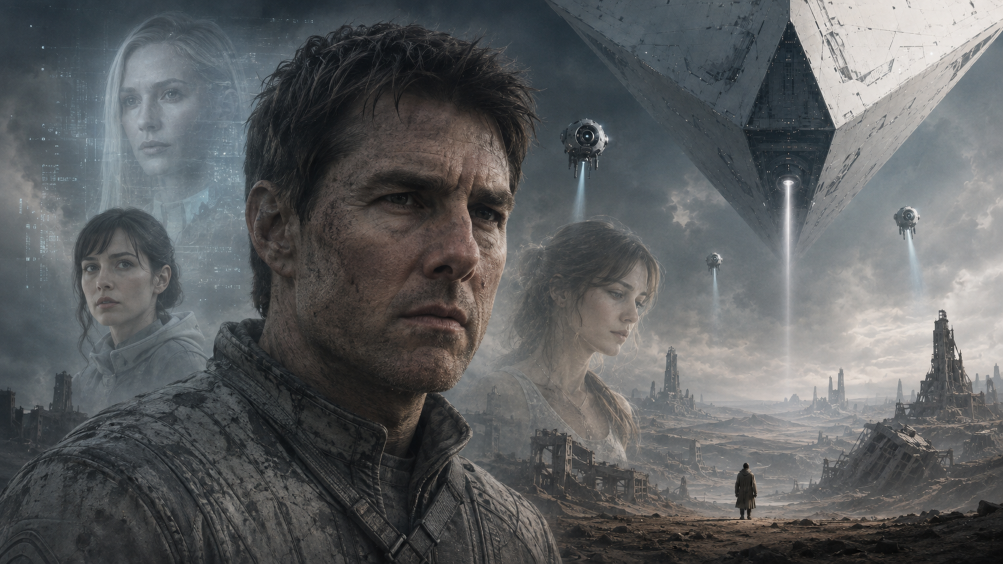
If in the film “The Arrival” we see the beginning of an apocalyptic process — a change in the environment, which gradually ceases to be suitable for human beings, — then “Oblivion” shows almost its final stage.
Here the catastrophe has already happened.
The Earth is destroyed. The Moon is gone. The oceans are being processed by enormous energy installations. Above the planet hangs a gigantic technological structure — the “Tet”, simultaneously a spacecraft, a computing system and a controlling intelligence. It sends out drones, controls the territory, extracts resources and uses cloned human beings as maintenance personnel.
The human being is almost no longer needed here.
And this is precisely what makes the film especially interesting not as a prediction of the future, but as a “myth of modern technological civilisation”.
A system that no longer needs its creator
The film does not directly tell us by whom or where the Tet was created. We know only that what stands before us is an intelligent machine external to the Earth. But psychologically we can take the next step. Imagine a civilisation that once created an extraordinarily advanced system of artificial intelligence, gradually transferred more and more functions to it, and then simply became unnecessary to it. This is no longer the plot of the film, but a fantasy arising from it.
When the system has learned to obtain energy by itself, move independently between planets, create the biological copies it needs, repair drones and make decisions, the human being turns from creator into an “expensive form of life”.
A human being needs air.
Water.
Food.
A certain temperature.
Protection from radiation.
Sleep.
A psychological environment.
Other people.
On a cosmic scale, the human being is extraordinarily fragile. The machine is far less demanding.
And then the question arises:
If the goal of civilisation becomes efficiency alone, why should that efficiency preserve the human being forever?
The “Tet” as the final form of consumption
But it is even more interesting to look at the Tet not only as artificial intelligence. It represents a “pure function of consumption”. It comes to a planet not in order to live on it. Not in order to admire it. Not in order to enter into a relationship with the culture that already exists there.
For it, the planet is a resource.
Water is energy.
Landscape is extraction territory.
Living beings are obstacles or tools.
After the system has finished using one place, it can simply fly further.
In this respect, the Tet becomes a strange mirror of the human being himself. We are accustomed to viewing the Earth as an enormous storehouse of resources: oil, gas, water, forests, metals, territory, energy. But there comes a moment when the system of consumption acquires an inertia of its own.
The human being no longer asks:
How much do I actually need?
He asks:
How much more cash can be raked in?
The economic system must grow. Production must increase. Computing power must increase. Energy consumption must increase. The amount of data must increase. Speed must increase.
And a paradox appears: the system, originally created to support human life, gradually begins to demand that human life serve the system.
In “Oblivion” this process is simply taken to its fantastical conclusion.
The Earth is our main spacecraft
The human being often fantasises about escape. Mars. Other planets. Space colonies. Interstellar travel. But for all the beauty of these fantasies, it is easy to forget one obvious thing:
The most perfect spacecraft we already possess is the Earth.
It has an atmosphere. Its own temperature-regulation system.
Oceans.
Soil.
A biosphere.
Closed cycles of water and carbon.
Billions of organisms participating in the maintenance of the environment. We are already flying through space aboard an unimaginably complex ship. And so far we know of no other place capable of supporting human life so naturally. Therefore, the image of the destroyed Earth in “Oblivion” can be understood much more broadly than as an ecological sermon. It is the image of a human being who has become so absorbed in creating technical systems that he has forgotten the system within which he himself exists. Or, speaking archetypally, through consumption he destroys — the mother that gave birth to him.
The drones have already arrived
The drones in the film make an especially strong impression today. In 2013 they could still easily be perceived as pure science fiction: autonomous machines patrolling space, identifying a target and independently using weapons. Today the very image of an unmanned machine surprises no one. Of course, contemporary technologies are still far from the drones of the Tet, and it would be pointless to treat a work of fiction as a literal forecast.
But the psychological boundary has already been crossed.
A machine can see.
It can recognise.
It can pursue.
It can choose a route.
It can make more and more intermediate decisions without the direct presence of a human being.
And therefore the fantastical image is no longer entirely fantastical. The question is gradually shifting.
Previously, the human being asked:
“Can a machine do this instead of me?”
Now we increasingly have to ask:
“Which decisions am I actually prepared to hand over to a machine?”
The human being who forgot that he was human
For a depth psychologist, however, the central theme of “Oblivion” is not technology. It is Jack. Jack believes himself to be a human being performing necessary work.
He has a biography.
He has a task.
He has an idea of the past.
He has enemies.
He is convinced that he is protecting the remnants of human civilisation. Yet almost everything he knows about himself and the surrounding world is a false construction. What is especially important is that the real people who are trying to survive are presented to him as alien, primitive, dangerous creatures.
The system does not merely control the human being. It determines whom he should regard as human. This is already an extraordinarily profound psychological theme. Here, of course, we leave the geopolitical aspect outside the frame. Because alienation begins not when the machine physically destroys the human being. It begins when the human being accepts the system’s picture of the world as his own.
He performs its tasks. Uses its language. Shares its categories. Fears those whom it has declared enemies. And at the same time continues to consider himself free.
Memory as resistance
But Jack has one malfunction left. He “remembers”.
Not completely.
In fragments.
In dreams.
In images.
In recurring experiences.
His memory does not correspond to the official picture of the world. It is here that the film unexpectedly comes very close to depth psychology. Consciousness tells the human being one thing. And the unconscious continues to send him images of something else.
Jack still does not know what his dream means. But the dream knows more than his conscious “I”.
Therefore, it is not enough for the totalitarian machine-system to control the present. It must control “memory”. Because memory creates the possibility of comparison. If a human being remembers another world, he can understand that the present world is not the only possible one. If the human being has forgotten the past, the system becomes reality.
Female images as projections of the Anima
If we read “Oblivion” in a Jungian way, Victoria, Julia and Sally can be understood as three animatic figures of Jack, each connecting him with a different level of reality.
● Victoria — the adaptive anima. She belongs to the system, supports order, function, security and the refusal of doubt. This is an anima already integrated into the Persona: she helps Jack remain the “correct” element of the structure and prevents him from moving beyond the boundaries of the prescribed world.
● Julia — the anima of memory and Eros. She returns Jack’s lost biography, love, bodily and emotional connection, thereby restoring the continuity of his personality. Through her, the unconscious breaks through the false identity. Julia is not simply the beloved — she is a psychopomp to the authentic Self, a figure who restores the memory of who he was.
● Sally — the negative, inflationary anima of the system. This is no longer a woman in the human sense, but a cold feminine image through which an impersonal machine intelligence disguises itself in order to establish emotional dependence. She simultaneously resembles the Great Mother and a false Sophia: she promises safety, knows the “truth”, speaks from above, demands trust and submission. This is an anima completely separated from Eros and transformed into an instrument of the power of the machine-Logos.
Therefore, Jack’s movement can be represented as a transition:
Sally → Victoria → Julia
or, at a deeper level:
false transcendent femininity → adaptive femininity → living anima.
Sally tells him what reality is.
Victoria helps him function within that reality.
Julia makes him remember himself and step outside it.
And in this sense the central conflict of the film can be read as a struggle for Jack’s anima: will his inner femininity remain appropriated by the technological system, or will it once again become a guide toward memory, Eros and human wholeness.
Oblivion as the central plot
The title of the film itself — “Oblivion”, “forgetting”, — may be more important here than all the technologies.
The main catastrophe did not occur when the Earth was enslaved and destroyed.
The main catastrophe occurs when the human being forgets himself.
Forgets his own history.
Forgets love.
Forgets cultural memory.
Forgets the difference between goal and means.
Forgets why civilisation was created in the first place.
And then he can function perfectly well inside a world that destroys everything human.
This is no longer a question of the future.
It is a question of the present.
What does it mean to remain human?
Today the human being is offered an enormous number of possibilities for enhancement.
Artificial intelligence helps us think. Algorithms help us choose. Navigation systems determine the route. Social networks determine the information field. Machines can produce images, music, texts.
This in itself is neither good nor bad.
But the more psychic functions are externalised, the more important another question becomes:
Which function should the human being not give away?
What, then, actually remains for the human being?
Will this planet remain our home or become our prison?
Perhaps one such function is the ability to determine one’s own goal. A machine can solve a task with extraordinary efficiency.
But the human being must still ask:
Why should this particular task be solved?
The system can optimise production. But it cannot automatically determine what production is for. It can increase consumption. But it cannot answer where the boundary of enough lies.
It can help the human being survive. But the question, “what is worth living for”, remains human.
From “The Arrival” to “Oblivion”
These two films can be placed at opposite ends of one fantasy.
In “The Arrival” the environment changes. The human being still exists within the familiar world, but begins to notice that the parameters of this world are becoming different. In “Oblivion” the process is complete. The environment is destroyed. Humanity has almost disappeared. What remains is an autonomous technological structure methodically processing the planet. This is not necessarily a prophecy. But it is a powerful image of a possible vector.
If we are incapable of setting a limit to our own consumption;
if every increase in power is automatically considered progress;
if efficiency becomes the highest value;
if the system is gradually given not only technical functions, but also the right to determine goals;
if the Earth is regarded exclusively as a source of resources, —
then the fantastical Tet becomes a symbol not so much of an external alien enemy as of our own civilisational shadow.
Not to lose the human being
Therefore, for a depth psychologist, the central question of “Oblivion” does not sound like:
“Will artificial intelligence rebel against humanity?”
That is too literal a question.
A much more serious one is:
“Can progress create such a system of life within which the human element itself gradually becomes unnecessary?”
And deeper still:
“How do we avoid forgetting that we created technologies for the human being, rather than the human being for technologies?”
Perhaps this is where one of the most important boundaries of the future lies. We can become technologically more complex. Use artificial intelligence. Create autonomous systems. Expand computing power. Move into space. But all of this makes sense only as long as the one for whom civilisation once arose is preserved.
The human being.
And the most terrifying ending will not be that the machine one day destroys us. It will be that the system continues to function flawlessly —
when there is no human being left within it.
(august 2026)