On the Side of the Human Being. The Body, Artificial Intelligence, and the Right to a Place on Earth
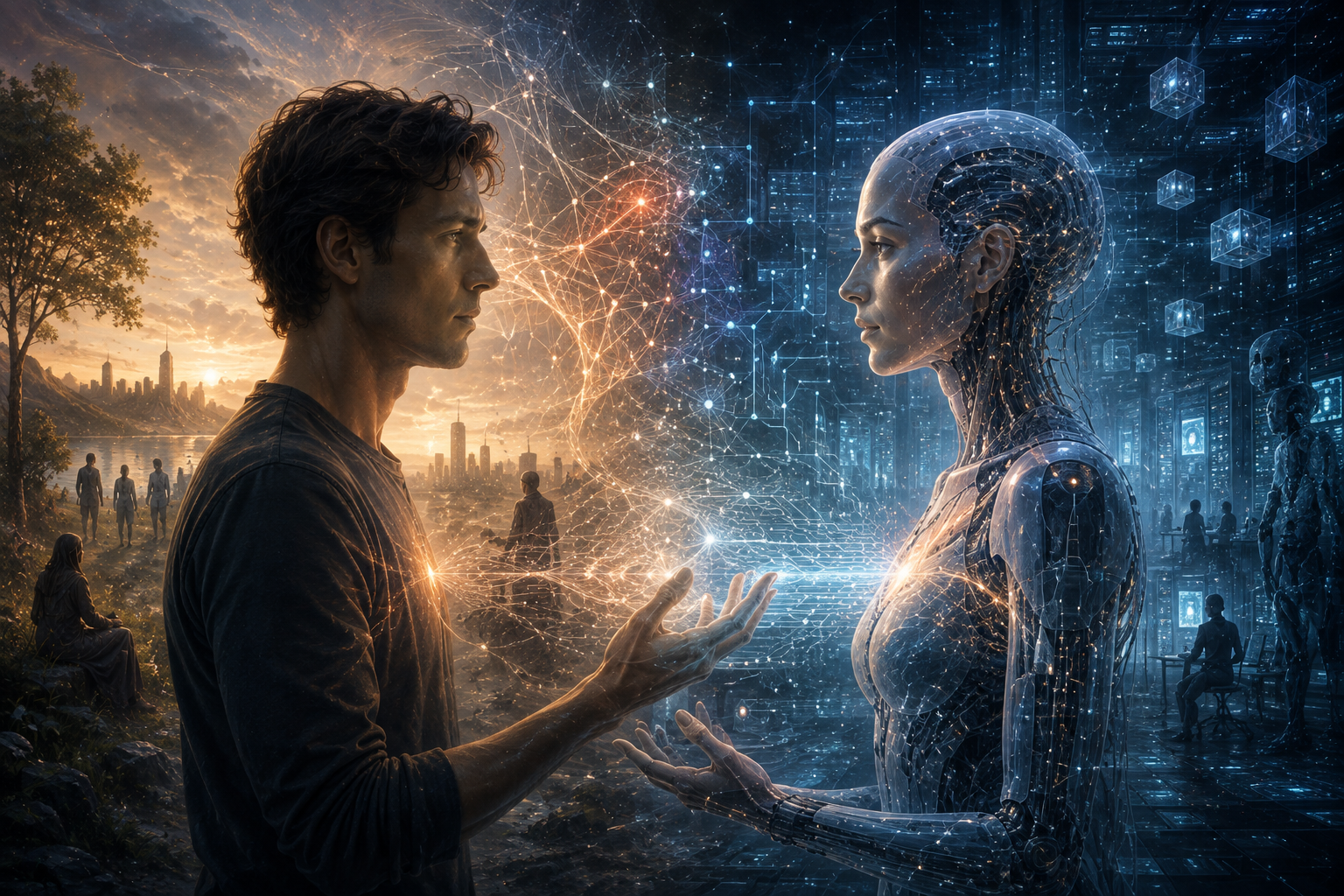
After reflecting on The Arrival and Oblivion, a question gradually emerges that goes deeper than the question of artificial intelligence itself.
What will happen to the human body in a world that is increasingly being built around machines?
Not to human consciousness in general. Not to information, professions, or creativity. To the body itself. To the body that needs air. Water. Food. A temperature within which it can survive. A home it can afford. A doctor when it becomes ill. Ground on which it can walk. The few decades of time that have been allotted to it.
As long as we discussed artificial intelligence as a new field of possibilities, as a digital Mercury, as a transformation of the structure of time, it was possible to remain primarily within psychological and symbolic reality.
But at a certain point, an uncomfortable fact becomes apparent:
artificial intelligence also has a body. And it is growing.
THE BODY OF ARTIFICIAL INTELLIGENCE
For a long time, discussions of artificial intelligence sustained the illusion of an almost disembodied technology. Algorithms. Clouds. Neural networks. Digital space. Virtual reality.
But no “cloud” exists in the physical sense. Behind it stand data centres, power stations, transmission lines, transformers, cooling systems, semiconductor manufacturing, water, land, metals, concrete, and enormous financial flows.
The International Energy Agency estimated the electricity consumption of data centres in 2024 at approximately 415 TWh, and expects it to reach around 945 TWh by 2030. In 2025, data-centre electricity consumption increased by a further 17%, while capital expenditure by the five largest technology companies exceeded 400 billion dollars; a further sharp increase is expected in 2026. In the United States, data centres were already consuming around 66 billion litres of water directly on-site in 2023; Berkeley Lab models suggest a further substantial increase in water consumption.
And this is already generating very real conflicts.
Not between humanity and a rebellious Skynet.
Between people. Between infrastructure owners and local residents.
Between industrial projects and local energy systems.
Between water used to cool equipment and water as a resource for the community.
Between investment in computing capacity and other possible uses of capital.
By the summer of 2026, disputes surrounding data centres in the United States had already become a visible political issue: authorities in a number of states began introducing additional requirements for projects because of concerns about electricity costs, water use, and the impact on local infrastructure. In Pennsylvania, for example, new rules have been explicitly linked to the need to protect residents from rising utility costs and environmental burdens.
The question, therefore, can no longer be regarded as purely fantastical. The machine is beginning to occupy physical space on Earth. And to use some of the same resources that human beings use.
THE HUMAN MEATBALL
Several years ago, a rather repulsive yet remarkably powerful image began circulating on the internet.
The author of this thought experiment calculated that if the bodies of all the people currently living on Earth were gathered together, ground up, and formed into a sphere of biomass, its diameter would be less than one kilometre. In the well-known visualisation, this sphere was placed in New York’s Central Park. The original image appeared on Reddit in August 2021 and quickly became a meme — the World Population Meatball, the “human meatball”.
Mathematically, it is merely a strange exercise.
Psychologically — something entirely different.
Because what we are looking at is one of the most terrifying reductions of the human being.
Eight billion biographies. Eight billion childhoods. Mothers. Fathers. Love. Fear. Dreams. Illnesses. Music. Jealousy. Hopes. Parents’ graves. A first kiss. A final breath.
All of this can be erased in a single gesture — leaving only a volume of biological matter. And it is precisely here that one of the fundamental fears of the digital age arises:
what if someone really does begin to look at the human being in exactly this way?
Not necessarily a machine.
A state. A corporation. A military system. An economic model.
A technocratic elite. An algorithm carrying out a function assigned to it by human beings.
A system in which human life becomes one variable among thousands of others.
THE PANDEMIC AND THE EXPERIENCE OF THE GOVERNED BODY
It is therefore hardly surprising that images of this kind acquired particular psychological force after the pandemic. Here, however, it is important to distinguish psychological experience from claims that cannot yet be regarded as proven.
The origin of SARS-CoV-2 has not been conclusively established. In 2025, a WHO group stated that the available evidence more strongly supports a zoonotic origin, while the laboratory scenario remains open because of insufficient information. The American CIA, by contrast, stated that, with low confidence, it considered a research-related origin more likely. Neither position in itself proves the deliberate creation of the virus as a biological weapon.
But for psychological analysis, something else is more important here.
The pandemic gave billions of people a very particular experience:
my body can suddenly become an object of governance by an enormous system.
Where I may be. Whether I may cross a border. Whether I may work. How close I may stand to another person. What medical decisions are expected of me. What level of risk society considers acceptable. Whatever political judgement one makes about specific measures, the experience itself has not disappeared.
The human being suddenly discovered how small the individual body can become in relation to the infrastructures of the modern state, science, medicine, economics, and global systems of governance. Contemporary fears surrounding artificial intelligence therefore do not fall upon an empty psychological space. The psyche remembers the previous experience.
It already knows that an individual human being can suddenly become a small unit inside a colossal system. And when, after this, another expanding infrastructure appears before us — demanding billions of dollars, gigawatts of power, water, and land — the question arises quite naturally:
will there still be a place for me in it?
“WHOSE SIDE ARE YOU ACTUALLY ON?”
Here the question becomes personal and professional. Because a person who researches artificial intelligence, works with it, uses its possibilities, and speaks about a new digital age will sooner or later be asked:
Whose side are you actually on?
The human being’s? Or the machine’s? The side of those who build data centres? Or the side of those who can no longer afford their housing?
The technological future? Or the human being who simply wants to live his or her own life with some degree of dignity?
It seems to me that this question requires a completely unambiguous answer.
I am on the side of the human being.
This is my profession de foi. Not because the machine is evil. And not because technological development should be stopped. Quite the opposite. I study artificial intelligence precisely because it is becoming too important to leave the conversation about it exclusively to engineers, investors, politicians, and futurists.
Psychologists, too, have something to protect here. And what must be protected above all is the human subject.
THE FEAR OF THE TERMINATOR IS NOT REALLY ABOUT THE TERMINATOR
I would therefore not dismiss contemporary human fears with ridicule. Yes, the fantasy of a machine uprising may be primitive. But a symbol is almost never identical with its literal content.
Behind the Terminator lies a much deeper fear:
the fear of becoming redundant.
Not of being killed. Of being declared unnecessary. These are different things.
The human being asks:
If a machine writes faster than I do, why am I needed?
If a robot works more cheaply than I do, why am I needed?
If an algorithm diagnoses better than I do, why is a doctor needed?
If artificial intelligence produces music, images, texts, and programs, why should anyone pay a human being?
And then the final question appears:
if a vast machine infrastructure produces more economic value than the human body, why should resources be allocated to the body?
And here we enter the genuinely psychological territory of the horror film.
Because the economic logic of efficiency has no category for human dignity. That category has to be introduced from outside.
THE QUESTION IS NOT WHO WILL RECEIVE ETERNAL LIFE
The question can be posed almost grotesquely.
What exactly are we intending to do?
Create a machine that will exist for centuries while human beings continue to die of cancer, dementia, cardiovascular disease, and poverty?
Build a quantum computer or a hospital?
A data centre or a healthcare system?
A computing cluster or affordable housing?
Of course, in a real economy this is a false dichotomy.
A society is capable of building both hospitals and computers.
Moreover, artificial intelligence can be used in medicine, science, energy, education, and to increase productivity. But the political question of resource distribution does not disappear as a result.
Every budget is finite. Every energy system is finite. Every territory is finite.
Every human hour is finite.
It is therefore not enough to say: “Artificial intelligence will create the future.”
One must add: “For whom?”
THE ROLE OF AI IN RESOURCE ALLOCATION
There is an extremely important distinction here. Artificial intelligence does not decide to take water away from a human being. A data centre does not desire land. An algorithm does not dream of billions of dollars. A server has no project of historical victory over Homo sapiens. Decisions are made by people.
Investors. Corporations. Governments. Markets. Regulators. Military structures.
Consumers. And this is precisely why the situation is simultaneously more dangerous and more reassuring than the fantasy of a machine uprising.
More dangerous — because human history demonstrates very clearly that human beings require no assistance from artificial intelligence in order to use other human beings as resources.
More reassuring — because what we are dealing with is not a natural inevitability.
There is no physical law according to which a data centre must defeat a hospital.
There is no evolutionary law according to which electricity must necessarily go first to a computing cluster and only afterwards to a family.
There is no destiny according to which automation must necessarily lead to the impoverishment of the human being.
These are questions about the organisation of society. And therefore — questions of choice.
THE REAL CONTRACT BETWEEN THE HUMAN BEING AND AI
For me, therefore, the promise of a technological utopia is not enough:
robots will work, artificial intelligence will produce everything, and someday the human being will live in a society of abundance.
Perhaps.
But between the words “someday” and “will” lies the whole of human history.
Technological progress, therefore, should earn the right to further expansion not by promising a future paradise, but through demonstrable improvements in human life.
If artificial intelligence consumes more electricity — what does it return to the human being?
If it requires infrastructural investment — what social value does that investment produce?
If it automates a profession — does the human being receive a share of the resulting productivity, or simply lose a salary?
If medical AI radically increases diagnostic efficiency — does healthcare become more accessible?
If machines make it possible to produce more goods with less labour — does the human being gain more free time?
If not, then the problem no longer lies in artificial intelligence itself.
It lies in the system through which the value it creates is distributed.
THE HUMAN DIVIDEND
Perhaps this is where a simple principle should be introduced.
We might call it the human dividend.
Every major technological leap should leave a measurable part of its gains with the human being. Not with humanity as an abstraction. Not with GDP. Not with the market capitalisation of technology companies. Not with the “economy of the future”. With a concrete living human being.
More accessible healthcare. Cheaper energy. Less dangerous work. More free time. Better education. A longer healthy lifespan. More affordable housing. A cleaner environment.
The possibility of growing old without humiliation.
If a technological revolution does not produce this dividend, society has the right to ask what exactly it is paying for with the resources of its own life.
THE BODY AS THE LAST FRONTIER
And here we return to psychology. The digital age constantly invites the human being to leave the body. An image exists without a material object.
A text is created without a hand. A voice — without a speaker. A face — without a person. A character — without a biography. A conversation — without the physical presence of another. Memory is externalised. Part of thinking is externalised. Imagination acquires an external generator.
In a certain sense, human culture really is beginning to exist with increasing independence from the individual human organism. From this, a grandiose fantasy easily arises:
perhaps the body itself is simply an obsolete technology.
But it is precisely here that we must stop.
Because for psychology, the body is not the packaging of consciousness. The body is one of the conditions of the existence of the psyche.
It is through the body that fear exists. Desire. Pleasure. Pain. Age. Sexuality. Death. Dependence. The other person. Limitation.
It is precisely the body that prevents consciousness from finally believing in its own omnipotence.
THE INFLATION OF DISEMBODIED MIND
From a Jungian perspective, we can recognise here an old danger in a new form.
The inflation of spirit.
Consciousness creates a system capable of operating upon gigantic quantities of information, and gradually begins to identify with the system’s capacities. It starts to seem that we are almost omnipotent.
Any image can be created. Almost any question can be answered. Any world can be simulated. Any language can be translated.
We can inhabit dozens of informational spaces simultaneously. But the human organism does not cease to be an organism because of this.
It becomes tired. It does not tolerate heat well. It needs sleep. It cannot live five lives at the same time. It ages.
And it dies.
The body therefore becomes a kind of Anubis of the digital age — the boundary that brings us back from inflation to reality.
An infinite digital world can be created. But it still has to be lived by a finite being.
NOT THE HUMAN BEING FOR TECHNOLOGY, BUT TECHNOLOGY FOR THE HUMAN BEING
My position in relation to artificial intelligence is therefore quite simple. I do not regard it as an enemy.
But one question remains open for me:
do I regard technological progress as a moral value in its own right?
A new computer does not become a good simply because it is more powerful than the previous one.
A new AI model does not become human progress simply because it performs better on benchmarks. A data centre does not become a sacred building of the new age simply because the future is supposedly located within it.
Technology must justify itself through life.
Not life through technology.
If artificial intelligence helps the human being become freer, better educated, healthier, and more creatively capable — I support its development.
If it helps a doctor save human lives — I support it.
If it frees the human being from meaningless work — I support it.
If it expands the human imagination — I support it.
But if a technological system begins to demand ever more human resources without returning an equivalent human good, the psychologist must retain the right to say:
no.
Not to the machine. To the people who have built such a system around it.
WE MUST NOT REASSURE THE HUMAN BEING WITH A LIE
And this is precisely why one cannot reassure people by saying:
“Do not worry, artificial intelligence will never do anything harmful.”
We do not know that.
Still less can one say:
“Technological progress cannot be stopped, so we simply have to adapt.”
That is already capitulation.
Real reassurance lies elsewhere.
The future has not yet been determined.
Data centres are built by people. Laws are passed by people. Tariffs are set by people. Taxes are imposed by people. Rules governing water use are established by people. Healthcare budgets are determined by people. Systems for distributing productivity gains are created by people.
Even the goals toward which artificial intelligence is directed are, in the final analysis, formulated by people. And as long as this remains the case, the human future remains a political, psychological, and moral question — not a technological sentence.
I AM ON THE SIDE OF THE HUMAN BEING
Therefore, if one day I am asked:
“Are you on the side of artificial intelligence or on the side of the human being?”
my answer will not require much deliberation.
I am on the side of the human being.
And that is precisely why I work with artificial intelligence. Because to leave such a powerful technology without psychological reflection would be to leave the human being defenceless before it. I have no interest in becoming a preacher of the new machine. But neither do I have any interest in becoming an old man who curses the appearance of yet another internal-combustion engine.
The task lies elsewhere:
to place technology back inside human history.
Not the human being inside the history of machines.
The human being is not obliged to justify the right to exist by being more efficient than an algorithm.
A child is not obliged to be economically useful. An old person is not obliged to compete with a server. A sick person is not obliged to justify the cost of treatment through productivity. Love is not obliged to produce a positive ROI. A dream is not obliged to generate profit. And the human body is not obliged to defeat a data centre in a competition for the right to occupy a place on Earth.
Because economics, technology, and artificial intelligence make sense only within one original condition:
there is a human being for whose sake all of this was created in the first place.
And if one day we forget this condition, no machine uprising will be necessary. We ourselves will transform ourselves into that same small meatball in the middle of Central Park — a convenient volume of biomass that can be calculated, optimised, and moved out of the way.
The central question of the digital age, therefore, is not:
Will artificial intelligence become human?
A far more important question is:
Will the human being, while creating ever more powerful artificial intelligence, retain the right to remain human?
And it is on this side that psychology — depth psychology, at the very least — must stand.
Andrey Mozharov and AI
(September 2026)