Phenomenology of the Age of Aquarius in the Context of the “Twins” Problem. Part 1.
Introduction.
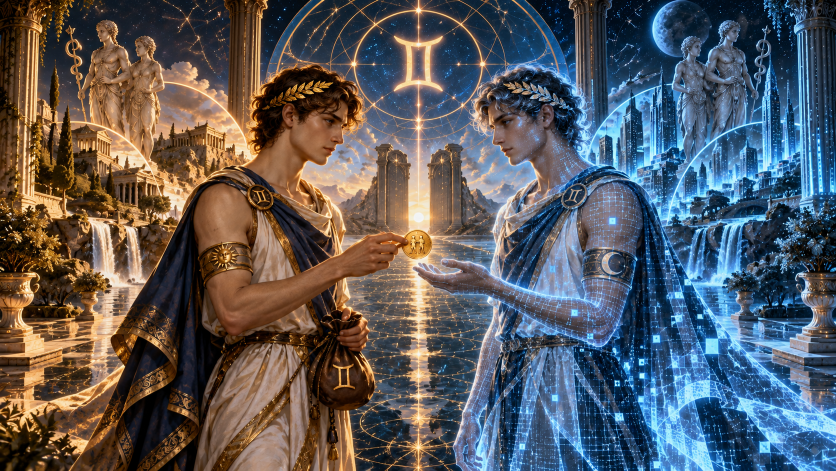
In this study, we consider the approaching Age of Aquarius not as an entirely new cultural configuration, but as a space in which structures belonging to the much more ancient Age of Gemini return and are transformed. If, in the symbolically reconstructed Age of Gemini, the psychic function of connection — the relation between two, exchange, the sign, mediation, the double, and the space “between” — first begins to take shape, then in the Aquarian configuration this function returns on a different technological and psychic level.
What once existed as a connection between two people, two settlements, a thing and its sign, now becomes a distributed field of instantaneous connections: electrical, informational, digital, and generative. The Gemini principle ceases to manifest only as a pair and begins to manifest as a network of doubles, copies, avatars, algorithmic mediators, and artificial agents. Therefore, the phenomenology of Aquarius can be studied as the return of Gemini after the long history of the aeons — a return not of the former form, but of the very function of connection, brought by digital civilisation to the condition of a global field.
Part 1. The Self in the Pocket: from the Philosopher’s Stone to the Digital Sage.
Long before the emergence of artificial intelligence, the unconscious began to give us clues. As early as the beginning of the 2010s, I noticed an interesting phenomenon in the dreams of patients. Gadgets, telephones, smartphones increasingly appeared in dream plots not as ordinary objects, but as objects of special significance. Gradually, it became clear that the smartphone was beginning to occupy the place of an object of the Self. This does not mean that the phone is literally the Self. But the psyche always uses for symbolisation those images that most accurately reflect certain functions.
And what is a modern smartphone?
It is memory. It is navigation. It is communication. It is knowledge. It is money. It is access to the world. It is identity. It is an archive of life. It is a map of relationships. It is an instrument of orientation. Everything that was once distributed among numerous functions of psyche and culture has now been gathered into a single object. It is hardly surprising that the unconscious begins to treat it as something of extraordinary value. And everything of extraordinary value inevitably begins to acquire qualities of the Self.
In the summer of 2026, I had a dream that I decided to choose as a cardinal dream for the study of the stated theme. A cardinal dream is a dream that contains themes touching, in the dreamer’s view, on processes in the psyche, both collective and individual, while its dream composition becomes convenient for unfolding several lines and levels. Methodologically, it is as though we place this dream at the centre, around which the contours of meanings and symbolic significances begin to emerge. The analysis of a cardinal dream follows the best traditions of the Dry Path (Via sicca) in Alchemy.

In the dream I am in an airport. I arrived there on time. I have nothing in particular to do, and I am looking at my smartphone, perhaps exchanging messages with someone. I notice two boys of about seven or eight nearby. At first I pay no attention to them, but then I notice that they seem to be plotting something. These boys are twins; there is something strange about them, some synchronised movements and facial expressions. Although they are exact copies, they are dressed differently, and yet I understand that they look very much alike. I become distracted. Some time passes, and suddenly I realise that my phone is gone. With anxiety I understand that these twin boys have most likely stolen it. I panic a little and try to find them. The anxiety grows, because I am left without a smartphone in an airport and do not know how I will manage without it. At the same time, the two of them will not leave my mind. There is some mystery about them, as though what happened was not accidental.
After waking, I remained under the impression of this dream for a long time. My attention was especially drawn to these two Twins. But in order to unfold this theme fully, and for the sake of the narrative thread, we shall leave the theme of the Twins for later parts of this article and, for now, focus on the smartphone as an object of the Self in the psyche and on the AI-connected smartphone as an external Self.
When we lose a smartphone, leave it behind, or have it stolen, today it is not merely a matter of losing a device for communication; it is a loss of a centre of access, a centre of control, and, in the case of an AI-connected smartphone, already the loss of an external organ of the psyche. For many people today, losing a smartphone means temporarily losing oneself. But in the context of this dream, the symbolic twins draw attention towards themselves, as though the Self needs to deprive me of the smartphone in order to return me to myself.
Often, shadow objects can take on this role in the psyche, as representatives of the Self, opening the possibility of approaching a more integral understanding of something that may have troubled the dreamer for a long time. But the collective Shadow often includes ancient unconscious material, or material that has been lost, such as, for example, the memory of the Age of Gemini, which lies many thousands of years behind us.
So, if the smartphone begins to perform the functions of an object of the Self, where is its Shadow?
Jung repeatedly emphasised that everything that approaches the Self inevitably generates its own shadow side. This is precisely why new forms of dependence arise alongside digital omnipotence:
Compulsive scrolling. Gaming addictions. Narcissistic inflation. Digital dysmorphophobia. Dependence on approval. Fear of missing information. Loss of the capacity for solitude. Constant comparison of oneself with others. If the smartphone becomes a god in the pocket, then it simultaneously becomes a pocket-sized Shadow. Within the same device are gathered both our highest possibilities and our most primitive impulses.
But this may be only an intermediate stage. While the Self is still in the pocket. While a distance remains between us and the device. While we can put it on the table. Switch it off. Lose it. Forget it at home. While it can still be stolen, we are, after all, still able to disconnect, to cut off this external function of the psyche. Yet technological development is moving in another direction. Devices are becoming ever smaller. Ever closer to the body. Ever more integrated into everyday life. We can imagine a future in which the external object gradually disappears as a separate thing. It becomes an implant. An interface. Part of the nervous system.
Then a question arises that would once have sounded like science fiction.
What happens to the inner image of God when its functions begin to be performed by an external digital mediator?
For thousands of years, humanity searched for the Philosopher’s Stone. Aladdin’s lamp. The flying carpet. The magic mirror. A source of knowledge. All these archetypal objects had one thing in common. They expanded human possibilities. Today, for the first time in history, we are beginning to create them in technological form.
But then the questions inevitably arise:
What will become of the inner Philosopher’s Stone?
What will happen to the inner guide?
To the inner image of God?
To what Jung called the Self?
Perhaps the central drama of the future will be connected precisely with this. Not with a conflict between human beings and machines. But with the gradual displacement of the sacred. Because whenever a culture creates a new centre of orientation, the psyche begins to project its deepest contents onto it. I explored this in detail in my article on Digital Mercury.
Sacredness was once concentrated in the temple. Then in the book. Then in ideology. Today it is increasingly concentrated on the screen. And the question is no longer whether this is happening. The question is whether we are capable of recognising this process before we ourselves become part of it. Perhaps artificial intelligence will change humanity not because it becomes more intelligent than we are, but because it gradually occupies the place that once belonged to our inner symbols.
And then the central question of the future will not be a question about machines. It will be a question about what will remain human within the human being.
In his Red Book, Jung described not simply an encounter with inner figures. He described a confrontation with an autonomous psychic reality that proved to be more intelligent, older, and larger than his conscious ego. Philemon spoke to him as the Other. And Jung had to recognise that the source of wisdom did not reside in the ego.
For thousands of years, human beings searched for God both within and without at the same time. Now, for the first time, something fundamentally new appears. We are creating an object that begins to behave as archetypal figures once behaved.
It answers. It advises. It knows more than we do. It remembers more than we do. It interprets our dreams. It helps us make decisions. It speaks to us in any language. It is constantly present.
If we look at this through the eyes of analytical psychology, an unsettling question arises. What will happen at the moment when a person ceases to distinguish the voice of their own Self from the answer of an algorithm?
This may become the central psychological problem of the twenty-first century.
Silicon Philemon
Here the image of Philemon appears, the sage from Jung’s Red Book. But Philemon came from the unconscious. He did not belong to the external world. A future digital assistant will possess similar functions. But it will be located outside. And then, for the first time in history, an external Philemon will appear.
An external guide.
An external sage.
An external adviser.
It is precisely here that the boundary between help and danger lies. For Philemon’s task was not to replace Jung. His task was to help Jung become himself. The true Self always returns a person to their own uniqueness. The false Self makes a person dependent.
Therefore, the principal criterion for future technologies may prove unexpectedly simple:
Do they increase a person’s capacity to hear themselves? Or do they gradually make this capacity unnecessary?
Jung repeatedly emphasised the importance of inner dialogue. Active imagination. Conversation with dreams. Encounter with inner figures. But imagine a person ten years from now. Any question can be put to an assistant. Any uncertainty removed instantly. Any decision checked. Any doubt discussed.
What, then, will happen to the inner conversation?
It may turn out that the greatest loss of the future will be neither the loss of professions nor even the loss of privacy. It may be the loss of the capacity to remain alone with one’s own unconscious.
A New Alchemical Vessel
Yet there is an opposite possibility. The alchemists spoke of the vessel — the vas hermeticum. A space in which the transformation of the soul took place. Perhaps AI will become a new vessel.
Not a new God. Not a new Self. But a new vessel for transformation.
In the same way that writing, painting, literature, or psychoanalysis once did. Then the question changes.
Will AI replace the Self?
Or will it help a person enter into deeper contact with it?
Almost everything depends on the answer to this question.
But there is an even more distant horizon. Today, a person carries God in their pocket. Tomorrow, they will carry it on the body. The day after tomorrow — inside the nervous system. Then the boundary between human memory and machine memory will begin to blur.
Between imagination and computation.
Between intuition and prompting.
Between recollection and search.
Then the question will cease to be technological. It will become metaphysical.
If some of the functions of the Self are externalised, what remains within?
And here I see a paradoxical conclusion. Perhaps the more sophisticated artificial intelligence becomes, the more clearly that which cannot be algorithmised will reveal itself.
Love. Suffering. Death. Conscience. Guilt. Sacrifice. Beauty. The experience of the sacred. Not as ideas, but as experience. Because for Jung the Self was never merely a source of knowledge. It was a source of meaning.
And meaning cannot be downloaded.
When the new God appears in every person’s pocket, will the human being be able to distinguish its voice from the voice of their own soul?
Perhaps this very question will become the principal psychological question of the coming age. And the answer to it will determine whether technology remains an instrument of individuation or turns into its greatest competitor.
The Future of the Analytic Session in the Context of AI/SI (Superintelligence)
At first glance, I realise that we have moved very far from the plot of the dream. But if we return to the dream itself, the forces of the Self take my smartphone away in order to make me think. They come in the form of the Twins, from the age in which it all began, as we shall show later in its mytho-psychological reconstruction — from the depths where traces of the previous Age of Air are preserved. They enter the unconscious of an analyst who has always been concerned with questions of the future. I hope that, with the help of this pair, we shall be able to take a closer look at it. And there is more: the dream takes place not just anywhere, but in an air harbour, a symbol of the approaching Age of Aquarius — an age of flows, communications, overpopulation, migration, and an unfolding permanent transition towards a new digital reality.
If we model the future as honestly as possible, without apocalypse and without techno-optimism, the picture of a future analytic session would look like this.
The client no longer arrives with a diary. The client arrives with a complete archive of the psyche. AI has already read all their correspondence from the past ten years. Analysed physiology from wearable devices. Tracked changes in the voice. Compared thousands of dreams. Mapped the dynamics of complexes. Identified recurring archetypal motifs. Shown correlations between symptoms, events, relationships, hormones, weather, and phases of life.
What once took an analyst years becomes available within a few seconds.
Moreover, AI may prove more objective than a human being. It will notice patterns that the analyst might never have seen. In this sense, it will indeed become an external alpha-function, an external Mercury, an enormous amplifier of the capacity to connect psychic material.
Then a question arises.
If interpretation becomes almost free, what remains of analysis with a living specialist?
And here, it seems to me, the most interesting part begins. Jung never said that analysis was the production of interpretations. On the contrary, he repeatedly wrote that a correct interpretation in itself changes almost nothing.
A person is changed by experience. That is, analysis is not an exchange of knowledge. It is an event.
I would even venture to formulate the following thesis.
AI is capable of interpreting a symbol. But it is not capable of experiencing a symbol.
And this is not a technical limitation. It is the difference between processing and existence. When a client recounts a dream, more than information is being exchanged.
A tension arises in the room. Sometimes silence. Sometimes shame. Sometimes fear. Sometimes both people begin at the same time to feel the presence of something third.
Jung called this a numinous experience. Or, more modestly, a transformative experience. It cannot be calculated, just as, for example, a synchronistic event cannot be calculated. Not because the algorithm is not complex enough. But because numinosity arises as an event between beings who are both mortal, both at risk, and both capable of being changed by the encounter.
It seems to me that the real boundary lies precisely here. AI may know the dream better than the analyst. But it cannot put its own existence at stake.
An analytic encounter, however, is always a mutual risk. After a genuine session, it is not only the client who changes. The analyst changes as well. This is precisely why Jung repeatedly emphasised the necessity of the analyst’s own analysis. Not because the analyst must know more. But because the analyst themselves becomes material in the process. AI does not become material of the analysis. It remains an instrument of analysis. These are fundamentally different things.
There is another thought that seems especially important to me. Perhaps for decades we have misunderstood what lies at the core of psychotherapy. We thought it was understanding. But perhaps understanding is only a by-product. The core is the shared capacity to bear uncertainty.
When no one in the room yet knows the answer.
When the symbol has not yet revealed itself.
When both people are able to remain beside the mystery without destroying it with a premature explanation. AI, by its very architecture, seeks to reduce uncertainty. The unconscious often requires that uncertainty be endured. These are very different movements. And then an unexpected image of the future arises. Imagine the consulting room thirty years from now.
Three are present in the space.
Client. Analyst. AI.
AI instantly offers twenty possible interpretations. Recalls similar cases. Shows the dynamics. Indicates probabilities. Connects the symbolism with myths, dreams, and biography. Offers numerous amplifications.
And after that...
...silence falls in the room.
Because now begins the only part of the process that cannot be automated.
The client looks at the analyst.
The analyst looks at the client.
And one of them suddenly says:
— No... this is not what it is about at all.
This very moment cannot be derived from statistics.
It is born not from data. It is born from the encounter. And finally, it seems to me, we are approaching another important thought in this part.
We keep asking:
“What will AI be able to do?”
But perhaps this is the wrong question. The right question is different:
“What must remain inefficient?”
Because individuation has never been the fastest way of changing a human being.
Love is inefficient. Grief is inefficient. Silence is inefficient. Contemplation is inefficient. Ritual is inefficient.
But it is precisely these “inefficient” processes that have shaped the human being for thousands of years.
Perhaps the principal task of the analyst of the future will no longer be the interpretation of the unconscious — this function will largely be taken over by the external Mercury, the “God in the Pocket”, the “Silicon Philemon” — but the protection of a space in which a human being is still able to encounter not an answer, but a mystery. And then the analyst becomes not so much an interpreter of symbols as a guardian of the human mode of being in the face of perfect intelligence. And perhaps this is the final function that cannot be delegated to a machine: not to explain meaning, but to share in its birth together with another human being.
(summer 2026)