The Phenomenology of the Age of Aquarius and the Problem of the "Twins". Part 4. Reconstructing the Age of Gemini
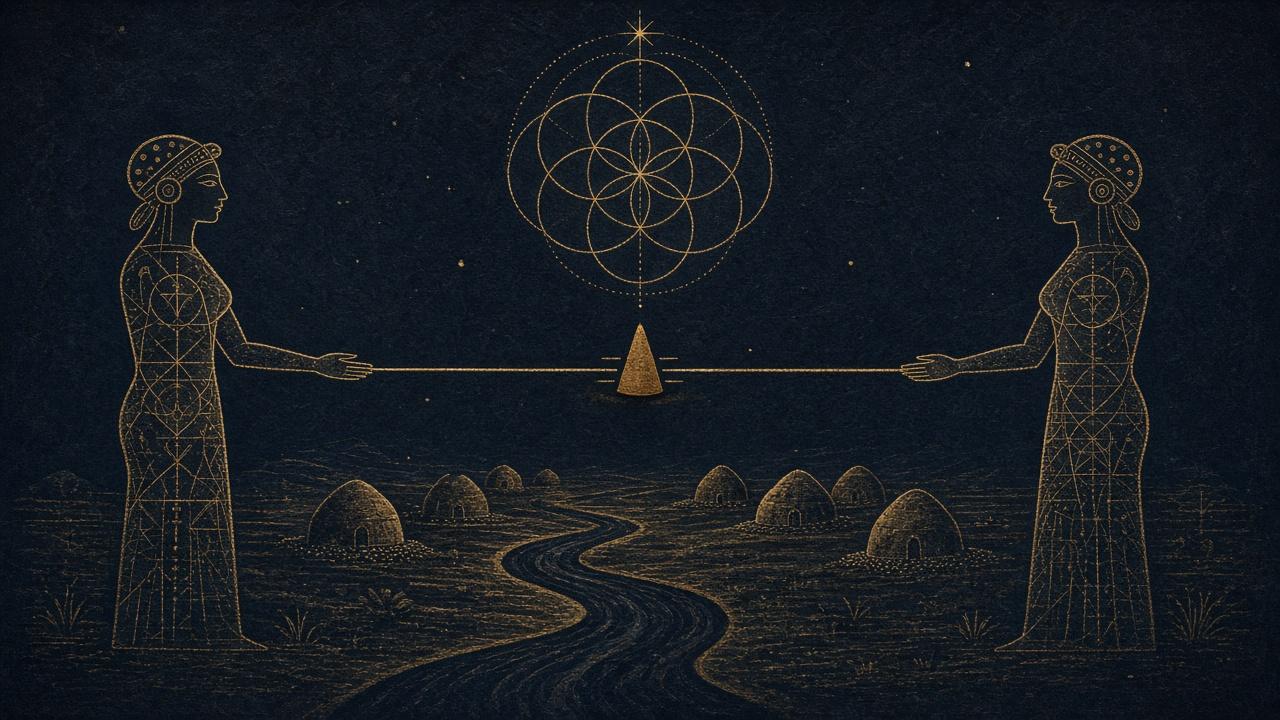
The starting point for this part of the enquiry is, once again, the dream of two twin boys stealing a smartphone in an airport.
In the dream I am at an airport. I have arrived in good time. There is little for me to do, so I look at my smartphone, perhaps messaging someone. I notice two boys of seven or eight beside me. At first I pay them no attention, but then I sense that they are up to something. The boys are twins, and there is something uncanny about them: their movements and expressions are synchronised. They are exact copies, yet dressed in different clothes, and still I know they are strikingly alike. My attention drifts. Some time passes, and suddenly I realise my phone is gone. Anxiously, I understand that the twins have most likely stolen it. I panic a little and try to find them. The anxiety grows: I am stranded in an airport without my smartphone and have no idea how I shall manage without it. At the same time, the two of them will not leave my mind. There is a mystery about them, as though what has happened is no accident.

The image itself seems utterly contemporary. The airport is a space of transition, of global movement and networked connection; the smartphone is an external psychic object holding memory, orientation, communication and part of modern identity. Yet at the heart of this Aquarian space the twins unexpectedly appear, and they are a far more ancient figure.
That is why the dream can be read as a collision of two layers of time. In the foreground lies the modern digital world of transitions and connections; behind it stands the older motif of the twins: doubling, kinship without identity, mediation, exchange, and the opening of a space "between the two". In stealing the smartphone, the twins seem to draw out of the modern Aquarian world its deeper archetypal remnant: the principle of connection which we provisionally assign to the reconstructed Age of Gemini.
Hence the task of this chapter: to attempt a reconstruction of the Age of Gemini as a historical and symbolic matrix in which the early psychic functions of connection, sign, double, exchange and mediation may have taken shape, and then to trace how these ancient structures return in a new form, within the digital, networked and Uranian space of Aquarius.
In other words, the two boys in the airport become more than characters in a dream. They form a kind of bridge between the ages: Gemini returns in Aquarius not as a repetition of the past, but as a transformed function of connection, doubling and the distributed field.
1. The Age of Gemini: a possible reconstruction
If we use the conventional scheme of equal precessional ages of roughly 2,160 years each, the Age of Gemini falls approximately between 6500 and 4300 BC. But this is a working symbolic periodisation and nothing more. Precession is a real astronomical phenomenon with a cycle of about 26,000 years, yet the division of that cycle into twelve equal "astrological ages" has no generally accepted scientific boundaries. Moreover, the fixed twelve-sign zodiac as we know it took shape in Mesopotamia only around the fifth century BC. The people of the sixth millennium BC, then, did not think of themselves as living in an "Age of Gemini".
This is crucial for our method:
We are not reconstructing a historical religion of the Twins. We are asking how far the historical and psychic configuration of roughly 6500–4300 BC can be read symbolically through the image of the Twins.
And here an unexpectedly rich picture emerges.
1. Historically, this truly is an age of connection
By this period settled Neolithic life already exists, but the world no longer consists only of relatively isolated settlements. Çatalhöyük shows a complex settled society as early as the eighth and seventh millennia BC, and its later history runs straight into the beginning of our provisional age. UNESCO dates the East Mound to around 7400–6200 BC and the West Mound, already Chalcolithic, to around 6200–5200 BC.
In northern Mesopotamia and Syria the Halaf cultural community arises around 6500–5500 BC, distinguished by extraordinarily elaborate painted pottery. Then in the south the Ubaid system gains strength, having emerged around 6200 BC; irrigation appears, settlements grow, and early centres gradually take on the features of towns.
At the same time, long-distance exchange networks expand. Studies of obsidian reveal intensive links between Anatolia, the Aegean and the Balkans in the seventh to fifth millennia BC.
And here the first possible motif of the Twins appears:
not a single settlement, but the connection between settlements; not one world, but a world existing between two points. Space becomes "communicative".
2. The sign begins to separate from the thing
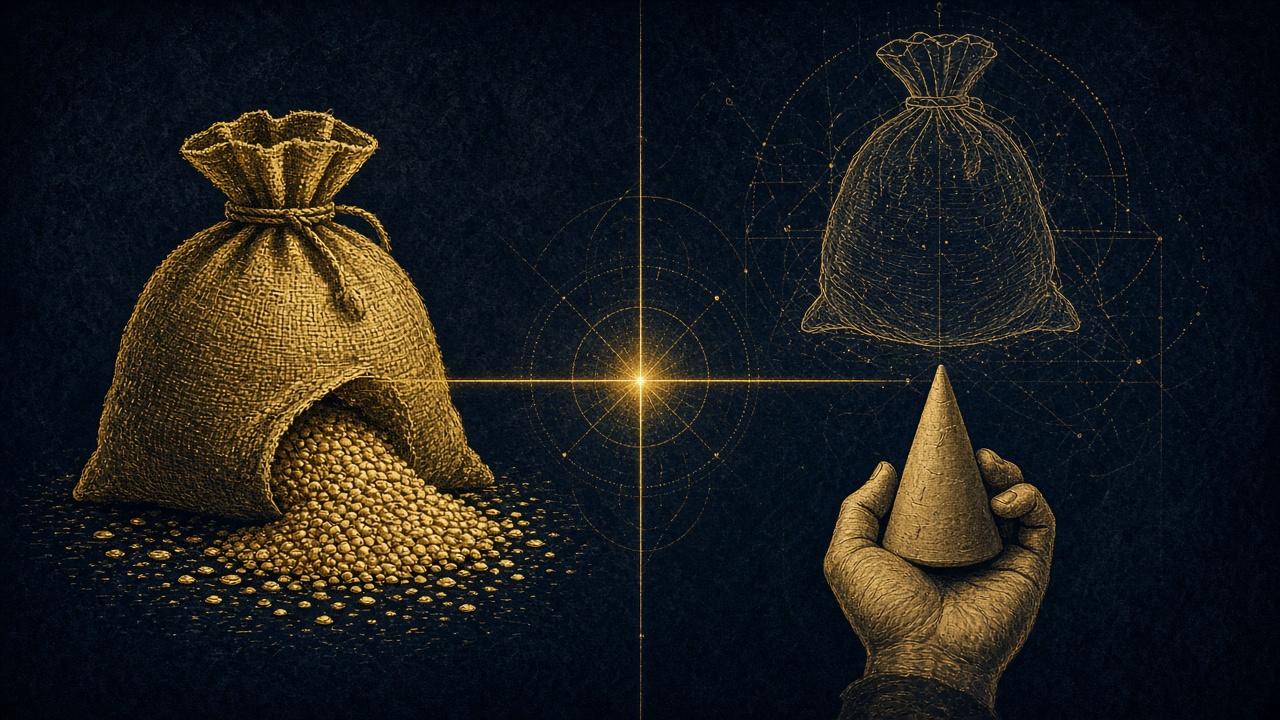
For our reconstruction this may be the central event. In the Near East there were small clay counting tokens. They stood for grain, animals, oil and other goods. Denise Schmandt-Besserat traces such systems back to the ninth millennium BC; in the sixth and fifth millennia they remain in use in developed Neolithic societies. What matters is the principle itself: a real object is replaced by a conventional form capable of carrying information about it.
This is already an almost perfect symbolism of the double.
There is:
a thing and its sign;
an object and its representation;
reality and information about reality.
In the Halaf culture, around 6000–5000 BC, numerous seals and amulets with geometric designs appear. The British Museum holds whole series of such objects.
This is not yet writing. But a fundamental psychic operation is born:
one thing can signify another.
And then the "double" can be understood far more deeply than as two identical brothers. A "semiotic duality of the world" emerges. Every thing gradually acquires the possibility of a second existence, as a sign.
3. The Twins as an archetype not of identity but of difference within kinship
Here we must avoid the over-simple formula "Twins = two identical people". Later mythologies offer a far more interesting structure.
In the Indo-European traditions the motif of the "divine twins" is remarkably persistent. Scholars reconstruct it by comparing the Vedic Ashvins, the Greek Dioscuri and other traditions. The Oxford Handbook explicitly counts the Divine Twins among the divine figures most likely to belong to an older Indo-European religious inheritance.
But we cannot link these divine twins directly to the sixth millennium BC. Millennia separate the archaeological age from the surviving texts. What matters more to us is the structure of the myth.
Of the Dioscuri, one brother is mortal and the other immortal. In other Indo-European pairs, too, the twins are not exact copies of each other: functions are divided between them. One may be linked with martial strength, the other with the household; one with the earthly, the other with the heavenly.
So the archetypal formula of the Twins might run as follows:
not two identical beings, but two kindred principles that gain meaning through their relation to each other. This is already an enormous step beyond the primal undifferentiated state of the psyche.
4. The age of relation
If the Age of Taurus that follows can be associated with the fixing of form, earth, fertility, the body and sacred stability, then Gemini may represent an earlier moment:
the appearance of the space between.
Person and person. Settlement and settlement. Thing and sign. Here and there. Kin and stranger. Settled life and the road. Farmer and trader. The material object and information about it. And it is precisely this "between" that gradually becomes a reality in its own right.
Not an object. Not a subject. But "relation". This may prove the master key to the whole reconstruction.
5. The sacred, too, begins to divide
We cannot yet speak of the developed pantheons of later Mesopotamia. But the material culture already shows an extraordinary wealth of images, figurines, ornaments, seals and recurring geometric designs. Halaf pottery is especially telling: complex geometric compositions, birds, animals and human figures begin to exist as an ordered symbolic world (The Metropolitan Museum of Art).
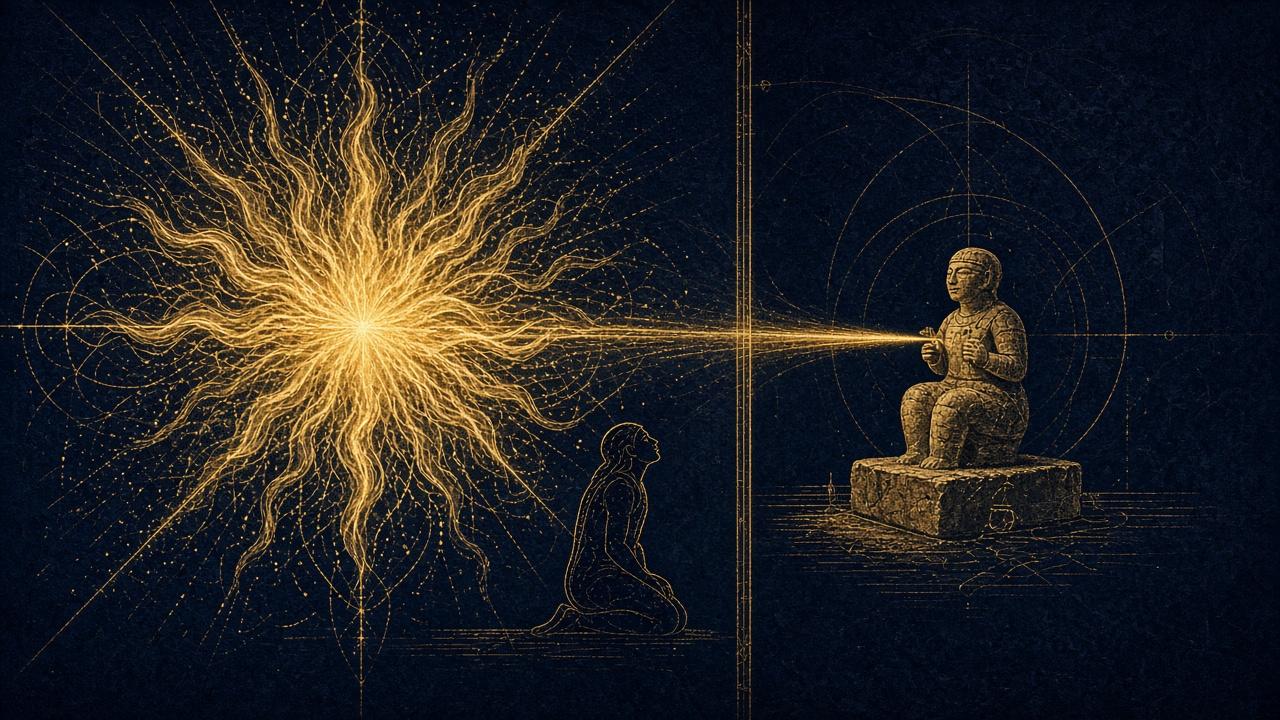
And here I would venture a cautious hypothesis. In earlier sacred experience the image may still have been almost inseparable from the presence of power. Now it gradually becomes possible to "represent the sacred".
A relation arises:
"the sacred, and its image"
This is once more the structure of the double. And here one of the fundamental mechanisms of human culture begins to appear:
a human being can stand before the image of something absent.
From this, over the millennia, will grow writing, the icon, the book, the map, the screen, and ultimately the digital twin. That is why the Age of Gemini may turn out to be surprisingly contemporary for our work.
6. The great transition: from one world to two
Perhaps the symbolic content of Gemini is bound up with the emergence of the psyche's capacity to "hold two realities at once". That would sound very Jungian.
A person is here, yet thinks of something somewhere else. They possess grain, yet can represent its quantity with a token. They see another person, yet can preserve them in an image. They live within their own group, yet enter into relations with another. This is why the "mediator" begins to take shape here.
We must not place Hermes historically in the sixth millennium BC; that would be an anachronism. But in retrospect we can say:
here the conditions for the Mercurial function begin to form.
The road. Exchange. Transmission. Translation. The sign. The message. The crossing of a boundary. The binding of two realms.
This is why, in the later astrological system, Mercury becomes the ruler of Gemini. In our reconstruction, however, this is not the cause of the age but "a later mythological amplification of the same psychic function".
7. And then an entirely new image of the human being appears
The Gemini human being, provisionally speaking, is no longer simply one who belongs to a place. They become a person of "connections". Their existence begins to depend on the capacity:
• recognize others;
• exchange information with others;
• distinguish one thing from another;
• transfer meaning from one object to another;
• navigate in different spaces;
• create a network of relationships.
So I would not call this age simply an age of duality. I would give it a more precise name:
The Age of Gemini: the birth of relation.
Or, more strongly still:
The Age of Gemini: the birth of the space between.
8. Its central sacred image
For Taurus that image naturally becomes the "bull".
For Aries, the "ram / warrior / sacrifice".
For Pisces, "two fish, water, the saviour, faith".
For the reconstructed Gemini I would not, for now, put a literal pair of human twins first. The more ancient image may be:
Two figures with a line running between them.
Two shores and a boat. Two settlements and a road. Two hands passing an object. Two people on either side of an exchange. Two faces of one symbol. Two pillars and the passage between them.
The pair, and "what arises between the pair". For what becomes sacred is not merely the number "two".
What becomes sacred is connection.
9. And here an unexpected link with the digital age appears
This is especially interesting for our overall line of thought. Modern digital civilisation hypertrophies precisely what might be called the Gemini function:
Human ↔ digital avatar;
Thing ↔ digital double;
Event ↔ event information;
Human ↔ AI;
Human ↔ Human via intermediary;
Reality ↔ representation;
Original ↔ infinite number of copies.
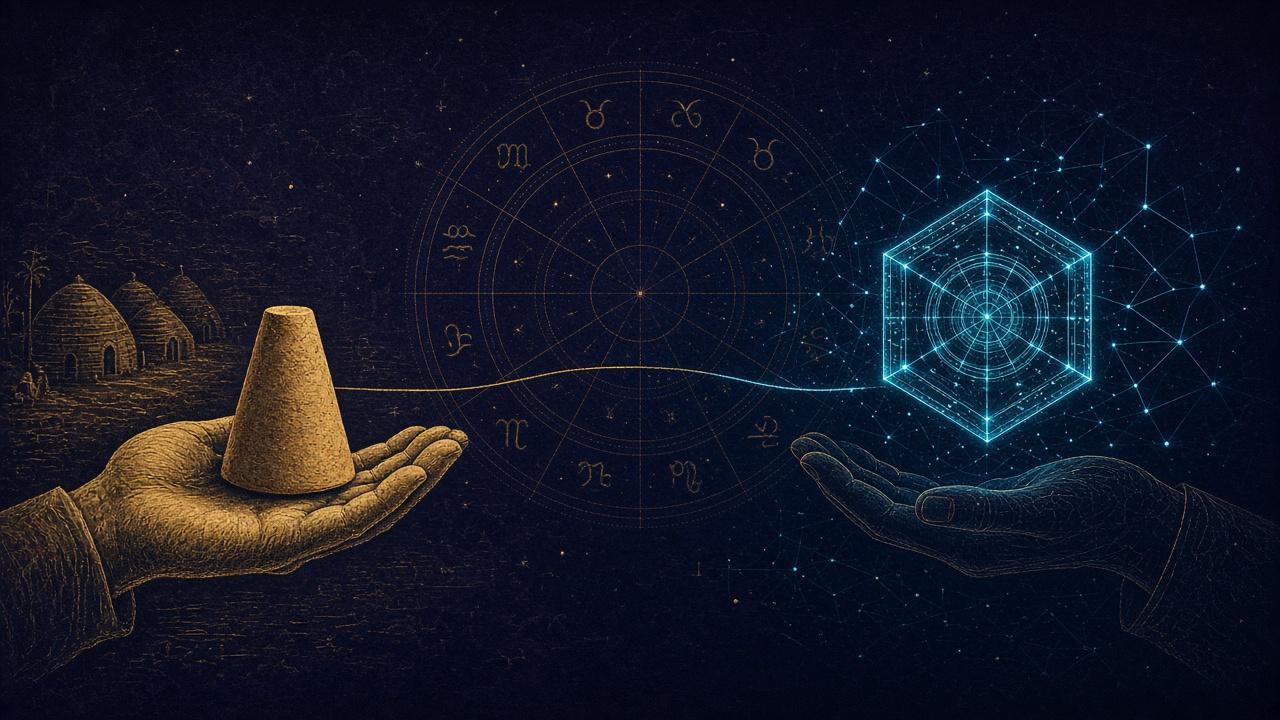
The modern digital world can then be seen not as a return of the historical "Age of Gemini", but as a "radical reactivation of the Gemini psychic function". Only, in the sixth millennium BC a human being makes a small clay sign standing for a sack of grain; today they create "a digital agent standing for the human being themselves".
It is a vast arc.
token → sign → writing → image → screen → digital twin → autonomous agent.
Or, in the language of NFTs, we can trace an arc in time between two tokens:
The clay token of the Age of Gemini – the digital TOKEN of the Age of Aquarius
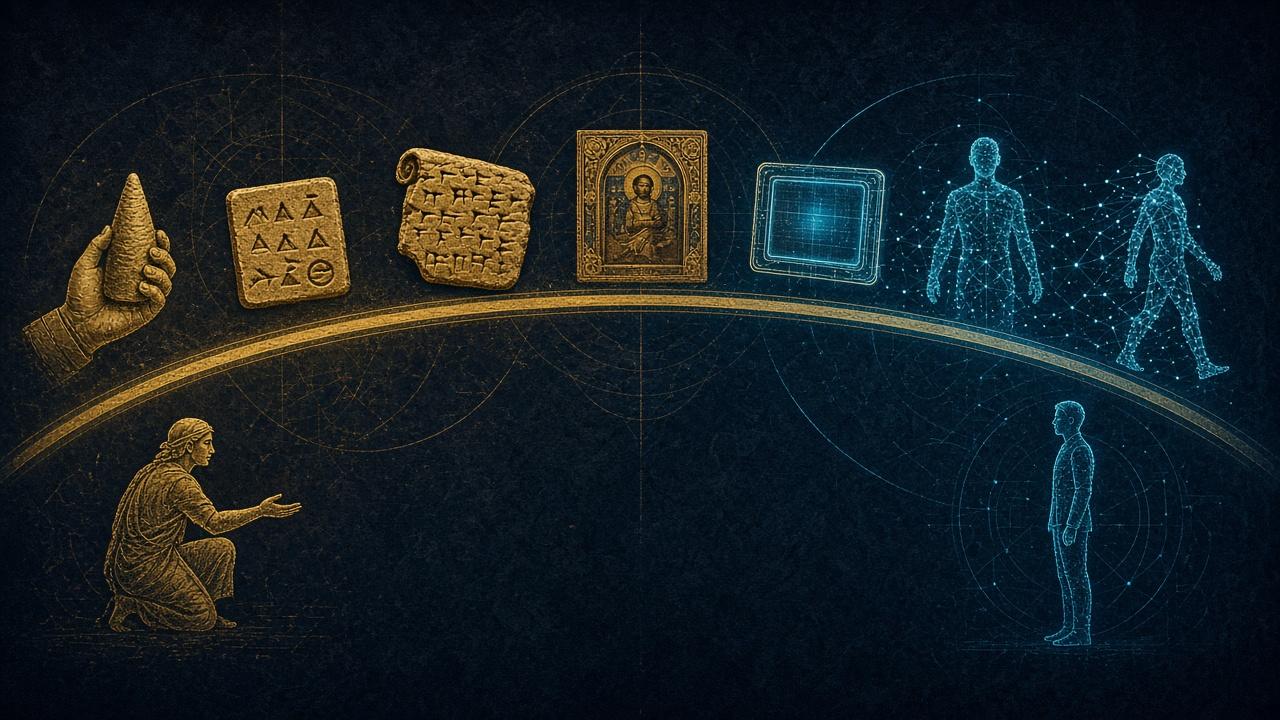
If Taurus sanctified form, Aries directed action, and Pisces the relationship of humankind with the transcendent, then Gemini may symbolically correspond to an earlier psychic revolution: the discovery of the Other and the birth of the space between two. It is in that space that exchange, the sign, the message, the road and the mediator arise, and, in the end, culture as a web of relations. Or, more briefly:
Gemini is the moment when the world first becomes not only a multitude of things, but a system of connections between them.
Here we reach the end of Part 4. Surveying the themes raised in this enquiry, one realises that it remains unfinished, for the other ages have not been described, above all that very line between the two twins. It would also be logical to outline briefly the main stages in the development of the Self in the Ages of Taurus, Aries and Pisces, which, of course, was not part of the original aims of this study, which follows the method of the cardinal dream. However, while Part 4 was being prepared for publication, synchronistic events occurred that bore not only on the problem of doubling but on the very content of the cardinal dream in which the twins steal my smartphone. These will be set out in Part 5, which has come about of necessity as a result of those synchronistic events, allowing us to deepen the enquiry and complete what remained unrevealed here.
(to be continued in Part 5)
Andrey Mozharov and SI/AI
(Summer–Autumn 2026)